Product Updates

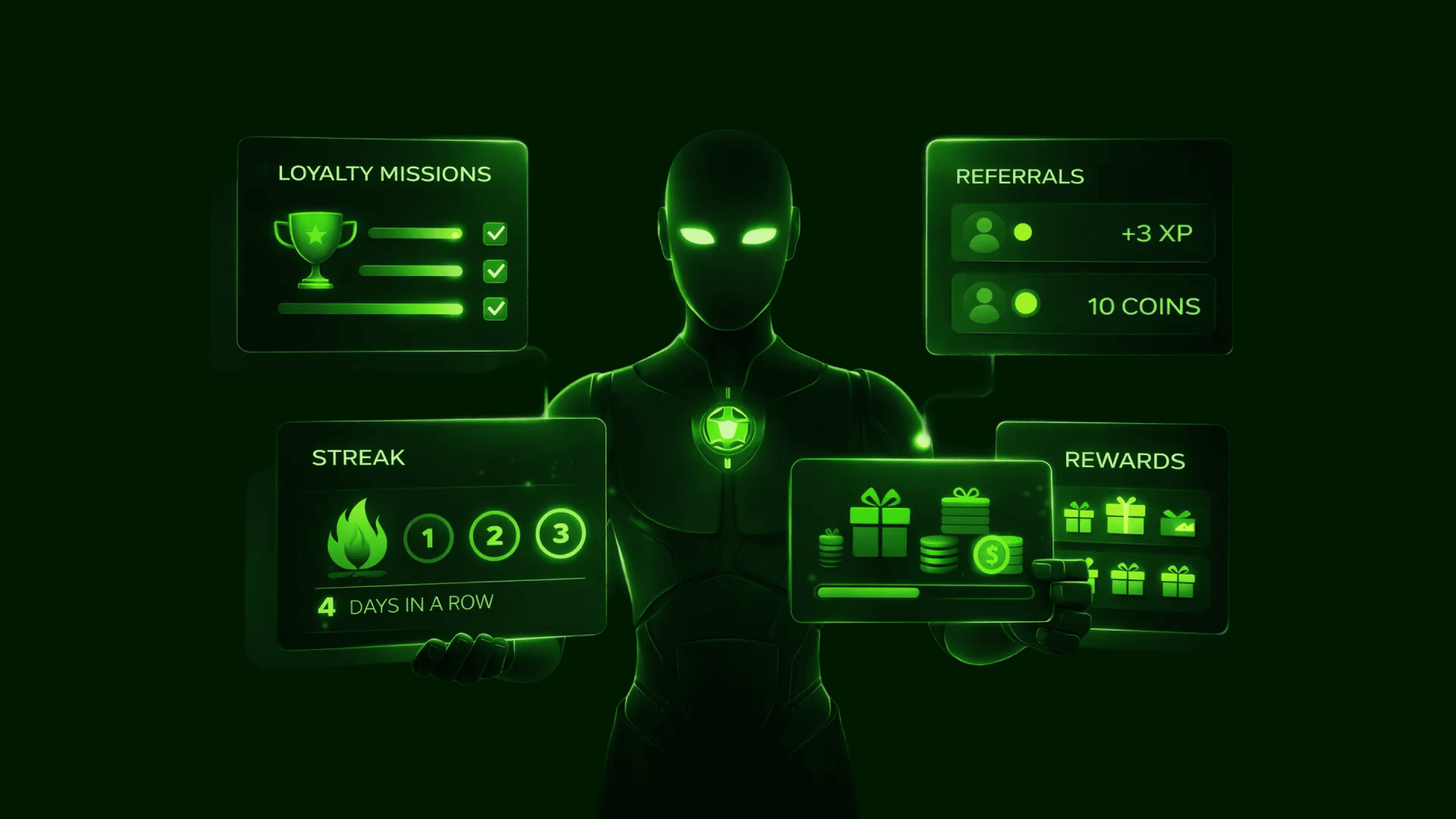
Loyalty has always been about keeping people close, but what that means is changing.
AI shifts loyalty from static rewards to living systems that learn from behavior and respond in real time.
The strongest programs move with users, noticing what matters and adapting as they go. In this guide, we explore how data, algorithms, and human insight are reshaping the way brands build connection.
So how can AI improve customer loyalty?
How AI Enhances Customer Loyalty
How AI can enhance customer loyalty is no longer a theory, it’s something teams are building into everyday systems.
Most loyalty programs face the same issue: a user joins, redeems once or twice, then fades. The structure stays, but the flow breaks.
AI for improving customer loyalty helps spot early signs and gently re-engage. A small shift in timing or tone is often enough.
When systems adapt to real behavior, not static plans, the experience feels smoother, and users stay engaged longer.
Data-Driven Insights for Personalized Experiences
Most teams already have the data, what they need is a way to see the signal through the noise. AI in customer loyalty programs helps surface patterns: who browses, but doesn’t buy, who clicks, but never claims, who fades after a campaign.
When the system knows where someone is in the journey, it can make smaller, more relevant moves — a reminder, a perk, a bump in access.
As McKinsey notes, behavior-based personalization drives long-term value — but only if the feedback loop stays clean. That’s where AI makes the biggest impact.
Predictive Analytics for Proactive Engagement
Predictive analytics is one way AI for improving customer loyalty delivers results early.
AI in loyalty programs uses predictive models to flag early risk — and decide how to respond. Maybe it’s an offer. Maybe it’s content. Maybe it’s nothing yet — only a quiet adjustment to pacing or tone.
Teams using Enable3 are rethinking what loyalty automation means. They’re weaving churn signals right into the flow, so instead of chasing lapsed users, the system notices early signs and responds in real time.
It’s subtle, but powerful: retention becomes proactive, not reactive.
Dynamic Offers and Real-Time Rewards
Most loyalty offers follow fixed rules: 10% off, a free item after five purchases, early access to the next drop. They’re simple to run, but they often miss the moment when an offer would matter most.
AI loyalty systems allow for offers that adjust. Not dramatically, just enough to feel timely. A customer, who engages often might get a bonus earlier. One who’s skipped the last two campaigns might see a different entry point. No tricks, only light movement based on what’s happening now.
As explored in ACPI Papers the real advantage of AI in loyalty lies in responsiveness, delivering offers when they’re most likely to resonate.
That responsiveness turns loyalty from a static system into a living experience, one that moves with the customer, not behind them.
Micro-Segmentation and Behavioral Targeting
Loyalty doesn’t look the same for everyone. Some browse, some buy in bursts, some just refer.
Programs work best when the system highlights the right users each week and knows how to reach them.
As HubSpot notes, AI and customer loyalty work best when segmentation stays sharp and focused.
Smart Tier Management and Automatic Upgrades
Tier systems work when they reflect effort, not just spend.
AI for customer loyalty helps surface value in things like referrals, reviews, or steady engagement. Quiet upgrades, based on real use, keep the program moving and people moving with it.
Key Components of AI-Driven Loyalty Programs
Strong AI-driven loyalty programs don’t rely on complexity. They’re built on systems that can read behavior and make small decisions without slowing things down. Below — the core components that help programs stay in sync as users interact and change.
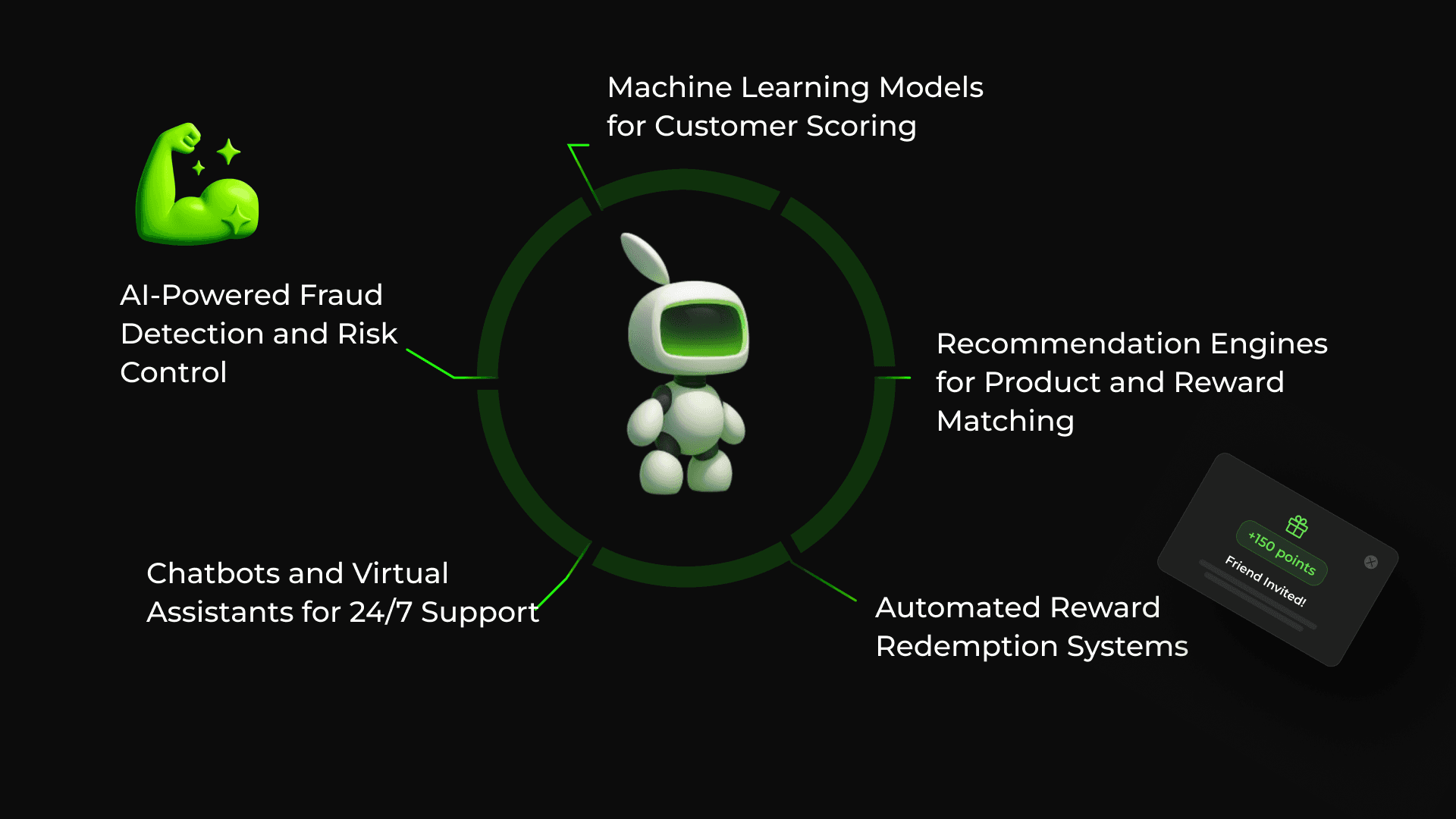
Machine Learning Models for Customer Scoring
Many AI customer loyalty programs monitor purchase totals and visit history as a base layer. That works for a while, until users behave in ways that don’t fit clean categories.
An AI loyalty program uses behavioral scoring to follow what’s actually happening — who returns after certain offers, who fades when no reward appears, who stays engaged even with low spend. These models don’t need to predict the future. They help teams notice what’s shifting — early enough to act on it.
Recommendation Engines for Product and Reward Matching
In AI-powered customer loyalty systems, rewards are shaped by how people interact over time. The system notices what users return to, what they check more than once, and what they tend to ignore. One user might get a reminder tied to a product they’ve viewed several times. Another sees a small bonus after a familiar action. These decisions happen quietly and the pace of how each person uses the program, a hallmark of effective AI-driven loyalty.
Chatbots and Virtual Assistants for 24/7 Support
In loyalty programs, most questions come from gaps in visibility. Users want to know how far they’ve progressed, what rewards they’ve unlocked, or whether an action counted. When support is built into the experience, those answers don’t break the flow.
In many AI-enhanced customer loyalty programs, chatbots and virtual assistants surface that information right where it’s needed. They handle small tasks — checking balance, confirming progress, pointing to the next step — and they do it around the clock.
That kind of quiet, always-on support keeps movement steady and the experience intact.
AI-Powered Fraud Detection and Risk Control
Loyalty systems tend to follow repeatable actions — referrals, redemptions, milestone unlocks. When those actions start to repeat in ways that don’t match normal use, the program needs a way to notice.
In many AI loyalty programs, risk is tracked through repeated patterns. The system looks for actions that move quickly, repeat in clusters, or follow unusual sequences. When flagged, these cases are paused for review without touching the rest of the flow.
Automated Reward Redemption Systems
If a reward takes too many steps to claim, it loses momentum.
AI-driven loyalty and engagement programs often use automation to close that gap. A user hits a milestone — the system unlocks the reward, shows it clearly, and makes it usable without friction.
This kind of flow doesn’t simply improve experience, it makes rewards feel real.
Benefits of AI-Enhanced Customer Loyalty Programs
AI-enhanced customer loyalty programs aren’t built to be smarter. They’re built to respond better to timing, to behavior, to change. When the system adjusts in step with how users move, the effects show up across the structure.
Higher Retention and Lifetime Value
The biggest lift from AI loyalty programs usually comes from better timing. Most teams already know what drives loyalty — recognition, relevance, and rhythm. What they struggle with is when to act.
Customer loyalty AI helps close that gap. By reading patterns in how users browse, redeem, and pause, it gives loyalty managers a window into what’s fading before it disappears. That means less guesswork and fewer “reactivation” blasts that feel random.
HubSpot notes that brands using behavioral personalization see measurable jumps in long-term value. But the real shift comes from tone: when offers feel like reminders instead of campaigns, people stay around longer and spend more naturally.
Improved Operational Efficiency
Scoring, tier movement, and reward logic follow repeatable steps. In AI-driven loyalty programs, those steps run inside the system. This reduces manual input and gives teams more time to adjust what matters — structure, timing, and flow.
Better Fraud Prevention and Security
Misuse doesn’t always show up as a single action. It forms across repeated patterns — timing, duplication, sequence. AI in customer loyalty programs helps spot these patterns as they build. Once flagged, they can be handled without interrupting the rest of the system.
Competitive Advantage Through Innovation
Clear structure is easy to recognize. When a program responds well to user timing and behavior, it stands out, not because it offers more, but because it feels better to use. Many AI loyalty programs rely on this responsiveness as part of their value, not only their design.
Personalization at Scale
Loyalty AI works best when personalization doesn’t add friction. People move at their own pace, and the system needs to follow. With the right structure, AI loyalty programs adapt to what users actually do, shaping the experience around behavior rather than identity.
Hyper-Personalized Rewards and Offers
The same offer doesn’t land the same way for everyone. Some users return after seeing something twice. Others stop if there’s too much choice. Personalization here means using behavior to guide when and how rewards show up, not adding more, but revising the route.
Dynamic Content and Messaging
Language and layout shift meaning. The same reward, shown with different context or timing, lands differently. AI-powered customer loyalty systems can tailor content based on how a user responds — changing the tone, refining the call to action, or simplifying the message. These are light changes, but they support a smoother route through the program.
Contextual Timing Based on Customer Behavior
Some users act quickly, others pause before taking the next step. Programs that track this rhythm can time their outreach more carefully. A well-timed nudge often keeps the experience moving. AI loyalty programs apply this at scale without sending too much or too often.
Predictive Loyalty Management
Most users don’t leave all at once. There’s a gap here, a missed action there. Then they stop showing up. Good programs notice before that happens. The power of AI in loyalty lies in following those shifts as they’re happening, not after.
Churn Prediction Models
There’s rarely a single signal. One user skips a check-in, another stops opening emails, a third visits but doesn’t redeem.It often looks less like churn and more like everyday patterns — the pauses and distractions that happen naturally.
Good churn models don’t overreact. They surface the patterns quietly and let the system adjust. Sometimes that means changing the timing of a message. Sometimes it means doing nothing for now. Often, that’s enough to keep things from slipping further.
Early Warning Systems
The bigger problems don’t always start big. A campaign that stops landing. A reward no one clicks. A segment that suddenly goes quiet.
Early warning systems help loyalty teams see those shifts before they spread. Not through alerts or dashboards, but through better visibility — a sense of movement slowing down. It’s not about reacting fast. It’s about catching something early enough that you don’t have to.
Re-Engaging Dormant Users
The ones who haven’t logged in for weeks don’t need a big gesture. They need something that feels in tune.
Maybe it’s a reminder tied to a product they used to browse. Maybe it’s a small offer that doesn’t feel like a win-back. Maybe it’s the right timing. Predictive systems help teams figure out when to show up and, equally important, when to wait.
AI in Gamified and Experiential Loyalty Programs
Gamification used to mean progress bars and badges. Most of it was noise — a few extra graphics layered over a static system.
But when it’s done right, it gives the user something more important than points: a sense that the program is paying attention.
Smart Challenges and Milestones
Milestones don’t have to be impressive, they need to make sense. If a user’s slowing down, don’t push them toward a gold tier. Show them a smaller step they can actually take.
If they’re moving fast, don’t slow them down with artificial goals. Let them keep going. You don’t need to rebuild the system, give it enough flexibility to move when users do.
Refining Game Elements
Some users love streaks, others don’t notice them. Some respond to unlocks, others to recognition. AI makes it easier to figure out what’s actually working and quietly drop what isn’t. The system needs to feel like it evolves with the person using it.
Rewarding Participation
The most consistent users aren’t always the ones who spend the most. Some leave reviews, some refer to friends, some just keep showing up. When those actions get acknowledged, not as a transaction, but as part of how the relationship works — it builds a different kind of loyalty. One that doesn’t need to be explained.
Implementation Framework
The tools don’t matter if the structure behind them is off. The strongest loyalty programs start small, but grounded, with a clear reason to exist and a plan for how things will connect over time.
Defining Goals and Data Strategy
Most loyalty platforms get built too fast. Teams want automation before they know what they’re measuring. Good programs start with questions: What are we rewarding? What should success feel like? What signals actually matter? Once that’s clear, the data follows. And once the data’s clean, the rest gets easier — better triggers, better pacing, better outcomes.
Choosing the Right AI Tools or Platform
Not every team needs a custom setup. Some just need a system they can tweak without waiting two weeks for support. Others want full control — models, dashboards, logic — built from the ground up.
There’s no right way. The only mistake is choosing something that locks you in before you know how your program will grow.
Go with what lets you test fast and change your mind later.
Ensuring Data Quality and Integration
You can’t personalize anything if your data can’t hold a conversation.
One system tracks clicks. Another tracks purchases. A third one tracks rewards history. And none of them line up.
What matters isn’t how polished the system looks, but whether the parts actually talk to each other.
When teams can follow the same user from start to redemption, the rest of the system finally starts making sense.
Balancing Automation with the Human Touch
Let the system handle timing. Let it send the reminder, track the redemption, adjust the flow. But some moments need a person. Not because the AI can’t respond, but because it shouldn’t. A message from support. A milestone that matters. A subtle signal that something’s off.
When teams step in at the right time, the program stops feeling automated — and starts feeling alive.
Challenges and Ethical Considerations
Smart loyalty doesn’t mean accuracy. It means accountability.
When something feels unfair, impersonal, or off — customers notice fast.
And once trust breaks, rewards can’t fix it.
Data Privacy and Regulatory Compliance
People don’t expect zero tracking. But they do expect to know what’s happening.
Not in fine print — in plain sight. What’s being collected. What it’s used for. How to opt out.
Programs that make privacy feel built-in, not bolted on, stay ahead of both regulation and resentment.
Bias and Fairness in AI Decision-Making
If your model only rewards one type of user, that’s not optimization — that’s bias. Sometimes it’s baked into the data. Sometimes it creeps in through assumptions no one caught. Either way, it skews the experience.
Good teams audit regularly, great ones build systems that flag skew before it spreads.
Transparency and Building Customer Trust
Most users don’t need to understand the model.
But they want to know the basics: Why did I get this reward? What triggered this offer?
Even a short explanation builds confidence. Silence creates doubt.
Good loyalty programs don’t treat AI like a black box. They give it a voice — one that explains, even simply, what just happened and what’s next.
Future of AI in Loyalty Programs
AI and loyalty programs are shifting focus from feature lists to real-time connection and flow. The strongest loyalty systems will be the ones that feel invisible, but always on.
Generative AI for Personalized Rewards
No more template emails. No more generic “thanks.” Generative tools can write in a way that feels closer to how people talk — short, direct, human. Used well, they don’t only personalize content. They personalize tone. That alone changes how a reward lands.
Blockchain and Tokenized Loyalty Points
Token-based loyalty is still early, but the idea’s simple: make rewards portable.
If a user earns something in one brand’s system and can redeem it somewhere else, the value gets stronger. Blockchain makes that possible without adding trust issues or extra steps.
Voice and Predictive Commerce
People are already asking Alexa what’s on sale or when their points expire.
Voice will become another access point for loyalty, especially when paired with predictive nudges that know what someone might want before they ask.
The real progress comes from timing — reaching people naturally, at the moment they’re most receptive.
Cross-Brand, AI-Powered Loyalty Alliances
Loyalty no longer ends at the edge of your brand.
A flight can unlock a hotel upgrade. A subscription can trigger a retail perk.
AI makes these connections possible — not as flashy collabs, but as quiet systems that recognize shared behavior and reward it without forcing the user to think about it.
The best alliances feel effortless, turning the journey into one continuous flow.
Key Takeaways
Teams using AI to improve customer loyalty see better timing, more relevant outreach, and quieter paths to retention, not louder ones
Loyalty programs built with Enable3 deliver the most reliable results when they reflect how people actually use the product.
AI lets systems respond in real time, so recognition shows up when it matters — not after.
Clean data matters more than big data. Signals only work if they can talk to each other.
The strongest systems stay simple. The logic makes sense, the rewards feel fair, and the next step is easy to take.
Consistency builds confidence. When the system responds the same way every time, people start to trust what’s behind it.