News

A strong loyalty marketing strategy creates value that grows over time. It stabilizes revenue, cushions CAC (customer acquisition cost) volatility, and creates a customer base that is harder for competitors to win away. In subscription, retail, QSR (quick-service restaurant), gaming, and travel, the brands with the healthiest economics all share one behavior: they treat loyalty programs as a strategic system, not a promotional tool.
Over the years, in SaaS and consumer industries alike, we’ve seen the same pattern. Customer loyalty grows when a company understands users’ value in their everyday interactions, and then designs marketing, product, and lifecycle touchpoints around that behavior. It’s operational work – part segmentation logic, part experience design, part ongoing calibration. But when it’s done well, the lift on customer retention, ARPU, and expansion is measurable and persistent.
This guide breaks down how to build a customer loyalty marketing strategy that holds up under real operating conditions – how to structure it, how to market a loyalty program effectively, how to measure it, and how to keep it evolving.
Key Takeaways
A loyalty program marketing strategy only works when it's built on a system, not a single reward mechanic – mechanics without loyalty strategy behind them tend to stall within a year.
Retention math is hard to ignore: lifting customer retention by just 5% can grow profits 25–95%, which is exactly why a loyalty marketing strategy keeps winning budget over acquisition spend.
If you're still asking “what is loyalty marketing?”, the short answer is that it's a system – value proposition, incentives, data, and channel strategy – not just loyalty points and a signup form.
Discounts move customers short-term; access, recognition, and experience are what a real customer loyalty marketing strategy uses to make that behavior stick.
The loyalty marketing examples that scale best – Starbucks, Sephora, H&M, Amazon Prime – all lean on one clear reward mechanic done well, not a pile of disconnected perks.
A well-timed, personalized nudge consistently outperforms a bigger blanket discount – precision beats generosity when you're building an effective marketing strategy for loyalty programs.
Low redemption isn't a sign customers don't care – it usually means the value isn't clear, and it's one of the loyalty program KPIs worth watching most closely.
The brands that keep their loyalty strategy marketing sharp treat it as a living system: continuous testing, holdouts, and small recalibrations, not a "launch once and walk away" project.
The loyalty marketing statistics back it up – 72% of consumers say a loyalty program makes them more likely to spend with a preferred brand, and 56% say it directly increases how much they spend.
What Is a Loyalty Marketing Strategy?
A loyalty marketing strategy is the coordinated set of actions a brand uses to increase customer retention, deepen engagement, and raise long-term value. It aligns product, lifecycle marketing, and incentives around behaviors that matter: repeat purchases, ongoing usage, expansion, advocacy, and reduced churn risk.
Across industries, building customer loyalty programs shares the same foundations: they establish long-term relationships, create emotional and experiential value, use data to reinforce meaningful behavior, and keep participation effortless. These patterns repeat in every mature brand with a stable, engaged customer base.
In practice, a loyalty marketing strategy includes:
A clear value proposition: why joining the ecosystem makes sense
Behavioral incentives: loyalty points, tiers, perks, and recognition
Targeted communication: triggered messages, lifecycle flows, and promotional rhythms
Data infrastructure: identity resolution, event streams, customer segmentation, and attribution
A marketing strategy for loyalty programs: how you promote, educate, and activate users across channels.
These five pieces only function as a system when they're built in the right order. Most teams start with behavioral incentives – the loyalty points, tiers, and perks that customers actually see – because that's the visible, fundable part of the work.
But a loyalty program built before the goals and segmentation are set tends to reward the wrong behavior: it pays people for actions they were already going to take, rather than nudging them toward the ones that move the business.
That's why a mature loyalty marketing strategy treats the value proposition and behavioral incentives as downstream decisions, not starting points. The sequence that holds up in practice looks like this: define what behavior you're trying to shift, understand which customer segments can realistically shift it, then design the mechanic and channel plan around that answer.
Skipping straight to mechanics is the single most common reason loyalty programs launch strong and fade within a year – the reward structure was never anchored to a specific business outcome, so there's nothing to recalibrate against when engagement dips.
Loyalty Strategy vs. Loyalty Program
A loyalty strategy is everything underneath that surface. It’s the system of goals, segmentation, data infrastructure, channel orchestration, and measurement that determines whether the loyalty program actually changes users’ behavior.
Loyalty strategy decides which customer segments get which incentives, how lifecycle emails and SMS reinforce the reward mechanic, how such mechanics tie to CLV (customer lifetime value) and retention, and how the whole system gets tested and refined over time.
The distinction matters because loyalty programs without loyalty strategy tend to stall – customers enroll, then disengage, because nothing behind the reward mechanic reinforces momentum.
Customer loyalty strategy without a loyalty program has nothing to execute against. The two only work as a growth lever when they’re built together, not bolted on separately.
Loyalty Program | Loyalty Strategy | |
What it is | The reward mechanic customers see – points, tiers, or membership rules | The system behind the reward mechanic – goals, data, channels, and measurement |
Scope | A single touchpoint or offer structure | End-to-end: product, CRM, brand, and performance marketing |
Owned by | Loyalty or CRM manager | Cross-functional – brand, CRM, and performance teams together |
Time horizon | Launched once, then runs on autopilot | Continuously tested, measured, and refined |
Core question | What do customers earn? | Why would customers keep coming back? |
Success measured by | Enrollment and redemption rate | Retention, CLV, NRR, and repeat purchase rate |
Fails when… | Rules stop matching how customers actually use the product | Teams operate in silos and reward mechanics stop tying to business outcomes |
Loyalty program vs. loyalty strategy comparative table
The confusion between the two terms shows up most often in vendor conversations. A sales pitch for "a loyalty program" is really a pitch for the reward mechanic – a platform to run points, tiers, or referral rules. It's a reasonable starting point, but it answers only one part of the equation.
Teams that treat the vendor selection as the whole project often end up with a technically sound loyalty program that nobody at the company can explain the purpose of six months later.
The loyalty strategy side is harder to buy off the shelf because it's organizational, not technical. It requires someone to own the goals, someone to own the segmentation logic, and a shared understanding across brand, CRM, and performance teams of what the loyalty program is supposed to prove.
That's also why customer loyalty strategy tends to mature in stages: early on, most companies are genuinely running a loyalty program with light strategic scaffolding around it, and that's fine. The problem only appears when growth plateaus and nobody can say which reward mechanic to adjust, because the reasoning behind the original design was never written down anywhere but a slide from the initial pitch.
Why a Loyalty Marketing Strategy Matters for Long-Term Growth
A good loyalty program reinforces buying habits by giving customers a consistent path back into the product. That path shows up in frequency curves, early-stage retention, and the mix of customers who move into higher-value segments.
Once customers start earning and using value inside a system they understand, their behavior settles into predictable patterns. Repeat cycles tighten, high-value cohorts grow, and the business feels less CAC pressure because it’s no longer rebuilding its customer acquisition funnel every month.
The benefit is structural. A customer loyalty system doesn’t fix bad fundamentals, but it amplifies good ones. It stabilizes the middle of the funnel, lifts predictable revenue, and gives marketing teams room to plan instead of react.
A well-designed customer loyalty system therefore supports customer retention by giving customers more reasons to return, engage, and continue using the product.
The math behind that stability is well documented: studies show increasing customer retention by just 5% can lift profits anywhere from 25% to 95%, and roughly 79% of consumers already engage with at least one loyalty program – meaning the infrastructure to capture that lift is usually already in place. The pressure to act on it is only growing: customer acquisition costs have climbed an estimated 222% over the past five years, while repeat customers already spend roughly 67% more per order than first-time buyers – which is precisely why retention keeps winning the argument against acquisition spend.
How customer loyalty marketing impacts ROI
Deloitte’s Consumer Loyalty Program Survey found that 72% of consumers are more likely to spend with their preferred brand because of a loyalty program, while 56% say they increase their spending. Another 80% say loyalty programs provide them with greater value from the brand.
The impact comes from several levers: higher purchase frequency, stronger retention, larger transactions, and lower costs of activating existing customers.
KPI | Benchmark | What it tells you |
Likelihood to spend with preferred brand | 72% of consumers say loyalty programs make them more likely to spend with their preferred brand | Indicates the potential impact of customer loyalty on purchase behavior and revenue |
Increased customer spending | 56% say they increase their spending because of a loyalty program | Direct indicator of potential revenue uplift from customer loyalty |
Perceived customer value | 80% say they get more from the brand because of its loyalty program | Shows whether the loyalty program creates enough perceived value to strengthen the relationship |
Non-price value contribution | Up to 40% of perceived brand value comes from factors beyond price, including experience, quality, service, and loyalty programs | Shows why loyalty strategy should extend beyond discounts and monetary rewards |
Loyalty program engagement | 8 loyalty programs enrolled / 5 actively used per consumer | Highlights the gap between enrollment and genuine engagement |
Loyalty marketing KPI & benchmark table
Core Elements of a Customer Loyalty Marketing Strategy
The foundation of a loyalty program has three pieces: clear objectives, a sharp view of your customer segments, and a value structure that creates momentum from the first interaction.
Set clear goals for customer loyalty and engagement
Customer loyalty only works when it supports measurable behavior shifts. Most teams focus on a few signals: purchase cadence in priority segments, retention in early cohorts, progression into high-value usage, and CLV lift. These signals anchor decisions about incentives, messaging, investment, and help you connect loyalty program goals to measurable business outcomes.
They also prevent the loyalty program from drifting toward activity that looks engaging but doesn’t move the business.
Define target segments and loyalty program personas
Segmentation drives the reward mechanics. These three inputs matter most:
How customers behave (pace, depth, routines);
How they contribute economically (CLV, margin stability);
What motivates continued use (value, convenience, recognition).
When these inputs are clear, incentive design becomes straightforward.
Design a value proposition that feels worth joining
A loyalty program earns attention when the benefit feels immediate and the path forward is obvious. Good value propositions create early movement – a quick win, a visible step, a sense of momentum. They balance practical rewards with recognition and access to exclusive benefits or early offers.
Designing a Loyalty Program Marketing Strategy Step by Step
Loyalty programs work when they follow the way customers already interact with the product. You start by mapping the real behavior – the return cycle, the adoption path, the points where attention slips. That map tells you what the system needs to reinforce, not what you wish customers would do.
Choose the right type of loyalty program for your brand
The format you choose defines how your customers move through your loyalty program. Points fit products with frequent actions and varied baskets. Brands use tiered loyalty programs when customers naturally progress through different levels of value. Memberships make sense when access or convenience already anchors the experience, especially when the format aligns to your business model.
Most brands end up with a hybrid because different segments respond to different cues. The job is to match the structure to the behavior of your highest-value cohorts. When the format fits, customers understand it instantly, and the loyalty program becomes far easier to operate over time.
Loyalty program type | How it works | Best suited for | Primary goal | Watch out for |
Points-based | Customers earn points for purchases or other valuable actions and redeem them for rewards. | High-frequency purchases, retail, QSR, ecommerce | Increase purchase frequency and repeat purchases | Points can become transactional and lose differentiation |
Tiered | Customers progress through levels and unlock increasingly valuable rewards or privileges. | Brands with meaningful differences in customer value, such as beauty, travel, hospitality, and premium retail | Increase CLV, spend, and customer commitment | Too many tiers or unreachable thresholds can discourage members |
Membership/subscription | Customers pay a recurring fee for ongoing benefits such as free shipping, exclusive access, or premium services. | High-frequency businesses where customers can repeatedly use the benefits | Increase retention, recurring revenue, and purchase frequency | Benefits must clearly outweigh the membership cost |
Hybrid | Combines two or more reward mechanics, such as points, tiers, referrals, challenges, or exclusive perks. | Mature loyalty programs serving multiple customer segments or behaviors | Address several retention and engagement goals simultaneously | Greater complexity and operational cost |
Loyalty programs by types
Decide on loyalty points, tiers, and reward structures
The reward mechanics shape how people move.
Loyalty points only work when the math is obvious and feels fair.
Loyalty tiers only work when each step unlocks something meaningful – not decoration, but access or capability.
Rewards work when they reinforce actions that actually matter to the business.
Before setting earn rates and thresholds, teams should understand how to calculate loyalty points so the reward structure remains understandable for customers and sustainable for the business.
Momentum breaks when these reward mechanics fall out of alignment. Earn rates creep up, thresholds stop matching real usage, reward catalogs spread without direction. Operators who run strong loyalty programs adjust early and often, because even small changes can shift how segments behave.
The broader system also needs reliable loyalty rewards software to manage earning, redemption, rules, and reward structures as the customer loyalty program scales.
Align loyalty program and reward mechanics with key business outcomes
A customer loyalty system earns its keep when every reward mechanic ties to a measurable outcome: tighter visit cycles, larger baskets or plan mix, deeper product usage, stronger brand advocacy.
Loyalty points should shorten the gap between actions. Thresholds should lift average value. Unlocks should push customers into features that reduce churn. Recognition should make referral or sharing a natural step.
When reward mechanics map cleanly to these outcomes, the loyalty program stops functioning like a marketing layer and starts acting like part of the growth model.
Top-performing loyalty programs can boost revenue from redeeming customers by 15–25% annually, driven by increased purchase frequency and larger basket sizes, according to McKinsey insights – direct evidence that reward mechanics tied to real behavioral outcomes outperform those built around generic discounting.
Marketing Strategy for Loyalty Programs Across Channels
Design of a customer loyalty program alone doesn’t create adoption. Customers join – and stay – when the loyalty program is visible, easy to understand, and consistently integrated into the channels they already use. This is one of the clearest ways customer loyalty adds value to your business.
That principle holds regardless of business model, but "channels" doesn't mean the same thing everywhere. For SaaS businesses, the relevant channels are usage-based – the product itself, in-app prompts, onboarding flows, and lifecycle emails – rather than a checkout counter. Loyalty for SaaS applies the same visibility-and-integration logic by connecting reward mechanics to product usage, feature adoption, engagement, and expansion, rather than relying exclusively on purchase-based rewards.
Translating that principle into practice – across retail, SaaS, or any other model – is where marketing strategy for loyalty programs becomes a real discipline. It blends lifecycle marketing, CRM orchestration, channel strategy, and behavioral design.
On-site and in-app promotion of your customer loyalty program
On-site and in-app surfaces are your highest-intent real estate. A dedicated loyalty landing page is one of the most effective ways to give members a single, always-on destination to check their status, understand the value proposition, and take the next step.
Loyalty programs use these surfaces to:
Explain the loyalty program in a single, glanceable frame;
Highlight immediate value (welcome reward, fast progress, unlocked benefits);
Show real-time status and progress to reinforce customer engagement;
Trigger contextual nudges based on actions and usage patterns.
Using email and SMS to launch customer loyalty programs and nurture members
Email and SMS carry the workload of education, activation, and reinforcement of customer loyalty programs.
Operators typically structure these channels around three motion types:
1. Customer loyalty programs’ launch and onboarding
Explain the loyalty program, show the first reward, and anchor early momentum. This phase usually delivers the biggest lift in long-term member value because it sets the rhythm customers follow later.
2. Lifecycle triggers
Loyalty points expiring, tier progress, streak reminders, replenishment windows, usage milestones. These are behavioral signals, not campaigns. They keep the loyalty program feeling alive.
3. Value reinforcement
Periodic summaries – points earned, progress made, benefits unlocked help customers feel the cumulative weight of their participation in the loyalty program. When people can see how their actions add up, they tend to stay engaged longer.
SMS is particularly effective for immediate communication with customers. Email provides context and storytelling. Together, they create a steady cadence that reminds members why the loyalty program matters without overwhelming them.
Leveraging social media and communities for brand advocacy
Social channels are less about enrollment and more about amplifying the identity of the loyalty program.
When done well, they create social proof around participation:
Members sharing rewards, milestones, or product experiences
Community challenges that drive activity
Visible recognition for top contributors or brand advocates
Drops, exclusives, or early-access events
Members may start inviting peers after seeing advocates publicly recognized in the community.
Emotional customer loyalty converts into advocacy when customers feel their participation is part of a broader community – not an isolated transactional loop. Brands that scale advocacy tend to treat social as an extension of the experience, not a promotional billboard.
Tactics for a High-Performing Loyalty Program Marketing Strategy
A strong loyalty program marketing strategy isn’t built from one big reward mechanic. It emerges from a set of small, deliberate interventions that encourage customers to keep moving forward. Below are the proven tactics that consistently lift customer engagement and long-term value.
Personalize offers based on user behavior and preferences
Personalization in customer loyalty is less about storytelling and more about precision. The data is already there – purchase cycles, usage depth, replenishment timing, feature adoption, category affinity. The question is whether the loyalty program uses this information to surface the right incentive at the right moment.
The most effective marketers treat personalization as an operating discipline:
Identify what each segment of customers needs to do next (return, upgrade, repeat, explore, redeem).
Match incentives to that next step, not to generic promotions.
Keep the logic stable enough that customers can sense the loyalty program understands their rhythm.
G2’s customer retention research reinforces an important principle for loyalty programs: relevance can drive engagement more effectively than simply increasing reward value. A well-timed, personalized loyalty offer or reminder can often be more effective than offering a bigger discount.
The table with statistics below shows how personalized experience impacts customers:
Statistic | What it shows |
93% of shoppers say they’re more likely to stay loyal to a brand that delivers a personalized experience | The clearest direct link between personalization and retention |
69% of shoppers say post-purchase content – reviews, care guidance, and real customer photos/videos – increases their confidence after buying | Personalized post-purchase touchpoints, not just pre-purchase offers, move the retention needle |
83% of consumers feel the customer experience still falls short of their expectations | The personalization gap between what brands deliver and what customers expect remains wide |
18% of consumers cite exclusive customer loyalty rewards as a top reason for repeat purchases from a new brand | Personalized, exclusive rewards matter, but rank behind price, shipping, and product quality as retention drivers |
G2 customer retention statistics table.
Use gamification, challenges, and streaks to drive engagement
Effective gamification is less about badges for their own sake and more about reinforcing valuable customer behaviors. When designed well, challenges and streaks give customers a clear structure for progressing through meaningful actions, encouraging repeat engagement with the product or store.
Loyalty program tactics that work:
Simple progress visuals that show forward movement;
Short-term challenges tied to broader behavior goals;
Streaks that reward consistency without punishing breaks too harshly;
Occasional community-wide challenges that create shared momentum.
Loyalty points, badges, and social visibility remain effective when they help users understand where they stand and what’s next.
The strongest loyalty marketing strategy uses gamification mechanics as scaffolding, not decoration.
Encourage referrals, reviews, and user-generated content
Referral and advocacy mechanics become far more powerful when integrated into customer loyalty incentives. A dedicated referral program can extend the loyalty strategy beyond retention, rewarding existing customers for bringing in new customers while giving them another reason to stay engaged with the loyalty program. Customers who already have momentum are more likely to recommend others – especially when recognition is part of the reward, as these are often your most loyal customers.
Effective referral programs include:
Tier credit for referrals;
Bonus points for verified reviews;
Spotlighting members in social channels or communities;
Early access or exclusive perks for advocates.
Emotionally engaged customers generate more UGC and refer more reliably. Tying advocacy to loyalty program accelerates that effect.
Reduce friction in loyalty-program enrollment and redemption
The best-designed incentive still underperforms if it’s difficult to join or redeem. Every extra field, login step, or confusing redemption rule creates friction. Customers rarely complain about it; they simply abandon the process.
Loyalty program patterns that work:
One-click or single-sign-on enrollment tied to an existing account;
Auto-applying rewards at checkout instead of requiring a code;
Clear, real-time visibility into what's redeemable right now;
Removing minimum-spend thresholds that don't map to actual purchase behavior.
Loyalty programs with the highest redemption rates consistently have the fewest steps between earning and claiming a reward – not the ones with the richest catalogs. Friction reduction is a low-cost lever: it doesn't require new rewards, only fewer obstacles between the customer and the ones already on offer.
Successful Loyalty Marketing Examples
Frameworks matter, but they're easiest to apply to real loyalty programs. The four examples below span different reward mechanics and industries; the fifth reflects what current 2026 shopper data shows about what keeps loyalty programs working.
Starbucks Loyalty Rewards Program
Starbucks Rewards ties earning directly to the channel customers already use most: the mobile app. Because ordering, payment, and point-earning happen in one flow, the reward mechanic never feels like a separate step – it's just how you order coffee. That frictionless integration is a large part of why the loyalty program sustains tens of millions of active monthly users.
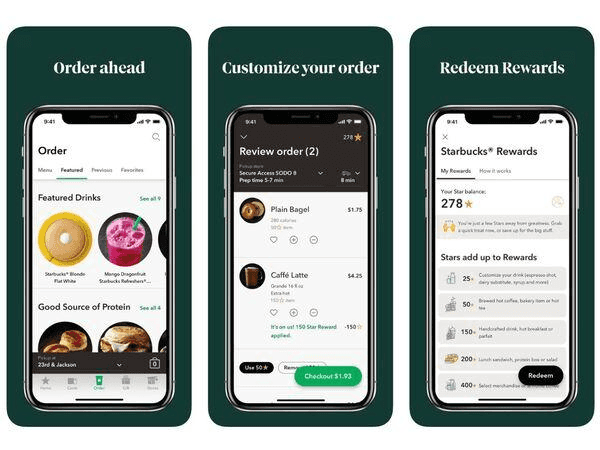
Source: Starbucks Rewards loyalty program
Sephora Loyalty Program
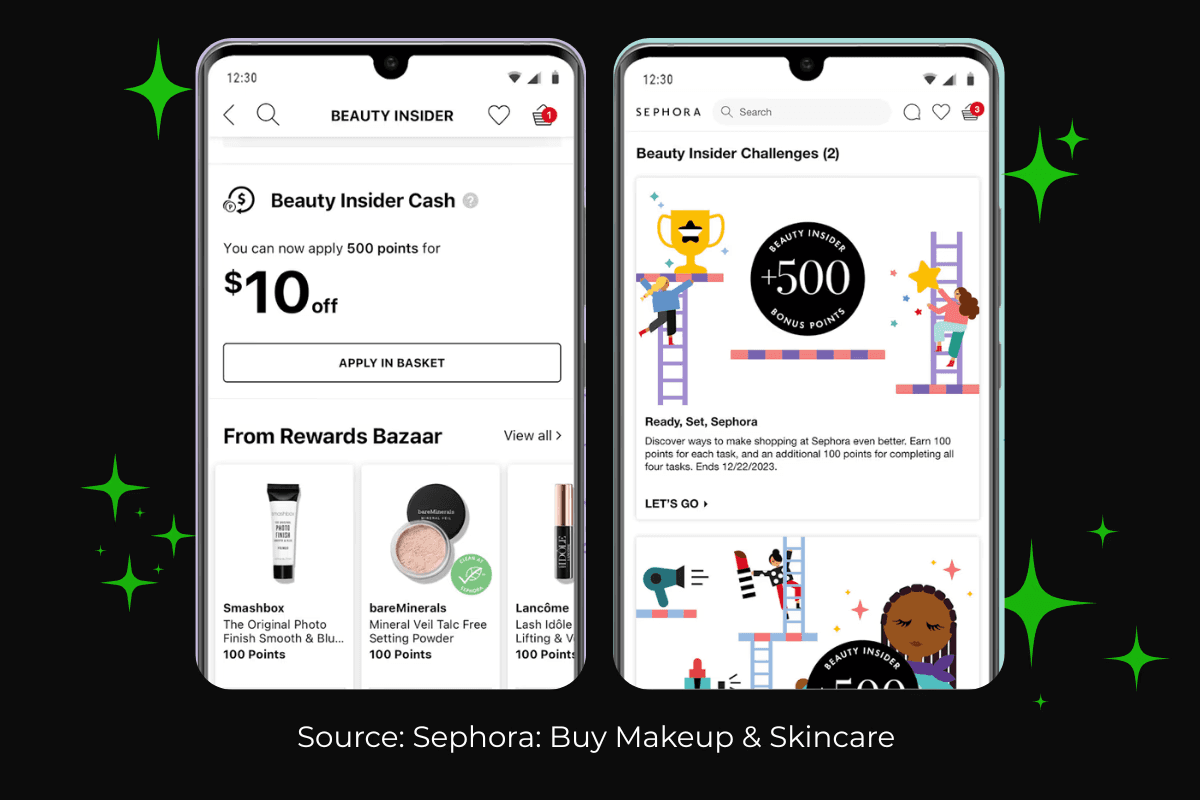
Sephora's Beauty Insider loyalty program leans on recognition over raw discounting. Free birthday gifts, no purchase required, and periodic point-earning "challenges" keep members engaged between purchases, not just at checkout – reinforcing the idea that customer loyalty grows in the gaps between transactions, not only during them.
H&M Customer Loyalty Program
H&M's loyalty program shows how a single reward mechanic – member pricing plus early access – can scale past 250 million members globally without needing constant novelty. The value proposition is simple enough to explain in one sentence, which is exactly why it travels across markets and languages without losing clarity.
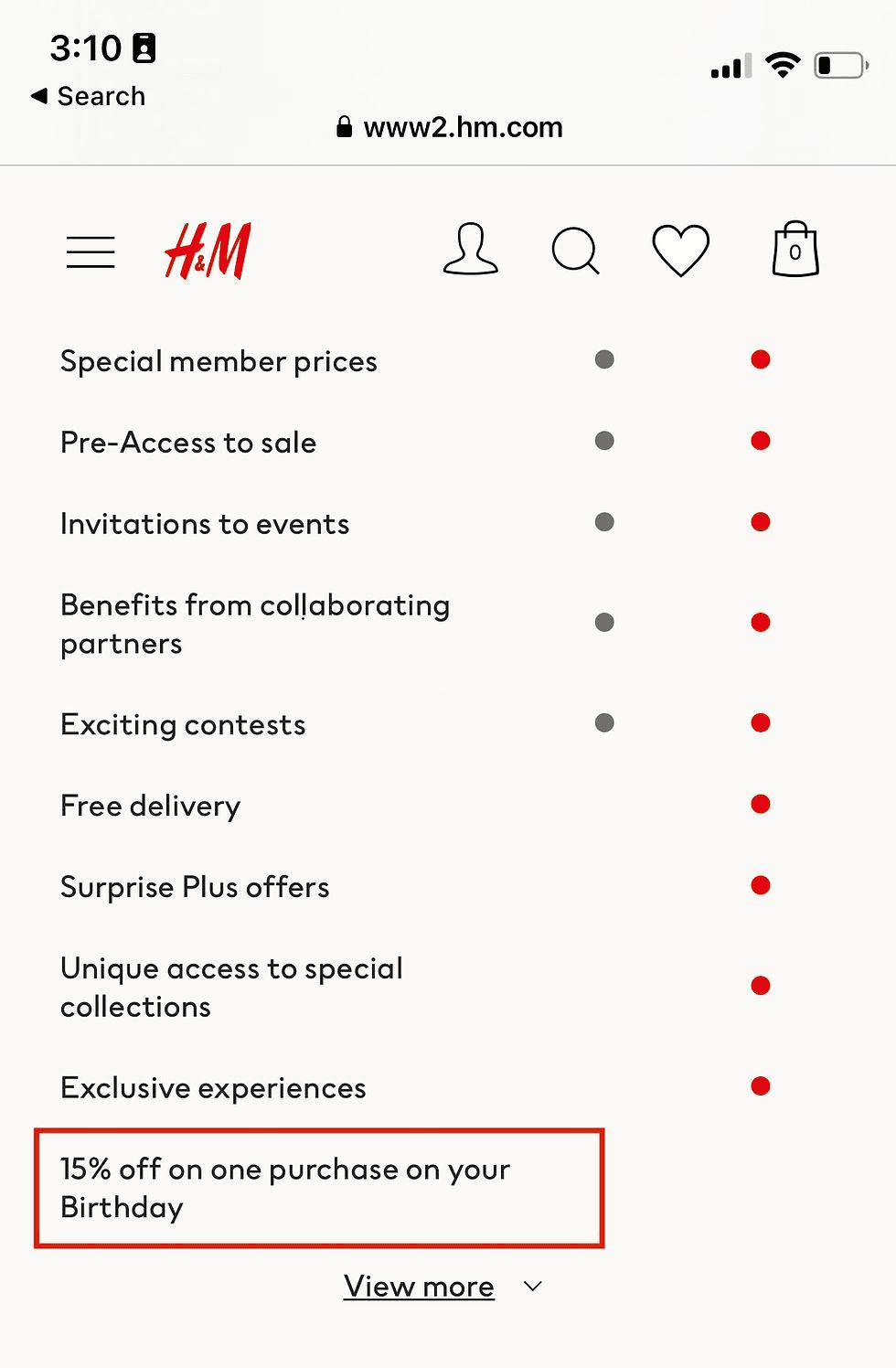
H&M loyalty program
Amazon’s Primary Loyalty Program
Amazon Prime represents the membership model at its most mature: a flat annual fee unlocks shipping speed, entertainment, and grocery savings across otherwise unrelated business lines. It's proof that a loyalty program doesn't have to run on points at all – access and convenience can be the entire reward.
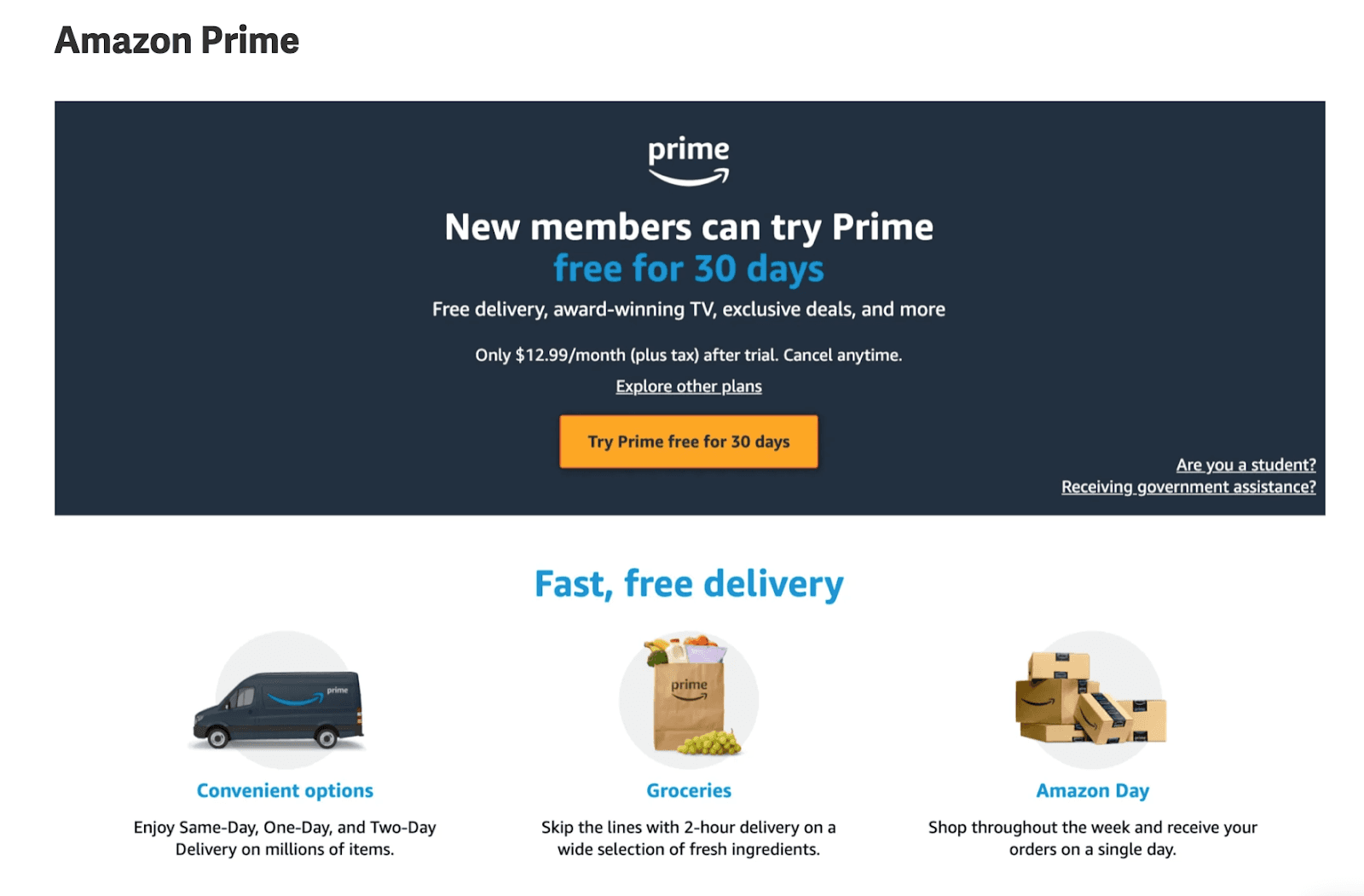
Amazon Prime subscription-based loyalty program rewards
Summing up the outcomes of these loyalty programs:
Brand | Loyalty program type | Standout reward mechanic | Scale |
Starbucks Rewards | Points | In-app ordering tied directly to points balance | 34.6M active U.S. members (2025) |
Sephora Beauty Insider | Tiered | Birthday gifts and gamified point challenges | 34M+ active U.S. members |
H&M Loyalty Program | Points + tiers | Member-only pricing and early sale access | 100M+ members globally |
Amazon Prime | Paid membership | Shipping, streaming, and grocery savings bundled into one fee | 60%+ of U.S. adults |
Brands’ loyalty marketing examples
What 2026 data says works: Studies show that 81% of consumers find it motivating just to see visible progress toward a reward, and 41% said exclusive, VIP-only discounts are the single offer type most likely to keep them shopping with a brand – more than double the pull of one-time discounts open to everyone. Brands such as McDonald’s and IKEA apply a similar approach, using their loyalty programs to turn customer behavior and preferences into personalized offers, rewards, and ongoing engagement – often capturing opt-ins and zero-party data before a customer ever earns their first point.
Aligning Loyalty Strategy and Marketing Team Workflows
A loyalty marketing strategy works only when the organization operates from the same playbook. Fragmented execution is one of the most common failure points. The companies that get loyalty strategy right build cross-functional alignment early and maintain it through shared data and shared incentives.
Integrate loyalty data into your marketing technology stack
Customer loyalty systems generate some of the highest-signal data in the organization: earning patterns, redemption behavior, time-to-repeat, engagement curves, drop-off points. But none of it matters if it lives in isolation.
Loyalty program integration priorities typically include:
CRM and CDP identity resolution
Real-time event streams for triggered messaging
Analytics that tie customer loyalty actions to revenue outcomes, with visibility on the same reporting layer as broader marketing data.
When customer loyalty data flows cleanly through the stack, personalization becomes operational rather than aspirational.
Coordinate loyalty campaigns between brand, CRM, and performance teams
Brand defines the narrative. CRM drives engagement. Performance manages acquisition economics. Loyalty strategy sits between them – which means misalignment creates noise instantly.
Using loyalty marketing software, businesses:
Plan shared calendars around loyalty program moments;
Use loyalty program tiers and segments to refine targeting;
Build acquisition creative that explains the value of joining;
Share insights so each group sees how their part fits into the full journey.
This is the operational backbone of loyalty strategy marketing. Without cross-functional coordination, even the strongest reward mechanics lose momentum.
Set shared KPIs for customer loyalty and lifecycle marketing
Customer loyalty should not be measured by enrollment alone. Businesses look for metrics that reflect actual behavior shifts:
Repeat rate;
Time between visits or usage sessions;
Tier concentration and progression;
Redemption health;
CLV contribution by customer loyalty status;
Share of revenue from members vs. non-members.
The most useful KPIs map directly to retention, monetization, and advocacy – the three outcomes customer loyalty is uniquely positioned to influence.
Measuring the Impact of Your Loyalty Marketing Strategy
The value of a customer loyalty system becomes visible only when you watch how it reshapes customer behavior over time. The companies that treat measurement as an operating loop, not a reporting ritual, are the ones that manage to keep loyalty programs relevant year after year.
Strong companies focus on a handful of signals that expose whether the loyalty program is creating a healthier customer base: more stable frequency, more predictable spend, better retention curves, and a growing share of revenue from members who behave like long-term users.
Loyalty program KPI | What it tells you |
Loyalty program enrollment | Shows the potential reach of a loyalty program, but enrollment alone does not indicate customer loyalty or engagement. |
Active loyalty program participation | Highlights the gap between enrollment and meaningful engagement. |
Spending impact | Indicates whether the loyalty program can influence customer value and purchase behavior. |
Purchase intent | Measures the loyalty program's potential influence on repeat purchasing. |
Perceived value | Useful for assessing whether the value exchange is strong enough to sustain participation. |
Active members | Provides a directional benchmark for member engagement, although results vary by industry and loyalty program design. |
Reward redemption | Helps identify whether rewards are sufficiently relevant, accessible, and easy to use. |
Loyalty program KPI benchmarks from Deloitte's 2025 Consumer Loyalty Program Survey and EY's 2025 Loyalty Market Study.
Key loyalty program metrics: enrollment, activity, redemption, and CLV
A mature customer loyalty marketing strategy looks at metrics that reveal movement, not just volume.
Enrollment quality
Raw sign-ups don’t tell you much. What matters is who joins your loyalty program and whether they resemble your high-value customer segments. Some brands use sign-up surges as a success metric; experienced teams look at the conversion from enrollment → first earn → first redemption.
Activity patterns
You want a customer loyalty engine that moves them through the fundamental actions – earning, returning, redeeming, progressing – in a pattern that compounds in the background. Activity curves, especially weeks-to-first-redemption, show how quickly the loyalty program becomes part of the customer’s routine.
Redemption health
Loyalty programs with low redemption rates almost always suffer from one of three issues: unclear value, overly complex rules, or misaligned incentives. Healthy redemption signals that customers understand the currency and see real utility in staying active. Finance cares about liability, but from a behavioral standpoint, redemption is momentum.
Retention and CLV
This is where the economics appear. When loyalty program members retain longer and spend more consistently – and they usually do when the loyalty program is well-built – the uplift compounds. CLV comparisons between members and non-members give leadership the confidence to keep investing. In multi-product environments, this metric often uncovers cross-sell and expansion opportunities that were previously invisible.
The point is to ensure you’re watching the behaviors that have a measurable impact on lifetime value.
Read also: Learn more about loyalty program metrics. |
How to test and optimize customer loyalty campaigns
Optimization in customer loyalty programs is not about chasing the “best-performing offer.” It’s about understanding which reward mechanics durably shift behavior. Groups that test consistently develop the intuition that becomes a strategic advantage.
Useful approaches include:
Testing earning structures
Small changes in earn rates or thresholds can alter purchase cadence. You learn quickly whether customers prefer steady progress or episodic boosts.Evaluating reward relevance
Swap reward types for a subset of users and watch how redemption patterns change. Utility-based rewards often drive participation; experiential rewards often drive brand advocacy.Testing timing and cadence
Many campaigns perform poorly not because of the message but because of when it arrives. Triggered messaging backed by real-time data consistently outperforms fixed calendars.Holdout methodology
Holdouts keep teams honest. Without them, every outcome looks like success. Mature operators maintain continuous holdouts across major reward mechanics, not just customer loyalty campaigns.
The best loyalty programs evolve through incremental learning. A steady flow of tests creates a loyalty program that adapts faster than competitors can copy.
Using insight to refine loyalty strategy marketing over time
Customer loyalty systems age fast when they aren’t maintained. The teams that keep them effective treat them like a living product. They watch how customers move, where progress slows, and which reward mechanics no longer match the current behavior curve.
The data usually points to small adjustments. Earn rates that once worked start dragging participation; thresholds set years ago stop matching real usage; reward portfolios lose their edge as habits shift. A few precise changes often restore momentum without altering the spine of the loyalty program.
Communication matters just as much. Many loyalty systems fall out of sync not because the reward mechanics are wrong, but because the story around them has drifted. Clearer frames, better placement in the product, and tighter lifecycle timing can make the same incentives feel new again.
As the customer loyalty system matures, new loops tend to reveal themselves – usage triggers, cross-category missions, small community moments that create shared movement. These loops expand the ways customers can engage without inflating cost.
Common Mistakes in Loyalty Strategy Marketing
Even mature teams run into the same traps when building customer loyalty systems. The patterns repeat across industries. What separates strong loyalty programs from weak ones is the speed and clarity with which these issues get corrected.
Overcomplicating loyalty program rules and rewards
Loyalty programs lose traction when the logic takes effort to decode. Customers shouldn’t need an explanation to understand how they earn or what they unlock. When the structure becomes dense – too many conditions, too many exceptions – engagement drops and operational cost rises. Simplicity doesn’t limit the loyalty program; it keeps the value legible at scale.
Focusing only on discounts instead of experiences
Discount-heavy systems create short-term movement but weaken the long-term economics. They also shift attention away from deeper forms of customer loyalty: access, recognition, convenience, shared milestones. These elements carry more weight in retention curves because they reinforce the customer’s place in the ecosystem, not just the price of the next transaction.
Fast Company recently echoed this shift, noting that the next generation of loyalty programs is moving away from discount-led thinking and toward value, access, and emotional connection.
Launching once and failing to keep the loyalty program fresh
Loyalty programs lose momentum when they remain static. Customer behavior shifts in small but meaningful ways, and the system has to keep pace. The teams that maintain strong performance review their reward mechanics regularly and make targeted adjustments – a mission tightened, a threshold reset, a new interaction added where usage patterns suggest an opening. These small moves keep the loyalty program aligned with how people actually engage, and they preserve the sense that the system is alive rather than archived.
Chasing enrollment over redemption
Sign-ups are the easiest customer loyalty metric to report and the least predictive of retention. A loyalty program can hit six-figure enrollment and still fail if few members ever redeem – the number looks healthy in a board deck while the behavior underneath tells a different story.
Running loyalty program in a silo
When the loyalty team can't see CRM, product, or performance data, incentives get built on guesses instead of signals. Reward mechanics drift from what customers actually do, and nobody notices until engagement has already slipped.
Case Study: How eSIM Plus Turned One-Time Buyers into Repeat Customers
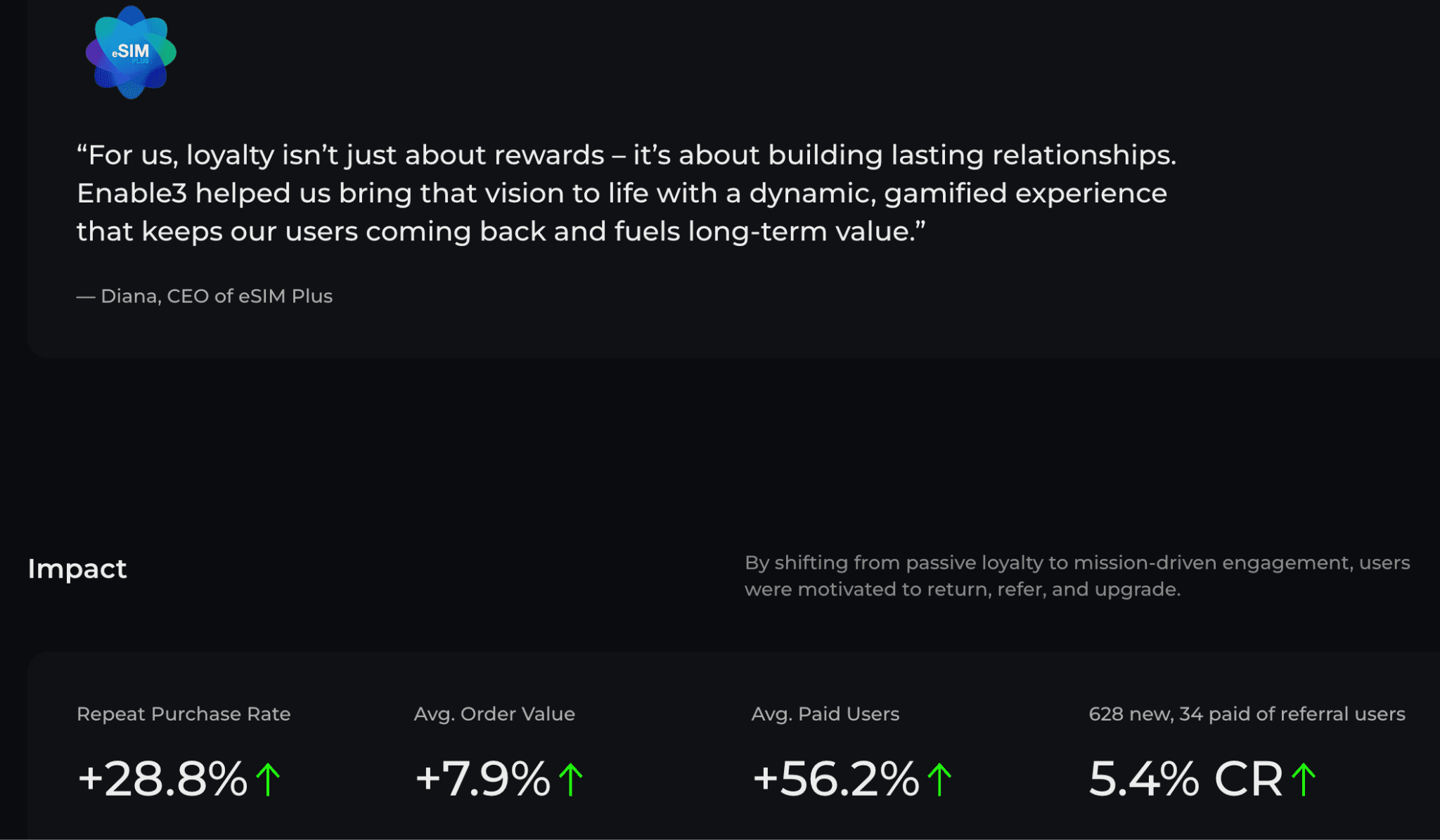
eSIM Plus, a prepaid mobile-data provider for travelers and global users, faced a familiar retention problem: 80–90% of customers made just one purchase. The company had static discount tiers but no meaningful way to re-engage users, reward valuable actions, or understand where customers dropped off.
To shift customer loyalty from a passive discount mechanism into an active engagement system, Enable3 helped the client to develop a loyalty marketing strategy. Thus, eSIM Plus introduced a points-based loyalty program with up to 5% back on purchases. The loyalty program was built directly into the app and paired with referrals, onboarding and upgrade missions, time-based quests, and a dedicated FAQ page that made participation easier to understand.
Before | Loyalty program approach | Outcome |
One-time purchase behavior | Points, missions, referrals, and in-app customer loyalty visibility | +28.8% repeat purchase rate |
Limited re-engagement path | Time-based quests and upgrade incentives | +7.9% average order value |
No acquisition reward loop | Built-in referral incentives | +56.2% average paid users |
eSIM Plus case study results
The referral loop added 628 new users, including 34 paid users – a 5.4% conversion rate. On top of that, the loyalty program gave eSIM Plus a repeatable way to encourage the behaviors that matter most: returning, upgrading, and referring.
The takeaway is simple: loyalty programs are most effective when they create clear next steps throughout the customer lifecycle. Rather than relying on blanket discounts, eSIM Plus used missions, visible progress, and timely incentives to turn engagement into a habit.
How Enable3 Supports Your Loyalty Marketing Strategy
A loyalty marketing strategy can look solid on paper and still fail in execution. The goals may be clear, but teams often struggle to turn them into behavioral mechanics, personalize experiences at scale, connect customer loyalty activity to business outcomes, and continuously optimize what works. Enable3 helps close that execution gap by giving product teams configurable tools to build, run, and measure customer loyalty experiences around real users’ behavior.
Problem #1: Your loyalty program rewards activity without changing the user behavior that matters
You may have loyalty points, tiers, and rewards in place, but customers are not necessarily moving toward the behaviors that drive retention, repeat purchases, expansion, or brand advocacy. Generic incentives can end up rewarding actions customers would have taken anyway.
Enable3 lets you build event-based missions around the behaviors you want to influence. You can create missions for onboarding, repeat purchases, feature adoption, referrals, upgrades, or other meaningful customer actions. This turns your loyalty program from a collection of rewards into a structured path that encourages customers to take the next valuable step.

Enable3: event-based mission creation interface
Problem #2: Your loyalty program experience treats every customer the same
A new customer who has barely engaged with your product should not necessarily receive the same incentive as a high-value customer who is close to reaching the next tier. When customer loyalty campaigns rely on broad segments, the experience quickly becomes less relevant.
With Enable3, you can create behavior-based customer segments and connect different loyalty mechanics to different customer groups. You can tailor missions, rewards, and engagement flows according to lifecycle stage, activity, customer loyalty status, or other behavioral signals. This makes personalization part of the loyalty program rather than a series of manually managed campaigns.

Enable3: behavior-based customer segments
Problem #3: Your customer loyalty team spends too much time managing campaigns manually
As a loyalty program grows, manually coordinating missions, rewards, customer segments, and triggered interactions becomes difficult to maintain. Operational complexity can slow down experimentation and make the customer experience inconsistent.
Enable3 Loyalty API automates customer loyalty interactions based on user actions and predefined rules. Once the mechanics are configured, missions, rewards, and other engagement elements can respond to relevant events without requiring teams to manage every interaction manually. This gives marketers more room to focus on marketing strategy, experimentation, and optimization.
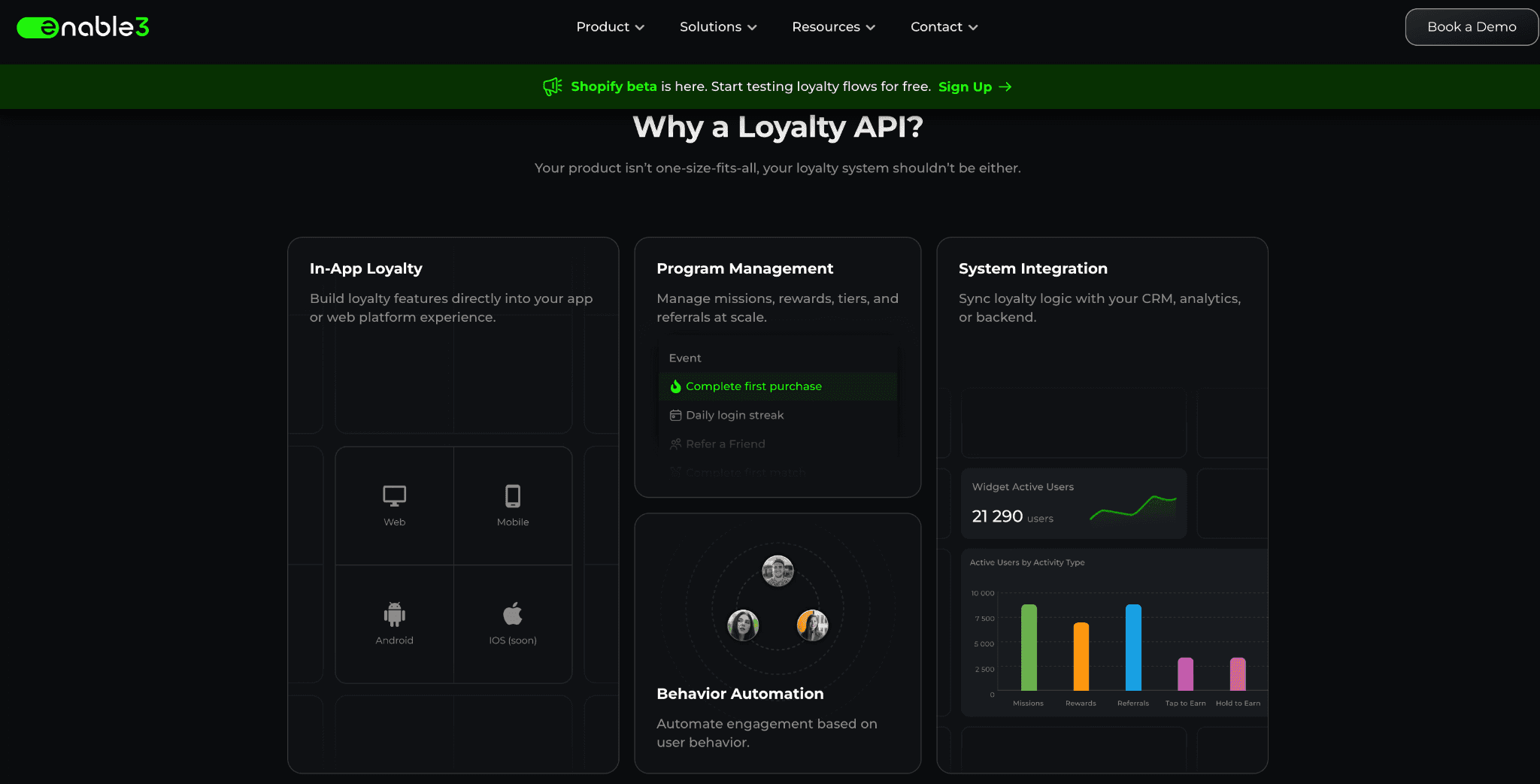
Enable3: Loyalty API
Problem #4: Your customer loyalty data is disconnected from the rest of your marketing strategy
Loyalty programs generate valuable behavioral signals – from earning and redemption patterns to engagement, progression, and customer activity. But when those signals remain isolated, it becomes difficult to understand which reward mechanics are actually influencing retention, CLV, or revenue.
Enable3 Analytics Platform Integrations provides visibility into customer loyalty activity and performance so teams can connect customer behavior with the mechanics designed to influence it. This supports the broader measurement framework outlined in this marketing strategy: tracking engagement, redemption, retention, CLV contribution, and the share of revenue generated by loyalty program members.
With Enable3, businesses can integrate with many and various platforms, such as:
CRM (HubSpor, Zoho);
Product analytics (Firebase, Amplitude);
Third-party rewards providers (Tremendous);
Social media (Telegram, X, Discord, Instagram, Facebook);
Backend & events (REST API, Webhooks).
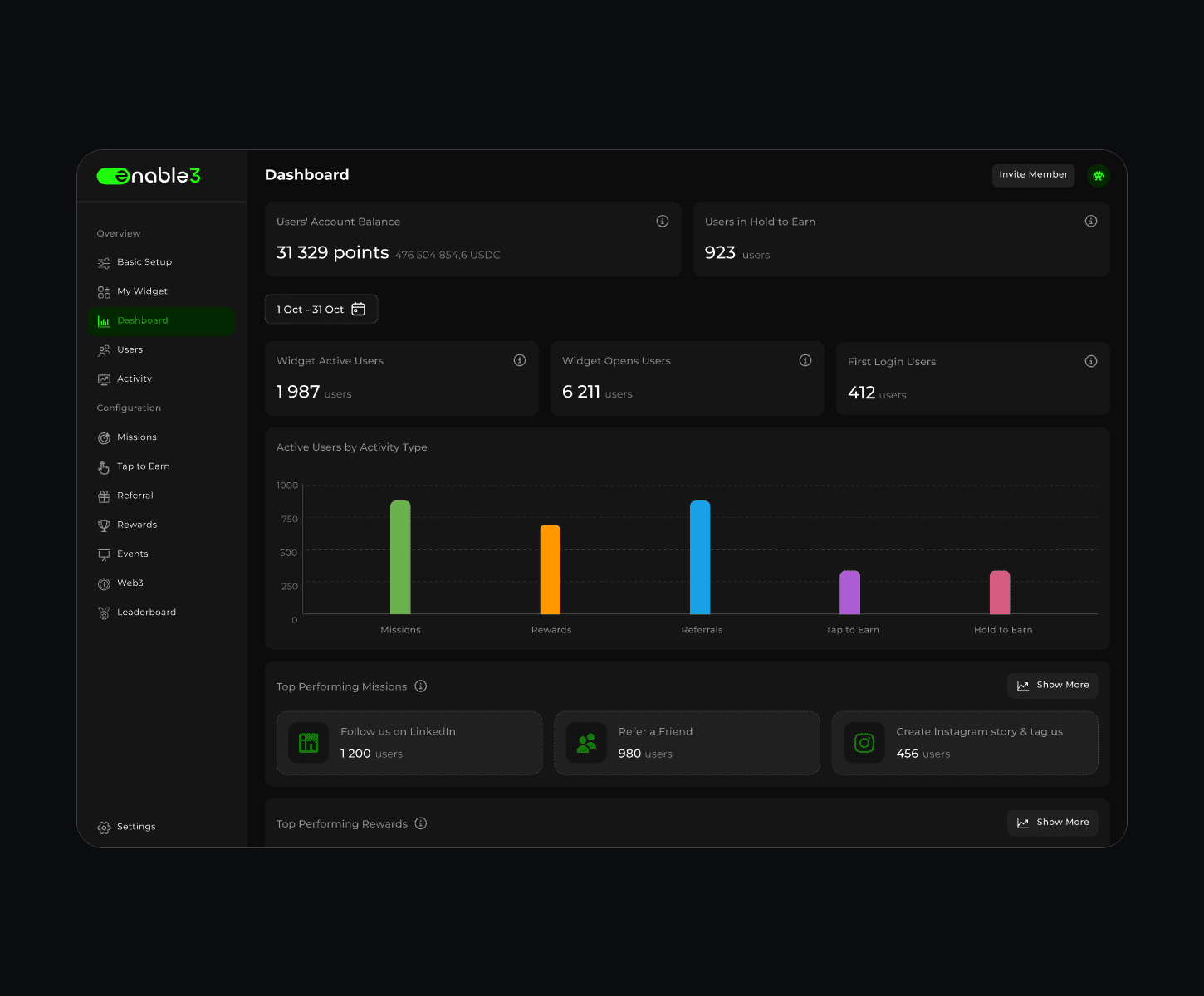
Enable3: Customer engagement, retention, and reward redemptions in one dashboard.
Problem #5: You know your loyalty program mechanics need testing, but changing them is difficult
Customer behavior changes over time. A reward threshold that worked six months ago may no longer motivate customers, while a mission that performs well for one segment may have little effect on another. If every change requires significant development work, teams are less likely to test and refine the loyalty program.
Enable3 loyalty-driven solutions for product teams offer configurable reward mechanics that can be adjusted as your loyalty strategy evolves. Product teams can experiment with missions, rewards, tiers, and other engagement mechanics, then use performance data to determine which combinations are worth scaling. This supports the continuous testing and holdout-based optimization approach recommended for mature loyalty programs.
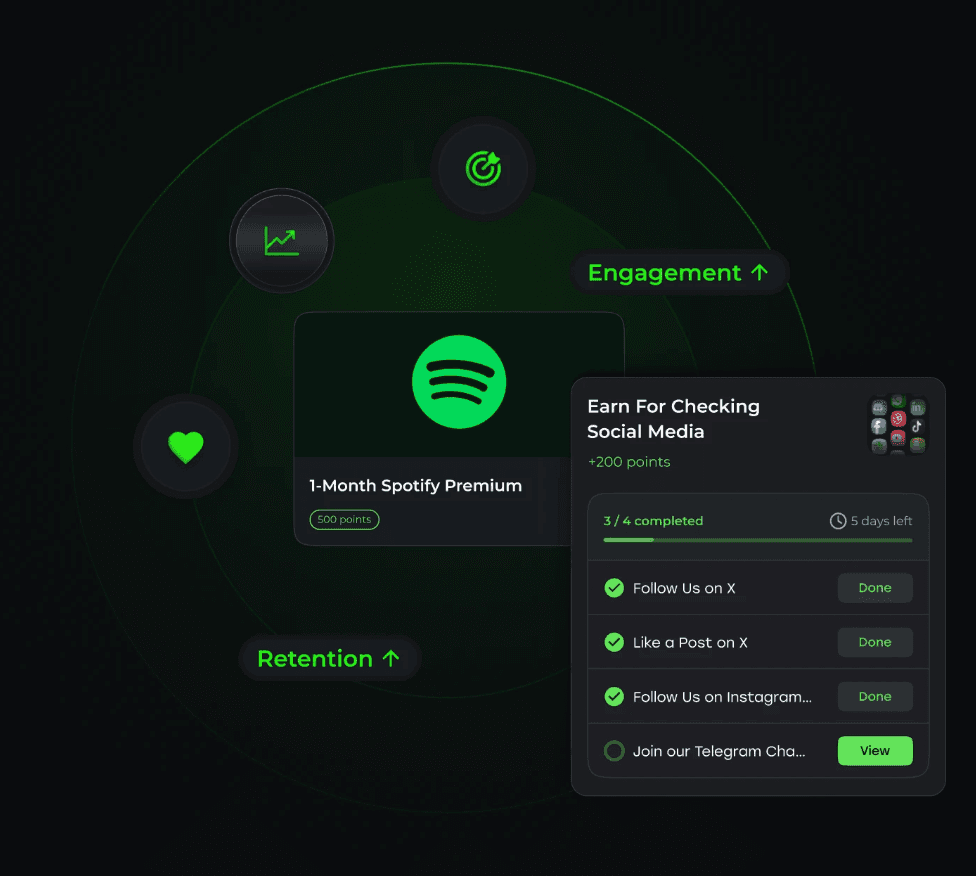
Enable3: Loyalty-driven solutions for product teams
Problem #6: Your rewards create engagement, but you cannot tell whether they create business value
A high redemption rate or mission completion rate does not automatically mean the loyalty program is improving retention or revenue. Without connecting customer loyalty activity to their behavior, it is difficult to know which reward mechanics deserve more investment.
Enable3 loyalty marketing software includes analytics capabilities that help teams monitor mission completion, reward activity, segment performance, and other customer loyalty signals. These insights can help identify where customers accelerate, where they stall, and which mechanics deserve further testing. Instead of optimizing for activity alone, teams can refine the customer loyalty system around the behaviors that contribute to long-term customer value.
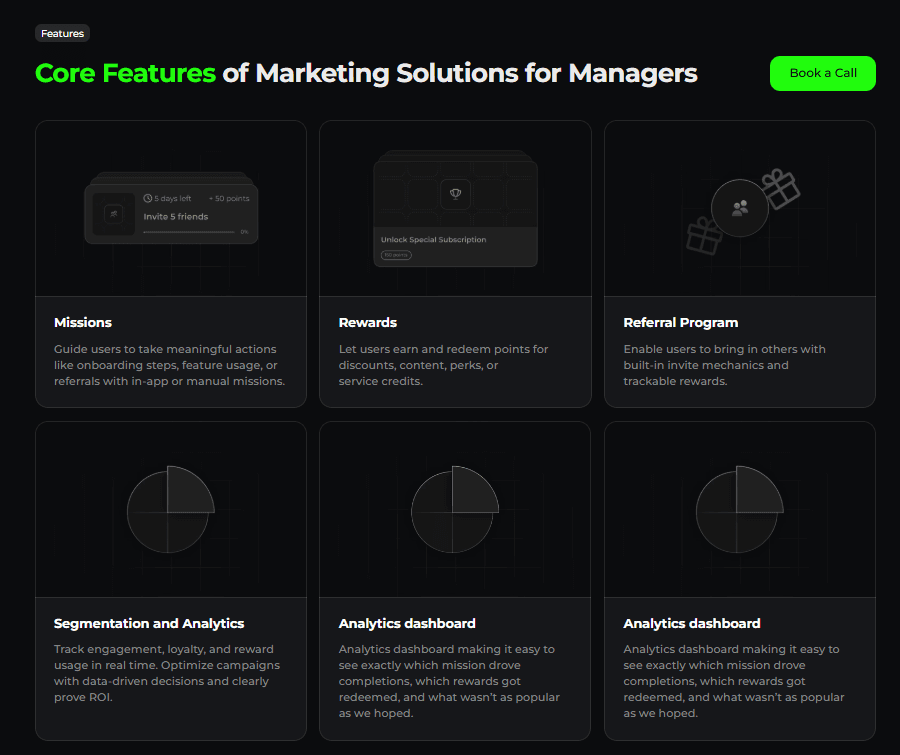
Enable3: loyalty marketing solutions
Enable3 helps businesses turn loyalty marketing strategies into operating systems for retention, engagement, and long-term customer value.
Book a demo to explore how Enable3 can fit your customer journey and loyalty goals.
[CTA placeholder] Talk to our team to explore how a loyalty strategy can fit your customer journey and business goals.
FAQ
What is a loyalty marketing strategy?
A loyalty marketing strategy is the coordinated set of actions a brand uses to increase customer retention, deepen engagement, and raise long-term value. It sits within the broader discipline of loyalty marketing, not just points or perks. It aligns product, lifecycle marketing, and incentives around behaviors that matter: repeat purchases, ongoing usage, expansion, advocacy, and reduced churn risk.
What is the difference between a loyalty program and a loyalty strategy?
A loyalty program is the reward mechanic – points, tiers, or membership rules customers interact with directly. A loyalty strategy is the broader system: goals, segmentation, channel marketing, data infrastructure, and measurement that make that reward mechanic work. The loyalty program is one component; the loyalty strategy determines whether it drives real retention.
What is a good ROI for a loyalty program?
A study shows that a good ROI benchmark for a loyalty program is around 5.2–5.3x ($5.20–$5.30 in revenue per dollar spent). Actual ROI varies by industry, loyalty program design, and segment maturity, so early-stage loyalty programs typically see lower returns before optimization.
How do you measure loyalty marketing success?
Loyalty marketing success is measured through retention, repeat purchases, customer lifetime value, engagement, and incremental revenue. Gartner reports that 22% of consumers find it harder for brands to maintain their loyalty, highlighting the need for differentiated loyalty programs and meaningful customer experiences.
What types of loyalty programs are there?
The main loyalty program types are points-based, tiered, membership, and hybrid models. Points-based remains the most common format – used by 57% of retailers, with about a third running cash-back and a quarter running tiered loyalty programs, according to Salesforce customer loyalty retention insights. Most mature brands blend formats into a hybrid
How much does loyalty marketing increase revenue?
Loyalty marketing can lift revenue meaningfully: top-performing loyalty programs see 15–25% annual revenue gains from their existing customer base, per McKinsey-referenced industry benchmarks. The exact lift depends on personalization depth and redemption health.
How do you build a loyalty marketing strategy from scratch?
Building a loyalty marketing strategy from scratch starts with setting clear behavioral goals, defining target segments and personas, and designing a value proposition worth joining. From there, choose the right loyalty program type – points, tiers, membership, or hybrid – and set and align every reward mechanic to measurable business outcomes.