Loyalty

If you’ve ever launched a loyalty program that went nowhere – flat signups, unused points, disengaged customers – you know the feeling. The problem usually isn’t the rewards. It’s the architecture.
Loyalty program architecture determines whether your program becomes a growth engine or another feature collecting dust. It’s the difference between Sephora’s Beauty Insider (34 million members driving 80% of annual sales) and the countless programs customers forget they joined.

This guide breaks down a loyalty system architecture: what it actually means, how to design one that really works, and when to build versus buy. If you’re a product manager, marketing lead, or founder evaluating loyalty platform architecture options, this is for you.
What Is Loyalty Architecture?
Loyalty architecture is a technical and strategic framework that powers everything your loyalty program does. It’s not about which rewards you offer – it’s about how those rewards get triggered, tracked, redeemed, and optimized across every customer touchpoint.
Think of it this way: your loyalty program design covers the “what” (earn 1 point per dollar, redeem for discounts). Your loyalty program architecture covers the “how” (real-time event capture, balance management, API integrations, fraud prevention, analytics pipelines).
Most loyalty programs fail at the architecture layer. Marketing teams create compelling reward structures, but the underlying systems can’t handle multi-channel attribution, struggle with real-time balance updates, or require engineering sprints for every campaign change. This disconnect between program design and technical execution is where good ideas go to die.
From Loyalty Program Design to System Architecture
Traditional program design starts with reward mechanics: points, tiers, cashback. That’s necessary but insufficient for true success.
Modern loyalty architecture starts differently. Instead of asking “what rewards should we offer?”, it asks:
What user behaviors actually drive lifetime value?
How do we capture those behaviors across web, mobile, POS, and partner systems?
How do we personalize rewards without manual segmentation?
How do marketing teams launch campaigns without engineering bottlenecks?
The companies winning at loyalty – Starbucks Rewards (34.6 million members, 41% of US transactions), Nike Membership, Amazon Prime – built the architectures that answer those questions. They didn’t just design better rewards. They designed better systems.
Understanding what makes these systems work requires looking at their core building blocks.
Core Components of a Loyalty System
Every loyalty management system shares common components. Getting these right determines whether your loyalty program scales or stalls.
Members, Identities, Balances, and Rewards
At the foundation sits your member data model. This isn’t just profiles – it’s every customer attribute that influences how they earn and redeem.
Balance management sounds simple until you need multiple point types (bonus points, promotional points, tier points), custom expiration rules, pending versus confirmed balances, and liability tracking for finance. Most homegrown solutions break when these requirements compound.
Your reward catalog needs similar flexibility. Static discounts work for basic loyalty programs, but modern loyalty architecture supports dynamic rewards: personalized offers based on segments, limited-availability perks, experiential rewards, partner redemptions, and increasingly, tokenized rewards that customers actually own.
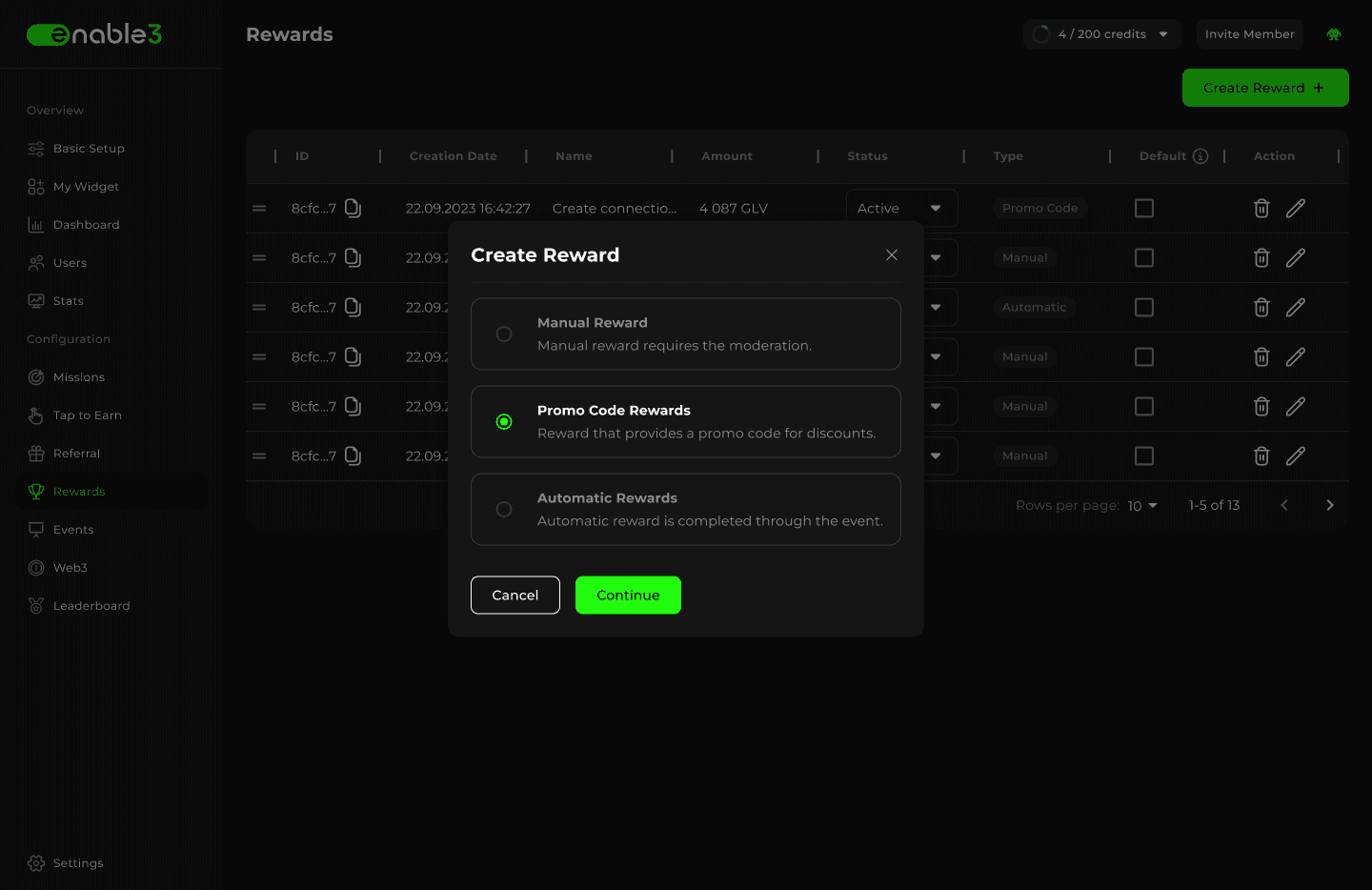
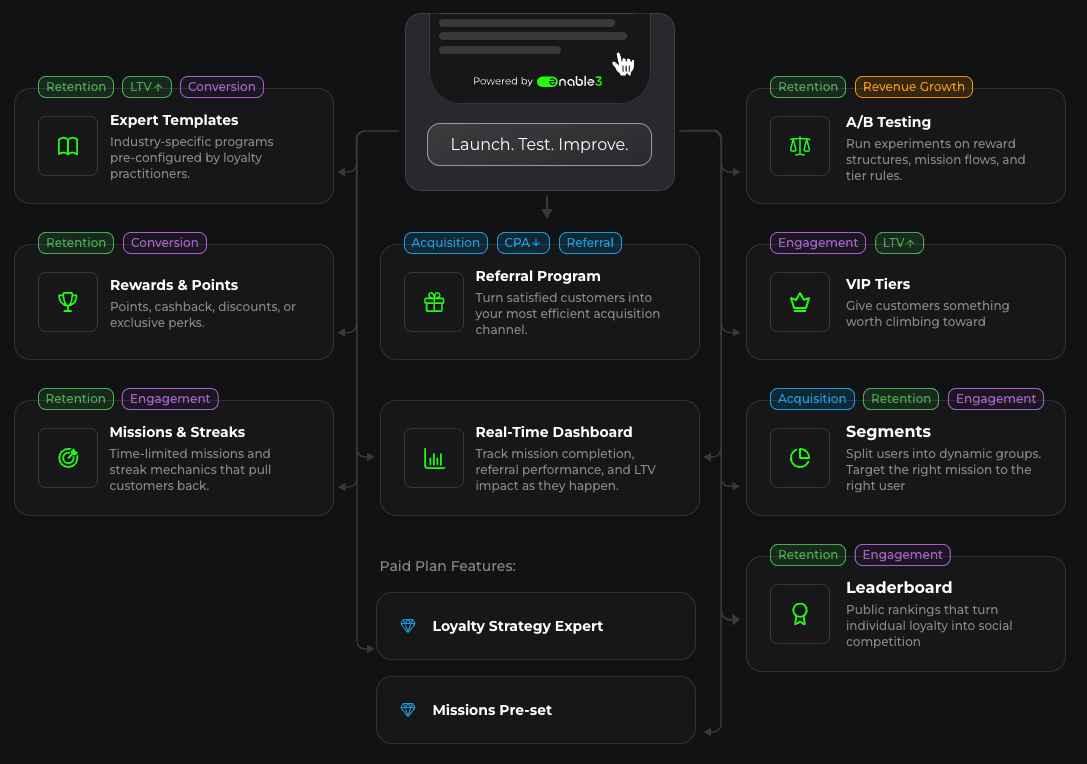
At Enable3, we built our points engine to handle this complexity upfront. The Rewards & Redeem module lets you choose which users are eligible to exchange points for discounts, content, perks, or service credits.
But having the right data model only matters if you can capture the events that drive it.
Events, Rules, and Transactions
This is where most loyalty system architectures succeed or fail.
Event-driven loyalty architecture captures user actions in real-time: purchases, app opens, content shares, referrals, feature usage, milestone completions. These events trigger point accruals, tier promotions, and personalized campaigns automatically.
The alternative – batch processing – worked when loyalty meant punch cards. Today’s customers expect instant gratification. They complete a purchase and want to see their points immediately, not “within 24-48 hours.”
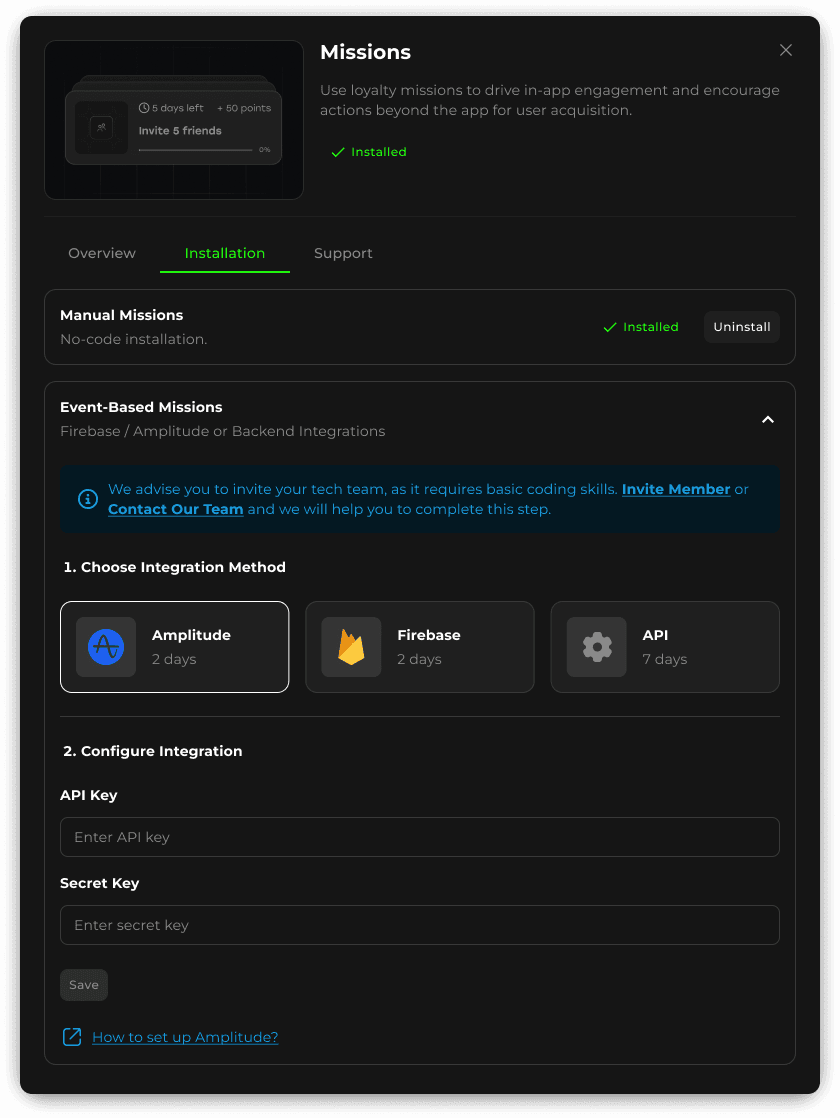
At Enable3, we centered our architecture on what we call Missions – event-based triggers that turn passive users into active participants. When a user completes a valuable action (ordering a taxi, finishing a workout, sending their first message), rewards are distributed automatically. Our clients typically see a 5.4% uptick in conversion rates after adopting Missions, as they create clear goals that users want to achieve.
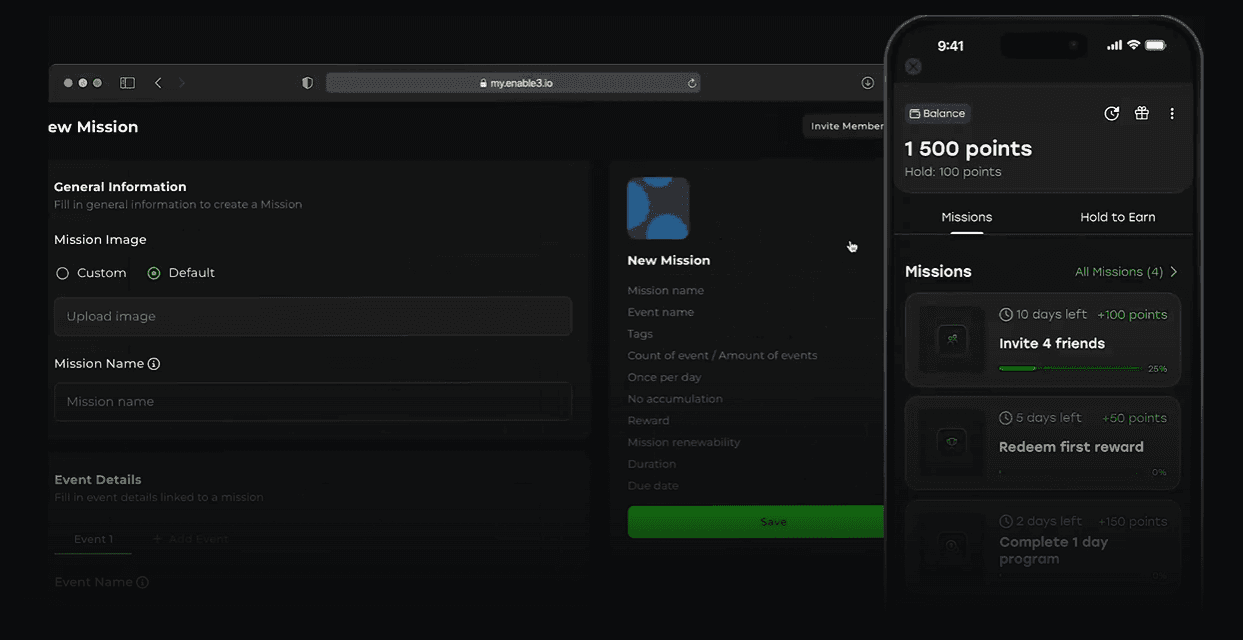
It should be noted that you don’t have to wait for the full integration to start rewarding users. Enable3’s no-code Missions can be connected to the pre-existing system events, so you can incorporate them into your campaign in days, not weeks.
How a Loyalty Fits into Your Technology Stack
Loyalty doesn’t exist in isolation. Your loyalty platform architecture must integrate with everything your customers touch and everything your teams use.
Channels and Touchpoints: Web, App, POS, and Partners
Customers don’t think in channels. They expect their loyalty balance and status to be consistent whether they’re on your website, mobile app, in a brick-and-mortar store, or interacting through a partner.

That consistency requires your loyalty platform architecture to serve as a single source of truth, accessible from every touchpoint through APIs for web and mobile, POS integrations for retail, partner APIs for coalition programs, and webhook callbacks for custom implementations.
Your customers don’t care how you implement this. All they want is less friction using your loyalty program. But behind the scenes, this integration challenge requires careful architectural planning.
Integration Layer and the Loyalty Engine
The loyalty engine is your loyalty program’s brain: it evaluates rules, calculates rewards, manages balances, and coordinates with external systems.
Your integration layer determines how that engine connects to everything else. At minimum, you need inbound connections for receiving customer events from web, mobile app, POS, and partner systems (these trigger reward calculations and program logic), outbound connections for pushing loyalty data to CRM, CDP, email platforms, and analytics tools (marketing needs segment data, finance needs liability reporting, customer service needs balance information), and callback systems for real-time notifications to external services when loyalty events occur.
For example, our callback system notifies your external services the moment relevant events happen – tier upgrades, redemptions, referral conversions, so downstream systems stay synchronized without polling. Combined with our API endpoints, this creates bidirectional integration: your systems push events in, we push notifications out. Server IP whitelisting and API key authentication secure these connections without adding implementation friction.
These integrations only deliver value, though, if the underlying architecture can adapt as your program evolves.
Designing a Flexible Loyalty Platform Architecture
The best loyalty architecture anticipates change. Campaigns will evolve. Reward structures will shift. Integrations will multiply. Your architecture either accommodates this or fights against it.
API-First and Event-Driven Design Principles
Two architectural patterns work together to create the flexibility modern loyalty programs need.
API-first design means every feature is accessible programmatically. Marketing teams might use a dashboard, but engineering teams can build custom experiences through the same underlying APIs. This prevents feature fragmentation and enables customization without forking.
Event-driven architecture decouples action capture from reward distribution. When a customer completes a purchase, that event propagates to the loyalty engine, triggers relevant campaigns, updates balances, and notifies integrated systems – all without tightly coupled dependencies. Want to add a new campaign? Subscribe it to relevant events. No code changes required.
We built Enable3 on these patterns because we’ve seen what happens when architectures can’t adapt. Our customer loyalty system is fundamentally event-driven – user actions trigger rewards through configurable rules, so marketing teams launch campaigns in minutes rather than waiting for engineering sprints. Everything available in our admin panel is equally accessible via API, giving technical teams flexibility to build custom experiences.
Composable Architecture and Extensibility
Composable architecture (sometimes called MACH: Microservices, API-first, Cloud-native, Headless) lets you assemble best-of-breed components rather than accepting monolithic vendor limitations. Your loyalty engine doesn’t need to be your email platform. Your points system doesn’t need to be your analytics tool.
This matters because your needs will change. Today, you might need basic points and tiers. Tomorrow, you might want referral mechanics, Web3 capabilities, or integration with a new partner platform. Composable architecture lets you add these capabilities without rebuilding from scratch.
These patterns matter even more when you consider how loyalty data flows through your broader technology stack.
Connecting Loyalty with the Data Ecosystem
Your loyalty system generates valuable data. Making that data actionable requires integration with your broader martech stack and careful consideration of how data moves through your systems.
CRM, CDP, CEP, and Analytics Platforms
CRM integration gives sales and support teams visibility into loyalty status, history, and opportunities. When a customer calls, agents should see their tier, recent rewards, and redemption patterns. Our CRM integration delivers this complete view – from initial engagement through reward redemption, so every customer conversation is informed by loyalty context.
CDP (Customer Data Platform) integration unifies loyalty data with other customer signals for segmentation and personalization. Understanding that a customer is Gold tier AND recently browsed specific products AND hasn’t purchased in 30 days enables targeted campaigns neither system could deliver alone.
CEP (Customer Engagement Platform) integration connects loyalty triggers to communication channels. Tier upgrade? Trigger a congratulations email. Points expiring? Send a push notification. Referred friend converted? Notify the referrer immediately.
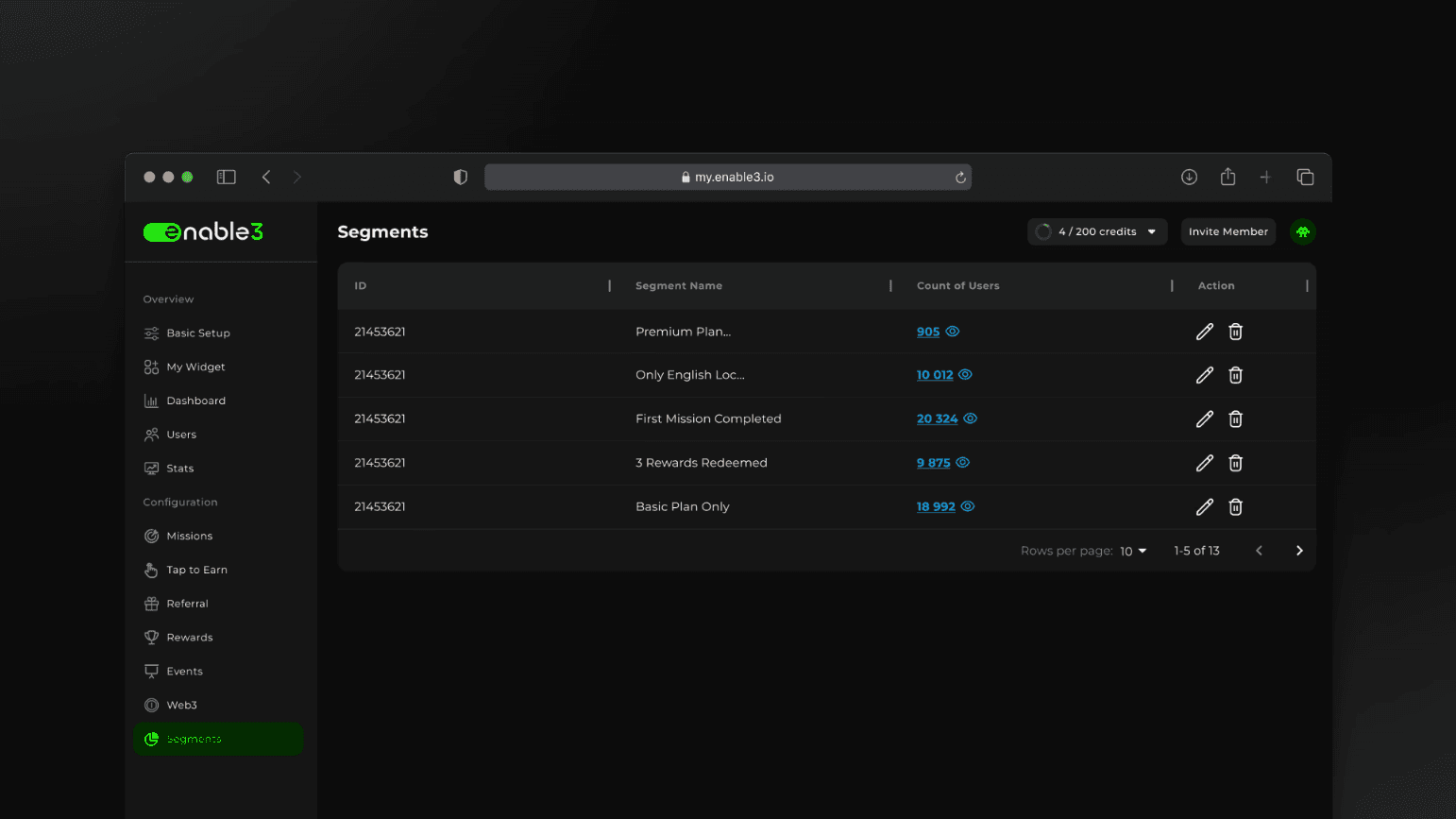
Our Segments feature makes this actionable by grouping users based on behavior. Marketing teams create VIP levels, regional campaigns, or product-specific reward structures, then target these segments with relevant campaigns.
Beyond pushing data to other systems, you need to consider how data flows within your loyalty architecture itself.
Real-Time vs Batch Data Flows and Liabilities
Data architecture decisions ripple through your entire loyalty program.
Real-time data enables immediate reward distribution, dynamic segmentation, and responsive campaigns. Customers see points instantly. Marketing teams see campaign performance live. Finance teams see liability changes as they happen.
Batch processing still has its place for heavy analytics, reporting, and reconciliation. Running complex queries against live transactional data impacts performance. Periodic snapshots provide analytical flexibility without operational risk.
Liability tracking is often overlooked until finance asks uncomfortable questions. Outstanding points represent financial obligations. Your architecture must calculate, report, and forecast these liabilities accurately, including the impact of expiration rules, breakage estimates, and promotional issuances.
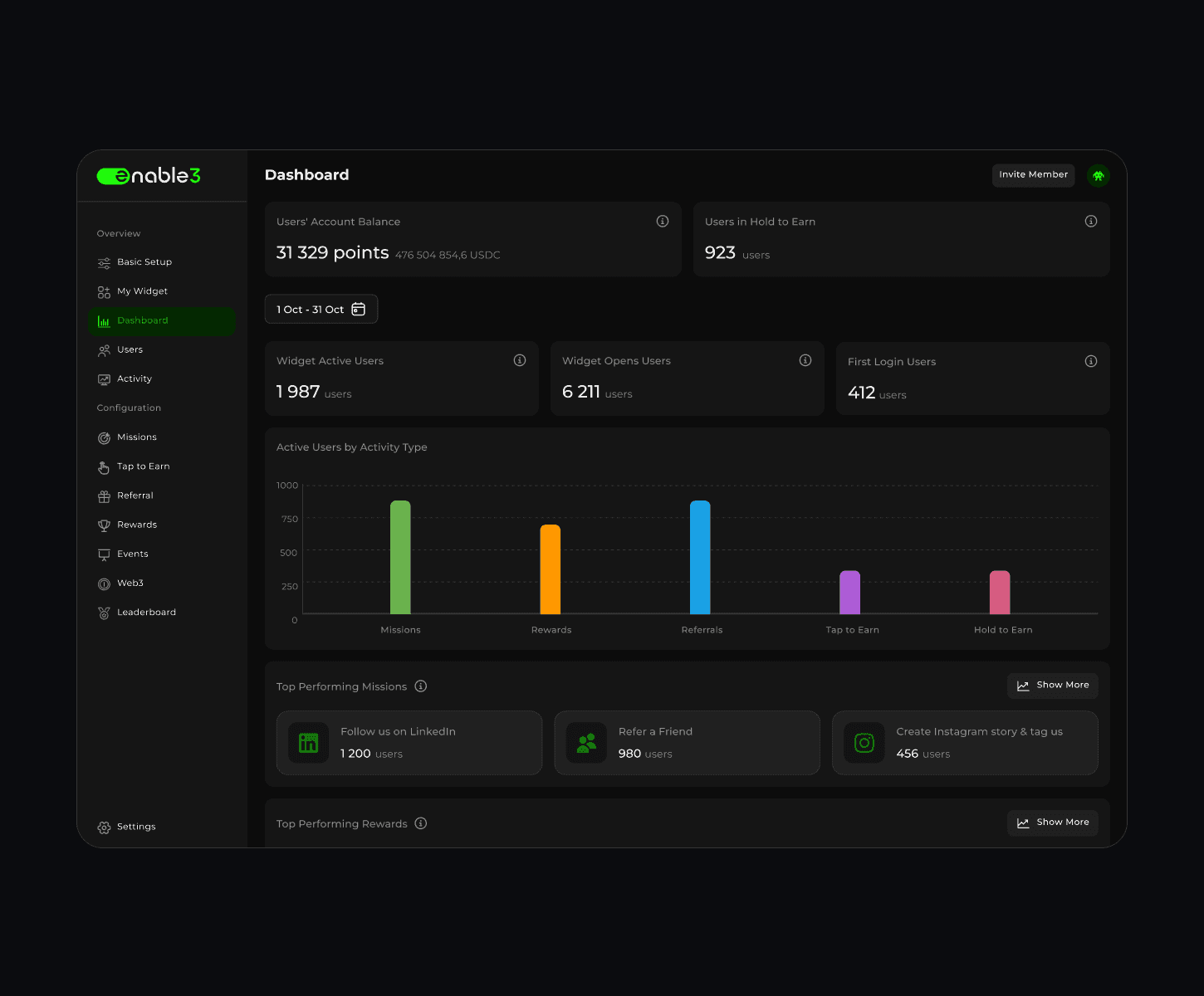
Enable3’s analytics provide instant access to the metrics that matter: sign-up rates, point activity, redemption trends, mission completion rates. Dashboard shows which missions users complete, which rewards they redeem, and where engagement drops off – giving you data to optimize continuously rather than guess.
But all this integration and flexibility means nothing if your system can’t handle real-world operational demands.
Reliability and Security
Loyalty programs handle real value – points, rewards, tier status – that customers expect to work correctly every time. Loyalty system architecture decisions here have real consequences.
Scalability, Performance, and Resilience
Loyalty systems face uneven demand. A flash sale, viral campaign, or partner promotion can spike event volume orders of magnitude above normal. Your architecture must handle these peaks without degrading performance.
This means horizontal scaling for the loyalty engine, queue-based event processing to absorb spikes, caching for frequently accessed data (balances, tier status), and geographic distribution for global programs.
Response time matters too. A customer completing a checkout shouldn’t wait seconds for their points to calculate. Real-time or near-real-time processing is table stakes.
Performance matters, but so does protecting the value within your customer loyalty system.
Security, Compliance, and Fraud Prevention
Points are currency. Your loyalty architecture must protect them accordingly.
Authentication and authorization control who can access what. API keys, IP whitelisting, and role-based access prevent unauthorized changes. Our Add Member feature lets you manage team permissions precisely, controlling who can modify programs versus who can only view reports, which reduces the risk as teams scale.
Fraud prevention matters increasingly as programs scale. Fake accounts, bot abuse, and referral fraud drain value. Velocity limits, verification requirements, and anomaly detection help identify suspicious patterns before they compound.
Compliance requirements vary by region and industry. GDPR affects how you handle EU customer data. PCI-DSS applies if you process payment information. SOC 2 demonstrates security practices to enterprise customers. Your architecture must support required controls without creating operational friction.
With all these loyalty system architectural considerations in mind, the fundamental question remains: should you build this yourself or buy a ready-to-use platform?
Build vs Buy: Choosing a Loyalty Management System
Every company faces this decision. The right answer depends on your constraints, timeline, and competitive positioning.
When to Build a Custom Loyalty System
Building makes sense when your loyalty model is your moat. If a proprietary loyalty mechanic is core to competitive differentiation – and that mechanic can’t be configured in existing platforms – custom development may be necessary.
It also makes sense when you have strong engineering resources AND patience. Building a robust loyalty infrastructure takes longer and costs more than teams initially estimate. Balance management alone involves edge cases that take months to discover and fix.
Finally, building might be simpler when your existing infrastructure has deep dependencies. If your data model, authentication system, or transaction processing has constraints that no external platform can accommodate, custom integration may be easier than platform adoption.
However, custom builds create ongoing maintenance burden. Every new feature, compliance requirement, and integration need competes for engineering resources against your core product.
When SaaS or Hybrid Platforms Make More Sense
Buying makes sense when time-to-value matters. SaaS platforms launch in weeks, not quarters. We designed Enable3 with three entry points – no-code setup for basic programs, low-code for customization, full API for deep integration, so teams start simple and quickly, and expand without switching platforms.
It’s also smart when your loyalty model uses standard mechanics. Points, tiers, referrals, missions, and gamification are solved problems. We’ve refined these mechanics across hundreds of implementations. You benefit from that learning without paying for it.
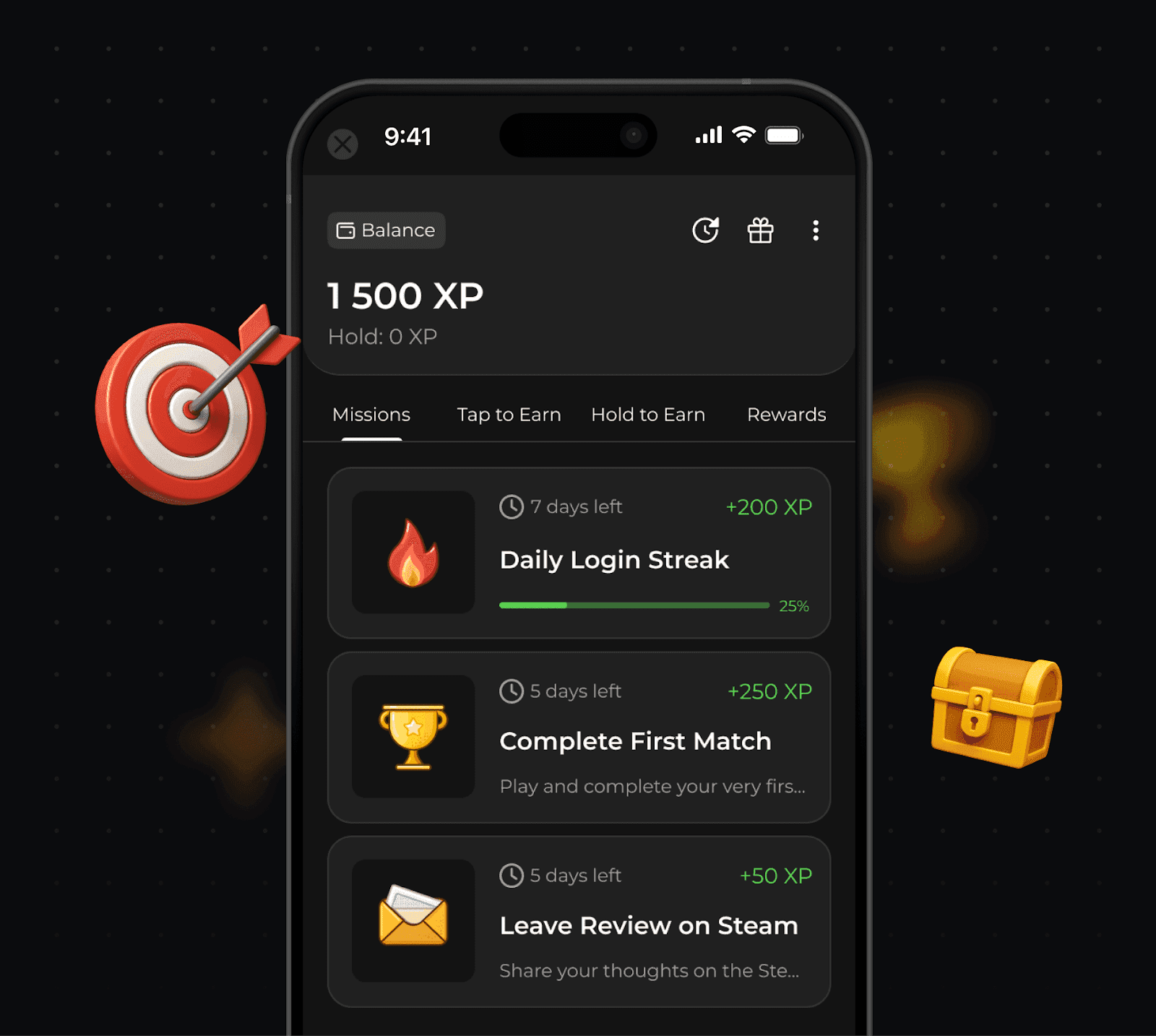
And if you want to explore emerging capabilities – Web3 loyalty, tokenization, hold-to-earn mechanics – these represent the next generation, but require specialized infrastructure. We offer these capabilities optionally, letting traditional programs add blockchain loyalty elements without rebuilding from scratch.
Hybrid approaches work too. Use a platform for core loyalty mechanics while building custom extensions for unique requirements. Our API-first architecture supports this pattern, providing the loyalty engine while your team builds custom experiences on top.
Whether you build or buy, certain mistakes plague loyalty implementations. Knowing them helps you avoid repeating them.
Still deciding: build or buy?
Get a 30-minute architecture review with our team.

Typical Loyalty Architecture Mistakes to Avoid
Engineering bottlenecks kill customer loyalty programs
When adding a double-points promotion requires code deployment, programs stagnate. Marketing teams need self-service capabilities bounded by guardrails engineering sets.
Single-channel thinking creates fragmented experiences
Building for web-only or app-only disappoints customers who expect consistency everywhere. Omnichannel delivery must be built-in from the very beginning.
Ignoring redemption experience wastes earning mechanics
Loyalty programs obsess over point accrual while redemption stays clunky. If customers can’t easily redeem, they don’t value earning. The full loop matters.
Over-engineering before validation wastes resources
Building comprehensive tier structures and complex rules before validating basic engagement is backwards. Start simple. Add complexity based on data, not assumptions.
Treating loyalty as a silo leaves value unrealized
If your loyalty system can’t integrate with CRM, CDP, and communication platforms, you’re missing opportunities for personalization and engagement across channels.
Conclusion: Design a Loyalty Architecture That Evolves
The best loyalty architecture isn’t the most complex. It’s the one that serves today’s needs and accommodates tomorrow’s opportunities.
Start with clear objectives: What behaviors do you want to incentivize? What's the business impact? How will you measure success?
Choose architecture patterns that match your capabilities: API-first if you have engineering resources for custom experiences. No-code if marketing needs autonomy. Composable if you’re integrating best-of-breed tools.
Prioritize integration from the beginning. Your loyalty system generates valuable data that should inform personalization across channels. If it operates in isolation, you’re leaving growth on the table.
And build for iteration. The companies winning at loyalty aren’t the ones who got it right the first time. They’re the ones whose architecture lets them learn and adapt faster than competitors.
We built Enable3 to be that architecture: a loyalty platform that scales from no-code widget to full API integration, supports traditional mechanics alongside Web3 capabilities, and gives teams the tools to iterate without engineering bottlenecks.
Your loyalty program is only as strong as the architecture underneath it. Make it count.
See the architecture in action

Frequently Asked Questions
What is a loyalty architecture in simple words?
Loyalty architecture is the technical foundation that makes your loyalty program work. While a program design covers what rewards you offer, an architecture covers how those rewards get triggered, tracked, and distributed across every customer touchpoint. It includes event capture systems, balance management, API integrations, and the rules engine that automates program logic.
Good architecture lets marketing teams launch campaigns independently, ensures customers see consistent experiences across channels, and scales as your program grows.
How is a loyalty architecture different from a campaign setup?
Campaign setup happens within a loyalty program: configuring a double-points weekend, creating a referral bonus, launching a seasonal quest. Loyalty architecture is the underlying system that makes those campaigns possible. Think of architecture as the kitchen – equipment, recipes, processes – while campaigns are individual dishes. Poor architecture requires custom development for every new idea, creating bottlenecks and limiting iteration speed.
Well-designed loyalty program architecture lets you create any campaign without engineering changes.
What systems do typically surround a loyalty management system?
Loyalty systems integrate with several platform categories:
CRM systems (Salesforce, HubSpot) receive loyalty data so sales and support teams see customer status.
CDPs (Segment, mParticle) combine loyalty signals with other customer data for unified profiles.
Email and push platforms (Klaviyo, Braze) trigger communications based on loyalty events.
POS systems capture in-store transactions.
E-commerce platforms (Shopify, Magento) track online purchases.
Analytics tools aggregate program performance data.
The customer loyalty platform sits at the center, exchanging data with each system through APIs and webhooks.
How technical do marketers need to be to work with loyalty platforms?
With modern loyalty platforms, not very. Marketing teams can create missions, configure rewards, set up quests, and launch campaigns through visual admin panels without writing code. They can build user segments, A/B test reward structures, and analyze performance through dashboards. Technical involvement becomes necessary for custom integrations, advanced API implementations, or non-standard data flows.
The goal of good loyalty platform architecture is precisely this separation: marketing independence for standard operations, engineering involvement only for custom requirements.
What should you prototype first when designing a loyalty system?
You should:
Start with your core engagement loop.
Identify the single most valuable customer behavior you want to incentivize (completing a purchase, achieving a milestone, referring friends).
Build the minimal architecture to capture that event, calculate rewards, and distribute them immediately.
Validate that loop with real users before adding complexity.
Once the core works, layer on additional mechanics: tiers, quests, gamification.
This approach prevents over-engineering and ensures your loyalty management system architecture solves real engagement problems rather than hypothetical ones.