Loyalty

Key takeaways
The global mobile engagement market is on track to reach roughly $256 billion by 2029 – a sign of how much the budget is shifting from acquisition to retention.
Day 30 retention averages roughly 4–5% across consumer apps (iOS 5.3%, Android 3.8%), so most of a typical app's first-month users are already gone before engagement work even has a chance to matter.
A DAU/MAU (stickiness) ratio around 20% is considered healthy for most apps; above 25% is strong.
A 5-percentage-point lift in retention has been linked to a 25–95% increase in profit over time.
Push notifications only help retention when they're targeted – generic, one-size-fits-all pushes tend to underperform personalized ones (see Push Notification section for the sourced comparison).
In 2026 time is limited, trust is earned, attention is rented. Winning apps fit seamlessly into users’ routines. Getting installs is easy. Getting return visits is what matters. That’s why customer engagement has become the defining metric for product teams.
This guide is built for teams who want to go beyond app installs. You’ll learn how to increase mobile app engagement with strategies that feel less like marketing and more like momentum. We’ll look at:
What user connection really means (and why it’s not the same as acquisition)
The mobile app engagement metrics that actually matter in 2026
How top apps like Duolingo and Headspace keep users hooked
What goes wrong (hint: it’s not always the features)
Campaigns that go beyond “push notifications” and into habit-building
And where mobile engagement is heading next – from AI to privacy-first design.
The goal goes beyond numbers, it’s to build experiences users love returning to. That starts with the basics: what engagement actually means, and why it's not the same thing as growth.
What Is Mobile App Engagement?
Definition and Purpose
Customer engagement is a pattern of returning actions – tapping, scrolling, recommending, staying – and, just as important, not uninstalling.
Think of it as the difference between a guest and a regular. You don’t want users to just try the app, you want them to build a habit with it.
When we talk about a strong mobile app engagement strategy, we’re really talking about building loops: touchpoints that feel useful, timely, personal. Involvement is what turns your app from “another tool” into something that lives in a person’s daily habits.
Why Customer Engagement Matters
A lot of teams still focus too much on app installs. But installs don't pay the bills – engagement does.
When existing users come back, they buy. They subscribe. They tell friends. They leave reviews. They help your algorithms. And they make it easier to grow without spending more on ads. This is exactly why a deliberate mobile app engagement strategy pays for itself faster than most marketing efforts aimed purely at new installs.
A 5-point lift in Day 30 retention alone has been tied to a 25–95% increase in profit – a bigger lever than most customer acquisition spend ever pulls, as reported by Bain & Company.
Customer engagement is the engine behind how to grow your app's active user base – without it, even the best-designed product burns out.
Mobile User Engagement vs Mobile User Acquisition
Let’s break this down.
User acquisition is getting people to the door.
User engagement is what makes them stay, explore, and come back.
An app with 100,000 installs and low activity is a leaky bucket. But an app with 10,000 loyal users can thrive. The best teams know this and focus their energy accordingly.
In 2026, mobile app user engagement metrics are what separate the apps that survive from those that scale.
Key Mobile App Engagement Metrics and Benchmarks
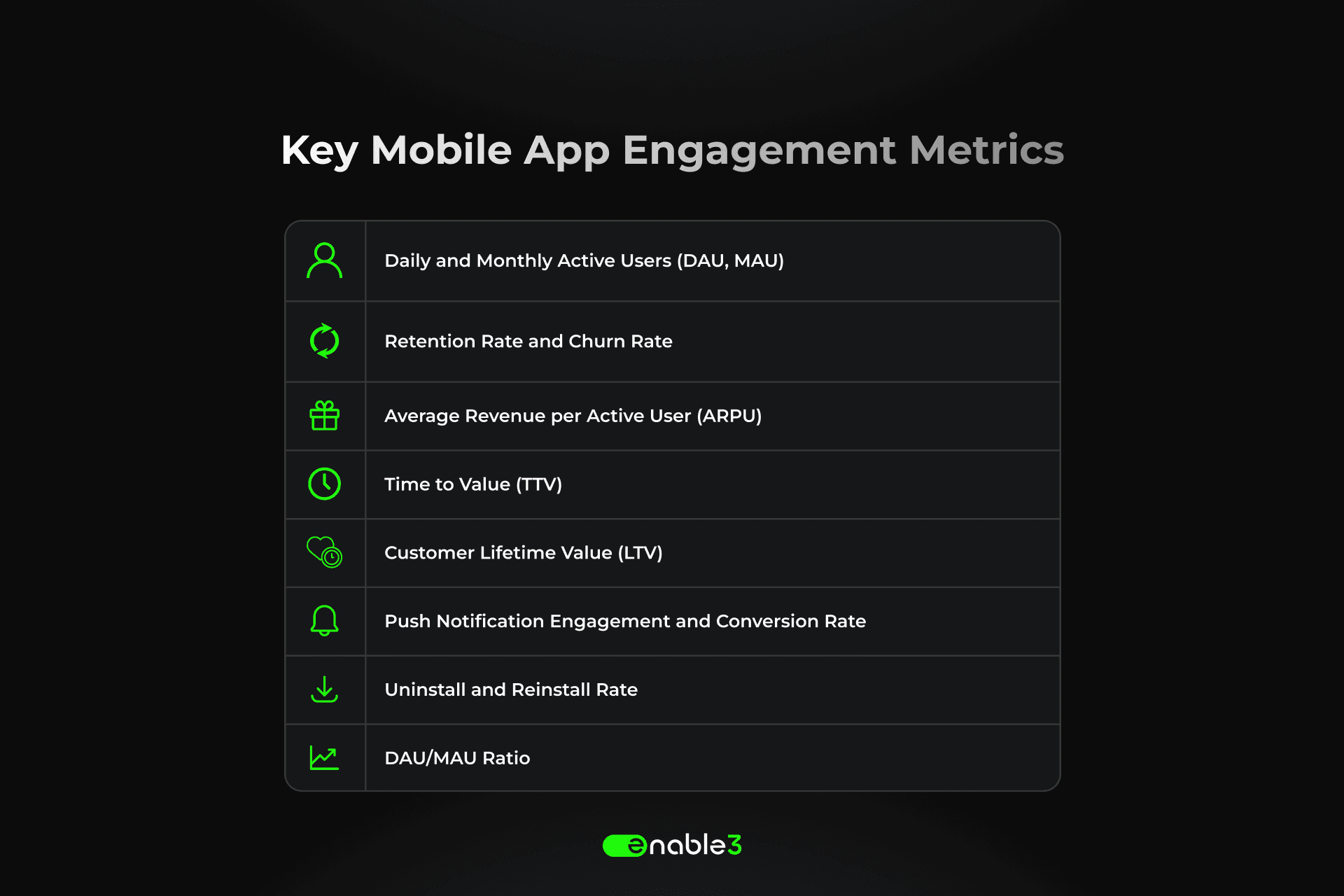
Not all mobile app engagement metrics matter equally, but the right ones show where your product delivers value.
Here’s what seasoned product teams are watching:
Mobile app engagement metric | How to calculate | Good | Strong |
DAU/MAU (stickiness) | Daily active users ÷ monthly active users | ~20% | 25%+ |
D1 retention | % of install cohort returning on day 1 | ~20-25% | 30%+ |
D7 retention | % of install cohort returning on day 7 | ~11–13% | 15%+ |
D30 retention | % of install cohort returning on day 30 | ~4–5% (Android/iOS) | 10%+ |
Session length | Avg. minutes per session, by category | 3–5 min | 5+ min |
ARPU | Revenue ÷ active users, per period | category-dependent | — |
Push opt-in rate (iOS) | % of installs granting notification permission | ~40–50% | 60%+ |
Uninstall rate (D30) | % of installs removed within 30 days | under 45% | under 30% |
DAU / MAU: Daily and Monthly Active Users
This isn’t about vanity – it’s about stickiness.
DAU shows how many users are active each day
MAU counts monthly actives
The ratio between them (DAU ÷ MAU) tells you how often people return
This benchmark varies by category – telecom or utility apps aren't opened daily, while wellness or gaming apps might be used several times. A ratio around 20% is considered healthy for most apps; above 25% signals real habit formation.
A strong ratio doesn't just mean usage – it means your app isn't being tested, it's being trusted, and that consistency is what long-term loyalty is built on. It's one of the first numbers any mobile app engagement strategy should track, since it tells you how many users are active on a given day relative to the month as a whole.
Retention Rate: D1, D7, D30
Day 1. Day 7. Day 30. These checkpoints are crucial – and how you calculate them matters as much as the number itself. Retention rate is the share of a specific install cohort that opens the app again on that exact day, not simply monthly active users divided by total installs. That second shortcut is a common mistake, and it produces an inflated, meaningless number.
When users leave early, improve onboarding first. Early drop-offs often signal a weak first impression.
High churn usually means:
Onboarding is confusing
Value is hidden
There’s no clear reason to return
The flip side – strong retention rates – signal a product that speaks the user’s language early and often. User retention and mobile app engagement move together: a product people don't come back to can't build the habit loops engagement work depends on.
Mobile User Retention | D1 | D7 | D30 |
Overall average | ~25-26% | ~11–13% | ~4–5% |
iOS | ~25.4% | — | ~5.3% |
Android | ~20.2% | — | ~3.8% |
Sources: overall figures from Adjust, Mobile App Trends 2026; iOS/Android split from Business of Apps, App Retention Rates.
For a deeper breakdown of what's driving these numbers and how to move them, see our guide on how to reduce customer churn and increase user retention.
Mobile User Retention Benchmarks by App Category
A blended D30 average tells you almost nothing on its own – the gap between categories is enormous, so the only useful comparison is against your own vertical, not the market as a whole.
Category of Mobile Apps | D30 retention |
Social / communication | 15–20% |
Productivity | 10–18% |
Gaming | 4–8% |
E-commerce | 3–6% |
Fintech | ~2% (down from 3% the prior year) |
Source: Adjust, Mobile App Trends 2026.
For the full picture on how these benchmarks break down, see our deeper look at mobile app retention.
That fintech number is worth pausing on. The old assumption – that banking and finance apps retain best because people check balances daily – no longer holds. Industry data shows finance-vertical D30 retention actually fell 33% year over year, the steepest drop of any category tracked, likely tied to market saturation in challenger banking and tighter BNPL regulation.
E-commerce sits at the bottom of the range for a different reason: purchases are episodic by nature, so daily-open stickiness is a weaker signal here than in other categories. A better lens for e-commerce is repeat purchase rate over a 60–90-day window, not DAU/MAU. This is a good example of why a one-size-fits-all mobile app engagement strategy rarely works across categories – the right key metrics to chase depend entirely on how the product gets used.
Session Length & Frequency
Ask yourself:
How long do your users stay?
How often do they come back?
The answers reveal more than just screen time – they show intent.
Long, frequent sessions suggest depth. But don’t chase time for its own sake. A quick, focused experience can be just as valuable – as long as it delivers. Session frequency is often the more diagnostic of the two: a user who opens the app briefly but often is showing a stronger habit loop than one long, occasional session.
Tracking how much time users spend per visit alongside how often they return gives a fuller picture than either number alone – and it's a pairing every mobile app engagement strategy should measure engagement against, not just one metric in isolation.
ARPU: Average Revenue per Active User
Not all users are equal. Some engage passively. Others pay, upgrade, and invite others.
ARPU is where user segmentation pays off – it helps you see which segment actually drives your business, and whether you're monetizing engagement effectively.
If your most active users aren’t converting, something’s missing in the loop.
Time to Value (TTV)
Every second between sign-up and the first “aha” moment is friction.
Time to Value measures how fast someone experiences the core benefit of your app. The shorter it is, the more likely they are to stick.
Want better TTV? Trim the fat. Kill the filler screens. Deliver value fast, and then deepen it.
Lifetime Value (LTV)
Customer Lifetime Value shows how much your app matters to people over time – and it's the metric most directly tied to retention. A 5-percentage-point improvement in Day 30 retention has been linked to profit gains of 25–95% over time, which is why LTV is the number most product teams end up defending to leadership, as stated by Bain & Company.
LTV rises when:
People stay longer
Use the app more
Pay for features
Engage with updates
Recommend it to others
Mobile user engagement is the thread that connects all of that. LTV is really just a lagging measure of customer behavior across the whole customer journey – which is why it belongs at the center of any mobile app engagement strategy conversation with leadership, not off to the side as a finance-only number.
Push Notification Engagement & Conversion
Push notifications only work when they add value.
Track:
Open rates
Action rates
Conversion events
These are the key metrics that tell you whether personalized notifications are actually driving user engagement, or just adding to the noise. A well-tuned push strategy often shows up first as a lift in conversion – see our guide on how to increase conversion rate for the mechanics behind that link.
iOS and Android opt-in rates for push permission also diverge meaningfully – worth checking your own numbers against platform norms rather than assuming parity, since default OS prompts and user privacy expectations differ between the two.
And personalize everything – generic, one-size-fits-all pushes consistently underperform messages tied to what a user actually did in the app. Personalized push notifications and personalized messaging built around real behavior, not just a name field, are what separate a push notification strategy that gets ignored from one that gets acted on.
Timing matters too: push notifications sent within the first 30 days after install have been found to drive a 75.8% impact on long-term retention, according to OneSignal’s 2026 State of Customer Engagement Report.
App Uninstall and Reinstall Rate
If mobile app installs are climbing but user engagement is dropping, look here.
A spike in uninstalls after onboarding? Your first impression didn’t land.
A surprising number of reinstalls? Users wanted to come back but couldn’t find enough value the first time.
These metrics show emotional responses. Use them. Roughly 45% of app installs are removed within 30 days – which is why a spike in early uninstalls is worth investigating before it's written off as normal user churn.
How to Increase Mobile App Engagement
There’s no silver bullet to increase mobile app engagement, but there is structure. The most loved apps didn’t stumble into high retention; they designed it, one intentional step at a time.
Here’s where to start:
Optimize the Onboarding Flow
The welcome screen greets – the first outcome convinces.
Good onboarding gives users real value fast. Every screen should make them think: “This app is worth keeping”. A seamless user experience during the onboarding process is the single biggest lever in any mobile app engagement strategy – most of the drop-off that happens later traces back to friction introduced right here.
Tips that work:
Cut the fluff. Fewer taps, clearer paths.
Use progressive onboarding – show features when they’re needed, not all at once.
Highlight success early. One quick win is worth five tooltips.
Apps like Headspace do this masterfully, offering a calming, guided path right from the first session – no friction, just flow. The same principle applies to structured onboarding built around event-based missions and contextual personalization rather than a static tutorial – the closer onboarding gets to real product value, the more likely a new user is to come back.
Where it breaks: a fast, frictionless flow that skips explaining the why behind a feature just produces users who breeze through onboarding and still don't come back – speed without context isn't the same as value.
Personalize the In-App Experience
Good personalization feels simple. It’s not about overwhelming users with options – it’s about helping them see what matters, right at the exact moment it feels most useful.
It could be as subtle as adjusting the interface to match the time of day. Or suggesting content based on what someone interacted with last week. These aren’t tricks – they’re thoughtful ways of making the product feel more responsive.
For example:
A fitness app might offer lower-intensity sessions in the evening when energy is lower.
A finance app could highlight patterns when spending suddenly changes.
Even small gestures – like remembering someone’s preferred layout, or greeting them by name – can create a sense of familiarity. Personalized content built from real usage patterns, not guesswork, is what turns a generic app into one that seems to understand its users.
That’s what builds comfort. And comfort leads to longer sessions, better retention, and a stronger sense of connection with the product.
Where it breaks: personalization built on stale behavioral data reads as tone-deaf rather than thoughtful – recommending last week's interest a month after the user moved on does more damage than showing nothing personalized at all.
Use Push Notifications Wisely
Push notifications work best when they’re subtle, timely, and helpful. They don’t interrupt – they guide. The difference is tone and timing.
The best notifications sound like a teammate, not a banner ad. They show up when they’re needed and they disappear when they’re not.
A good example? 🡺“Hey Mia, your flight gate changed. Want directions?”
That’s clarity. That’s care.
On the other hand, a push that feels like a shout or a sell breaks the flow. It feels out of place. And the moment it feels off, users start tuning out – or worse, turning off notifications altogether.
Push should always have a reason to exist. When it does, it builds trust. And trust is what keeps people coming back. Sending notifications without a clear reason is the fastest way to overwhelm users – and avoiding that is half the job of any healthy push strategy.
Frequency matters as much as tone: apps that keep push volume to a handful of genuinely relevant messages a week tend to hold onto users better than ones sending something daily regardless of relevance.
Where it breaks: even a well-written, well-timed push stops working the moment it becomes predictable background noise.
Add Gamification Elements
Done right, gamification builds a sense of flow. Something to follow, build on, and return to.
It gives users a sense of place and progress.
Simple tools go a long way:
Visual progress bars that show what’s complete and what’s next
Gentle streaks that celebrate consistency
Micro-rewards that feel like a “well done,” not just a transaction
Leaderboards or badges that reflect achievement, not competition.
Duolingo shows how even simple game mechanics – streaks, XP, small rewards – can become powerful drivers of habit. Research from the University of Zaragoza, published in the Journal of Business Research, found that gamification increases engagement precisely by satisfying users' core psychological needs for competence, autonomy, and relatedness – it's not gamification for its own sake, it's structure that supports behavior that already wants to happen.
The same mechanics – visual progress, streaks, milestone rewards – are the backbone of most gamification mechanics used in product engagement work today. Executed properly, these patterns motivate users and incentivize the exact behaviors a mobile app engagement strategy is trying to build, without ever feeling like a chore. For more real-world examples of these mechanics, see our breakdown of gamification for customer engagement.
Create Reward-Based or Loyalty Campaigns
People love feeling seen. Loyalty systems work because they recognize consistency and effort. They give users a reason to continue and a reason to feel good about it.
There’s no need to over-engineer it. The strongest loyalty campaigns are simple and clear:
Perks that unlock after regular use
Referrals that benefit both sides
Quiet surprises – like a bonus for reaching 30 sessions, or a thank-you after a great review.
A reward doesn’t have to be big to be meaningful. It just has to feel earned. A free feature unlock, an extra credit, or even a personalized message can turn an average user into a loyal one – the mechanics matter less than the timing and the sense of recognition behind them.
This is where loyalty rewards software and loyalty for mobile apps tools tend to earn their keep: they make consistency trackable without turning every interaction into a transaction. A tiered loyalty system in particular is good at incentivizing user engagement over the long run, since the reward for staying grows alongside the relationship instead of staying flat.
The goal isn’t to gamify everything. It’s to acknowledge the relationship. When people feel appreciated, they engage on their own.
Where it breaks: loyalty mechanics built around one-time deals rather than recognizing ongoing behavior tend to attract deal-seekers, not loyal users – the difference shows up in repeat engagement, not signup numbers. For a deeper look at what actually drives long-term loyalty, see our guide on how to build customer loyalty.
Leverage In-App Messaging and Chat
Sometimes, push is too external. Email is too late. In-app messaging hits right at the point of action.
Use it to:
Nudge next steps
Offer tips where users get stuck
Re-engage users who stall mid-flow.
Bonus: add live chat or AI-driven support. When users feel heard, they’re more likely to stay. Most app developers underestimate how much a responsive customer engagement channel inside the product does for retention, compared to routing everything to a separate support inbox.
Apps that integrate lightweight chat (even async or bot-assisted) tend to see meaningfully better satisfaction and retention than ones that funnel every question into an email ticket – the closer support sits to the moment of confusion, the more likely it resolves before someone gives up.
Encourage Feedback and Reviews
Don’t just ask for five stars – ask for insight.
Prompt feedback at the right moment (after a success, not a fail), and make it easy to leave:
1-tap surveys
Emoji sentiment check-ins
“What could be better?” free-text fields.
Users love being part of the process – especially when they see their feedback show up in future updates. User feedback is one of the few signals that tells you not just that engagement dropped, but why.
Where it breaks: asking for a review right after a frustrating moment does the opposite of what you want – timing the ask around a genuine win matters more than the ask itself.
Implement Email and Re-Engagement Campaigns
Email isn’t dead. It’s just been misused.
Great re-engagement emails feel personal and helpful, not spammy.
Try:
“We miss you” + real value (new features, updates)
Personalized usage highlights (“You saved $200 last month!”)
Product education (“Did you know you can do this?”).
Best of all? Email lets you tell stories – something push can’t do as well.
Where it breaks: re-engagement email tends to underperform when it's really just a discount code with no real update behind it – people can tell the difference between "we miss you" and "we miss your money."
Update Frequently and Announce New Features
Engagement drops when users think your app is stale.
Updates show progress. But don’t just ship silently – celebrate it.
Use:
In-app feature tours
Update emails
Release notes with tone and personality.
Regular, well-communicated feature updates signal an app is actively maintained – and users notice the difference between an app that evolves and one that's gone quiet. This is one of the simplest ways to enhance user engagement without touching the core product at all – just making sure users know it's still improving.
Starbucks' loyalty program alone drives roughly 60% of the company's U.S. revenue and has grown to over 35 million active members, as claimed by Starbucks Investor Relations, a scale that only holds up because the app keeps giving members reasons to open it.
Integrate Social Sharing Features
Social isn’t just about virality. It’s about identity.
When users can share progress, invites, or moments – it deepens their connection to the app.
Ideas:
Shareable milestones (“I just hit 100 sessions on [App Name]”)
Embedded invite loops (“Train with a friend and both unlock X”)
Social badges, not just private ones.
Done right, social features feel like extensions of your product – not distractions from it. Users are more likely to return when they can see a user's friends making progress alongside them, or find an in-app community built around the same goal – that shared context does more for retention than the sharing mechanic itself.
Where it breaks: social sharing rarely moves the needle for fintech or utility apps, where users have little interest in broadcasting their financial habits or account-management activity – save this tactic for categories where sharing progress feels natural, not performative.
Mobile App Engagement Campaigns That Work
Now let’s talk about execution. Strategy is one thing, but mobile app engagement campaigns make it real.
Mobile User Onboarding Campaigns
Your welcome flow is just the beginning.
Follow it with:
Drip emails that mirror the user journey
“Did you try this?” nudges for secondary features
Win-back sequences for early drop-offs.
Pro Tip: celebrate small wins early (first milestone, first completed task). It builds confidence.
Mobile User Retention Campaigns
Built for users who are active and you want them to stay that way.
Ideas:
Streak incentives
Level-up rewards
Mid-cycle surprise content.
Push is great here, but in-app moments often work even better. Think: new UI cards when a user hits a milestone. Our guide to missions and rewards shows how these mechanics fit together in practice.
Mobile User Re-Engagement Campaigns
These users drifted. Bring them back gently.
Use:
“We’ve missed you” emails with something new
Personalized nudges based on their past usage
Push messages timed to previous behavior windows.
And remember: a returning user doesn’t want to start over. Make re-entry smooth.
Mobile App Seasonal or Milestone Campaigns
These campaigns ride the wave of real-world behavior.
Examples:
Year-in-review (Spotify-style)
End-of-month challenges
Holiday-themed perks
App anniversaries.
They create emotion – and emotion brings users back, which is precisely the kind of mobile app engagement seasonal campaigns are built to capture. For how to structure the reward logic behind them, see our loyalty program strategy guide.
Referral or “Invite a Friend” Campaigns
Still one of the most powerful tools – especially when gamified.
Great referral loops:
Reward both sender and receiver
Show visual progress (“3 of 5 invites complete”)
Layer with status (“You’re 1 invite away from Gold Tier”).
Apps with structured, transparent referral systems tend to see stronger repeat engagement than ones relying on one-time reward links – visible progress and dual-sided rewards give both people a reason to stay invested, not just the person who sent the invite.
A dedicated referral program with clear tiering tends to outperform a flat one-time bonus for exactly that reason – it's one of the most reliable ways to boost user referrals without paying for every single one upfront, since existing users do the work of user referrals for you.
Building a Right Mobile App Engagement Strategy
A successful mobile app engagement strategy grows when the product makes sense. When each screen connects to the next. When the timing feels right, and the user doesn’t have to guess what to do.
That kind of experience doesn’t happen by luck. It’s built through a dynamic pattern – one that adapts, listens, and moves with your users – and it only works as a continuous process, not a one-time setup. The same principles apply just as much to engagement for SaaS products as they do to consumer mobile apps – the mechanics change, the underlying logic doesn't.
Understand Mobile App User Segments and Intent
Before you build anything, know who you're building for.
Some people sign in once a day. Some once a month. Some only after a push. The way they use your product and the reasons they keep coming back aren’t the same.
A clear view of these patterns – where users are in their journey and what keeps them moving – is what makes it possible to design flows that feel relevant instead of generic. This starts with genuinely trying to understand user behavior rather than assuming it, since the same feature can mean something completely different to two different segments.
A simple KPI tree helps here: start from one north star metric (say, D30 retention), then break it into the 2–3 behaviors that actually drive it (first meaningful action completed, second session within a week, a feature adopted beyond onboarding).
Define Mobile User Engagement KPIs
Good metrics don’t just show performance – they show momentum.
Track what actually matters:
How long it takes for a new user to do something meaningful
Where people pause, and where they drop off
How usage changes after a key event or message
Whether people come back and why.
Connecting real user actions to real outcomes – not just collecting numbers – is what turns a metrics dashboard into an actual decision-making tool, and it's the difference between tracking key metrics and actually being able to increase customer engagement because of them. For a full breakdown of which numbers actually matter here, see our guide to loyalty program metrics.
Three segments tend to cover most products at a basic level: new users still forming a habit, active users at risk of drifting, and lapsed users who've already gone quiet – each needs a different signal to track and a different nudge to respond to it.
Map the Mobile App User Journey Across Touchpoints
People don’t move through your product in a straight line. They bounce between screens, features, reminders, and returns.
Mapping that journey helps you understand where they slow down, what nudges work, and what moments get ignored.
Making that journey visible – across onboarding, usage, push, email, and chat – is what lets a team build flows that feel like one continuous experience instead of a series of disconnected steps.
Set Up Mobile App Tracking and Analytics Infrastructure
If you can’t see what’s happening, you can’t adjust it.
It’s not about having more data. It’s about seeing the right signals at the right time – the skipped screen, the repeated session, the missed conversion that only happens after someone opens the app three times in a row.
Automate Mobile User Engagement Workflows Using Data Triggers
Sometimes a push lands because it’s well-timed. Sometimes a message works because it shows up the moment a user is ready.
That only happens when workflows are connected to behavior.
With behavioral triggers, teams can automate reactions (identifying who dropped off onboarding, hit a milestone, or missed a key feature) and respond with relevant actions.
Test, Measure, and Optimize Continuously
Customer engagement changes. What worked last month might be flat today. That’s normal. Top teams test continuously, adjusting small details instead of relaunching big updates.
Testing a copy change, a reward placement, or a message delay – and watching what shifts in behavior – usually tells you more than relaunching an entire strategy would. You don't need a new plan. You need a better signal, and a cheap enough way to test one thing at a time.
This is where Enable3 tends to matter most in practice – not as a replacement for strategy, but as the layer that makes continuous testing fast enough to actually happen.
Common Pitfalls That Reduce Mobile App Engagement
It’s not always the big things. Mobile app engagement often fades because of small missteps that pile up quietly, and most of them are avoidable once you know what to look for.
Overloading App Users with Notifications
Too many reminders don’t feel helpful. They feel like noise – this is the clearest case of failing to avoid overwhelming users, and it's almost always a volume problem, not a content problem.
When that happens, users stop listening – and once someone disables notifications entirely, re-opting them back in almost never happens.
How to detect it: watch opt-out rate over the first 90 days; a steady climb, rather than a one-time dip after a specific campaign, usually means overall volume is the problem, not any single message.
Poor Mobile App User Onboarding and Hidden Value
If people don’t see why the app matters within the first few minutes, they close it. And most don’t come back.
How to detect it: a high install-to-first-session rate paired with a low return-second-session rate is the clearest signal – the app is getting downloaded and opened, but nothing in that first visit is landing. It's also worth separating install attribution from actual in-app behavior data – a campaign can report a "successful" install that never converts into a single meaningful action. A weak first session is often really a product adoption problem wearing an onboarding costume.
Lack of Personalization
When everything looks the same for everyone, the experience gets dull fast. Even small context – timing, name, last action – makes it feel more connected.
How to detect it: flat mobile app engagement across very different user segments (new vs. loyal, casual vs. power user) usually means the experience isn't actually adapting to who's using it.
Inconsistent UX Across Devices
People move between phone, tablet, and desktop. If the product feels different in each place, habits don’t form.
How to detect it: compare retention curves by platform – a meaningful gap between iOS, Android, and web usually points to inconsistency in the experience itself, not just differences in each platform's user base.
Ignoring App Post-Install Behavior
The download is not the win. Real results show in post-install behavior.
How to detect it: watch for a gap between install numbers and activation events – a campaign that drives installs without a matching rise in first-meaningful-action completions is optimizing for the wrong metric entirely.
The Future of Mobile App Engagement in 2026
AI-Driven Personalization and Predictive Campaigns
More apps will use real behavior to shape what happens next. Not just based on who the user is, but what they’ve done, what they skipped, and what they need next.
A fitness app noticing three skipped morning workouts might shift its nudge to evening instead of insisting on the original plan; a finance app noticing a spending pattern might surface a relevant tip before the user goes looking for one.
The shift is from static personalization (name, city, plan tier) to dynamic personalization that updates with every session – reading user engagement patterns in near-real time instead of relying on a profile set up once at signup.
Cross-Channel User Retention with Email, SMS, and In-App Sync
Customer engagement won’t restart every time you switch a channel.
A push notification, a follow-up email, and an in-app message about the same event will increasingly work as one continuous thread rather than three disconnected touches – a shift that's already redefining what mobile app engagement looks like across channels. So, someone who dismisses a push should see the same context waiting in-app, not a redundant repeat of the same generic message.
Agentic and Chat-Based Engagement of App Users
Menus are shrinking in favor of conversational interfaces: instead of navigating three levels of settings, a user increasingly just asks for what they want, and an in-app assistant handles the rest.
This shift is less about voice specifically and more about apps taking on small tasks proactively – surfacing a relevant action before the user has to hunt for the menu item that does it.
Privacy-First Mobile App User Engagement Strategies
Clarity builds trust. Users increasingly expect transparency in what's tracked, why it matters, and how it helps them – shaped directly by frameworks like Apple's App Tracking Transparency, the EU's GDPR, and the broader move toward privacy-preserving measurement (Google's Privacy Sandbox included).
Apps that treat this strategy as a compliance checkbox tend to feel intrusive; apps that treat it as a trust-building moment – explaining a permission request in plain language before the system prompt appears – tend to see better opt-in rates.
Integration of Loyalty and Gamification Systems
Progress will be built directly into core product behavior rather than added as a separate rewards tab – a streak that tracks itself, a milestone that surfaces naturally at the right moment.
This is the space where gamification in loyalty programs and traditional retention work are converging fastest: the reward mechanic and the core action stop being two separate things. For a wider view of where this is heading, see our overview of loyalty program trends.
How Enable3 Can Increase Mobile App Engagement
Enable3 is built to help teams move faster from ideas to action.
When a user signs up and stalls, you can set up a simple sequence to bring them back – a small mission, a helpful nudge, a gentle reminder triggered by behavior. It takes minutes to launch, no coding required. Ready-made templates give you a proven structure to start from instead of a blank canvas.
If daily engagement is the goal, Enable3 supports lightweight mechanics like check-ins and habit-based rewards. Nothing intrusive – just small reasons to return that feel natural inside the product.
You can set up referrals so people actually see how their invites work – who joined, what they’ve unlocked, and what’s next. It’s clear and easy to follow, and that’s usually enough to keep people involved.
If someone stops showing up, it’s easy to bring them back into the flow – not with another generic message, but by pointing them to something they might genuinely care about.
Even flows that are usually a bit tricky become smoother when you break them into steps and guide the user along the way.
Enable3 helps teams notice what’s working – and build more of it, treating this stage as a continuous process rather than a campaign with an end date.
Conclusion
Mobile user engagement doesn’t start and stop, it flows, adapts, and compounds over time.
When the product listens, adapts, and supports – people stay. They open the app again. They explore more. They bring others in. That kind of loyalty doesn’t come from hacks. It’s earned through cohesion.
Enable3 gives teams the tools to build that rhythm – clearly, simply, and with the flexibility to grow alongside the product. No tricks. Just a mobile app engagement strategy built on structure that works, not on guesswork.
Ready to see what this looks like in practice? Talk to our team.
Frequently Asked Questions
What is a good mobile app retention rate?
Day 1 retention around 20-25%, Day 7 around 11–13%, and Day 30 around 4–5% are typical averages across consumer apps. These vary sharply by category, so compare against your own vertical rather than the blended average.
How do you calculate mobile app retention rate?
Mobile app retention rate is the share of a specific install cohort that returns on a given day – not total monthly active users divided by installs. That shortcut inflates the number and produces a figure that doesn't reflect real user behavior.
What is the difference between app engagement and app retention?
Mobile app engagement measures the depth and frequency of what users do inside the app – sessions, features used, actions taken. Mobile app retention measures simply whether they come back at all. The two are related but distinct: an app can have highly engaged sessions from a shrinking user base, or broad retention with shallow, infrequent use.
How many push notifications is too many?
There's no universal number, but sending only a few genuinely relevant messages a week tends to outperform daily broadcasts regardless of quality. Once opt-out rates start climbing steadily rather than dipping after one campaign, volume – not content – is usually the problem.
Why do users uninstall apps?
The most common reasons are running out of phone storage, not finding enough value in the first session, and notification overload. Roughly 45% of installs are removed within 30 days industry-wide, which is why early onboarding carries so much weight.
Which mobile app user engagement tactics have the biggest impact?
User Onboarding and time-to-value consistently matter most across categories, since a weak first session undermines everything built after it. Gamification and reward mechanics add the most for apps with naturally repeatable behavior – fitness, learning, habit-tracking – and less for one-off-use categories like utilities.