Loyalty


Most loyalty programs in hospitality try to solve one problem: how to get a guest to book the same brand twice.
Marriott Bonvoy solves a different one: how to make the brand the default for every travel decision a guest makes for the rest of their mature life.
That is a far harder problem, and the gap between those two ambitions is what makes Bonvoy worth a careful teardown.
The numbers tell the story before the loyalty structure does. As of year-end 2025, Marriott Bonvoy had nearly 271 million members worldwide, adding 43 million in a single year, with loyalty members accounting for 68% of global room nights and 75% in the US and Canada. In any other category, a customer loyalty program of that scale would be a logistical compromise. In hospitality, it is the operating system.
In this teardown I'll break down each layer of the Marriott loyalty program – membership page, enrollment, the six-tier ladder, points accrual, Bonvoy Moments, elite benefits, and the Bonvoy app – and pull out the architectural decisions you can apply to your own loyalty program, whether you operate in hospitality, retail, fintech, or any other category where loyalty has to compound over years rather than weeks.
If you've been benchmarking against the best hotel loyalty programs to figure out what to copy and what to skip, this should serve as a working reference.
Why Marriott Bonvoy is the Hospitality Loyalty Benchmark
The Marriott Bonvoy hotel loyalty program launched in February 2019 as a consolidation of three legacy loyalty programs – Marriott Rewards, The Ritz-Carlton Rewards, and SPG (Starwood Preferred Guest). Since then, program penetration has grown to 68% of room nights globally.
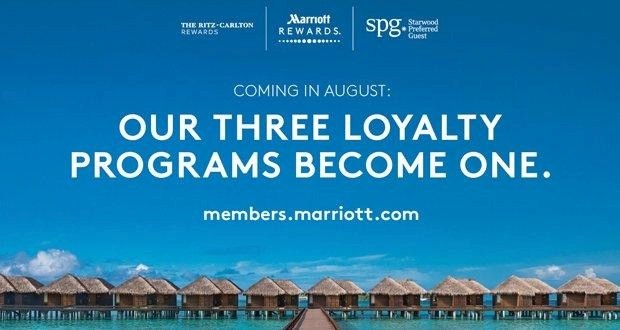
That migration is the single most useful benchmark in the loyalty program's history: when a fragmented loyalty base is consolidated correctly, member share grows. When it is done badly, members churn to competitors.
Bonvoy did it correctly, and the result is the largest, deepest, and most operationally integrated hospitality loyalty program in the world.
But size is not the reason Bonvoy is the hospitality loyalty benchmark. The reason is that this hotel loyalty program covers the full travel decision tree – not just the hotel night, but everything around it.
Their members earn:
when they book a stay
when they book a tour
when they ride with Uber
when they buy a Starbucks coffee linked to their account, and
when they spend on a Marriott co-branded credit card.
The Bonvoy loyalty program turns hospitality from a single transaction into a continuous relationship, and that is the real lesson for anyone designing a hospitality loyalty program – or, more broadly, any loyalty program built to compete with platform-scale aggregators.
The Membership Page: Designing the Front Door
The Marriott Bonvoy membership page is the most-trafficked entry point into their loyalty program, and it does something most loyalty landing pages do not. It leads with outcomes.
Information Hierarchy: Benefits → Tiers → Join
The Bonvoy membership page is structured around three questions a prospective member is actually asking: What do I get? How do I move up? How do I join? In that order. Most loyalty pages I have audited do the opposite – they lead with mechanics ("Earn 10 points per dollar...") and bury the outcome the member actually cares about ("...for free nights at over 9,000 hotels").
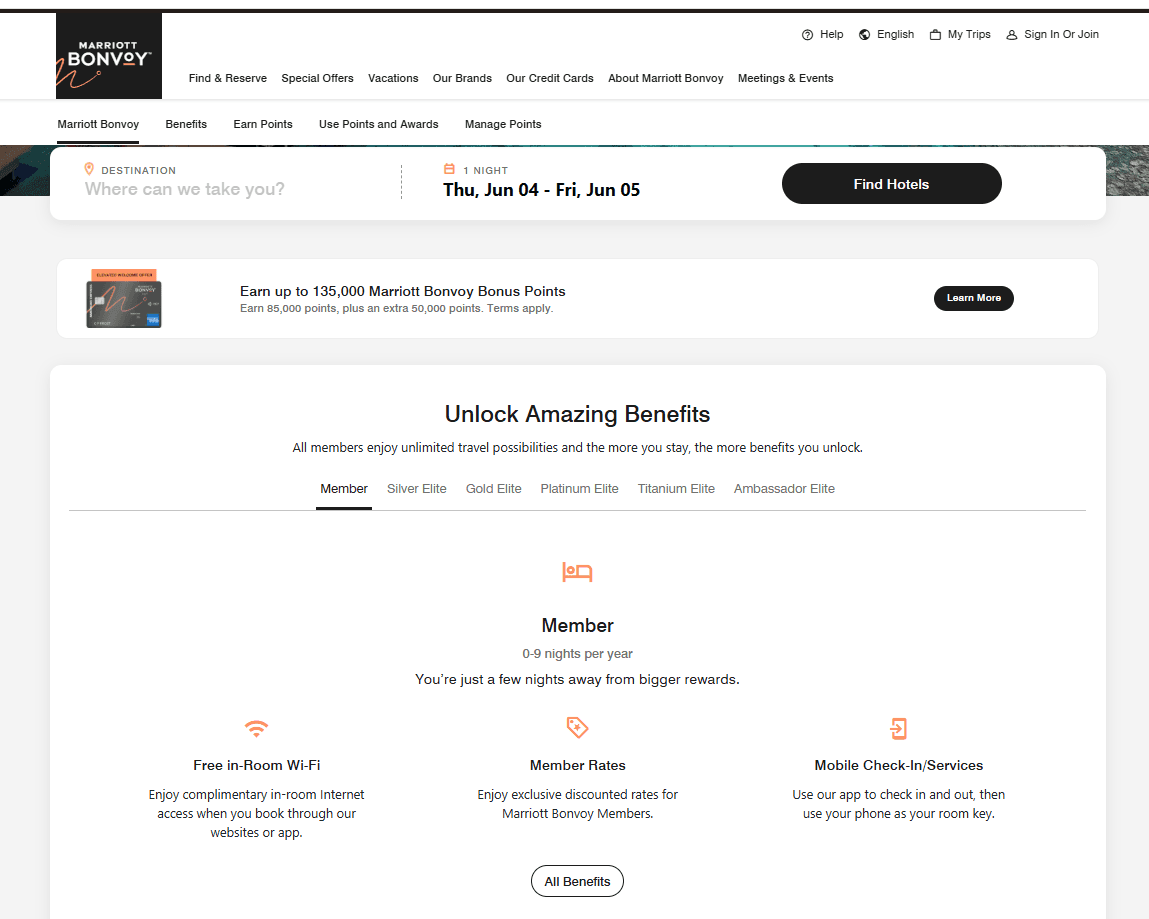
Marriott Bonvoy’s membership page with benefits, how to earn and use points, and ways to explore sections
The Bonvoy landing page leads with what a member can do: free nights, room upgrades, exclusive Moments experiences. Only after the outcome is established do the mechanics appear. That sequencing matters because the join decision is emotional, not analytical, and the membership page has roughly 15 seconds to make the emotional case before the visitor leaves.
Lead with Outcomes, Not Mechanics
In my experience, the biggest single conversion lift on a loyalty landing page comes from rewriting the headline to describe the destination, not the journey. "Earn points faster with our tiered loyalty program" is mechanics. "Free nights at hotels in 140+ countries" is the outcome. Both are accurate. Only one of them sells.
What You Can Steal – US/EU Parallels
If you are designing a loyalty landing page for a non-hospitality product, the structural lesson translates directly: lead with what the member will get, not how the loyalty program works.
Sephora's Beauty Insider landing page leads with "Earn rewards on every purchase" followed immediately by visible reward examples – not by an explanation of points-per-dollar mechanics.
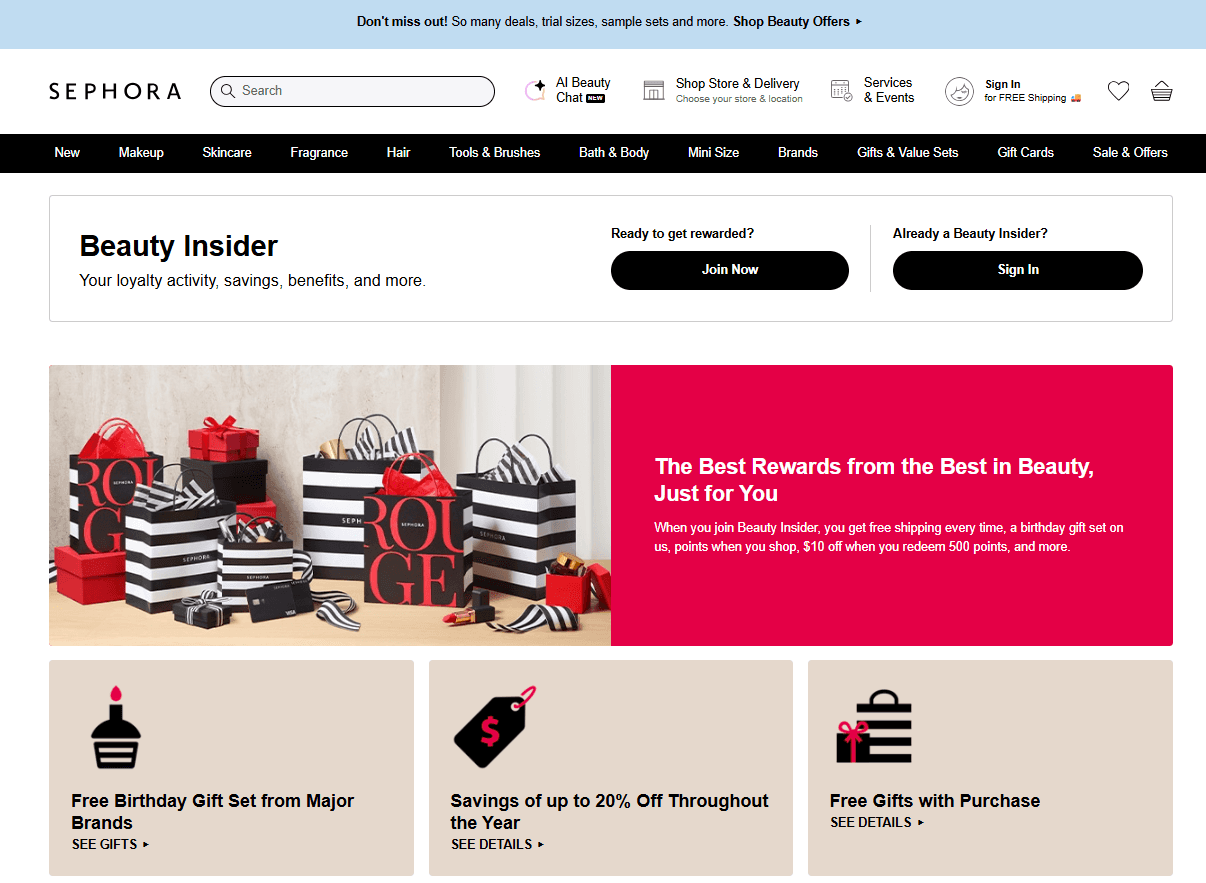
Sephora’s Beauty Insider loyalty landing page with benefits, exclusive rewards, tiers and more.
Nike loyalty program’s membership page leads with "Become a Nike Member" and the perks that follow, not with the structure of how membership works.
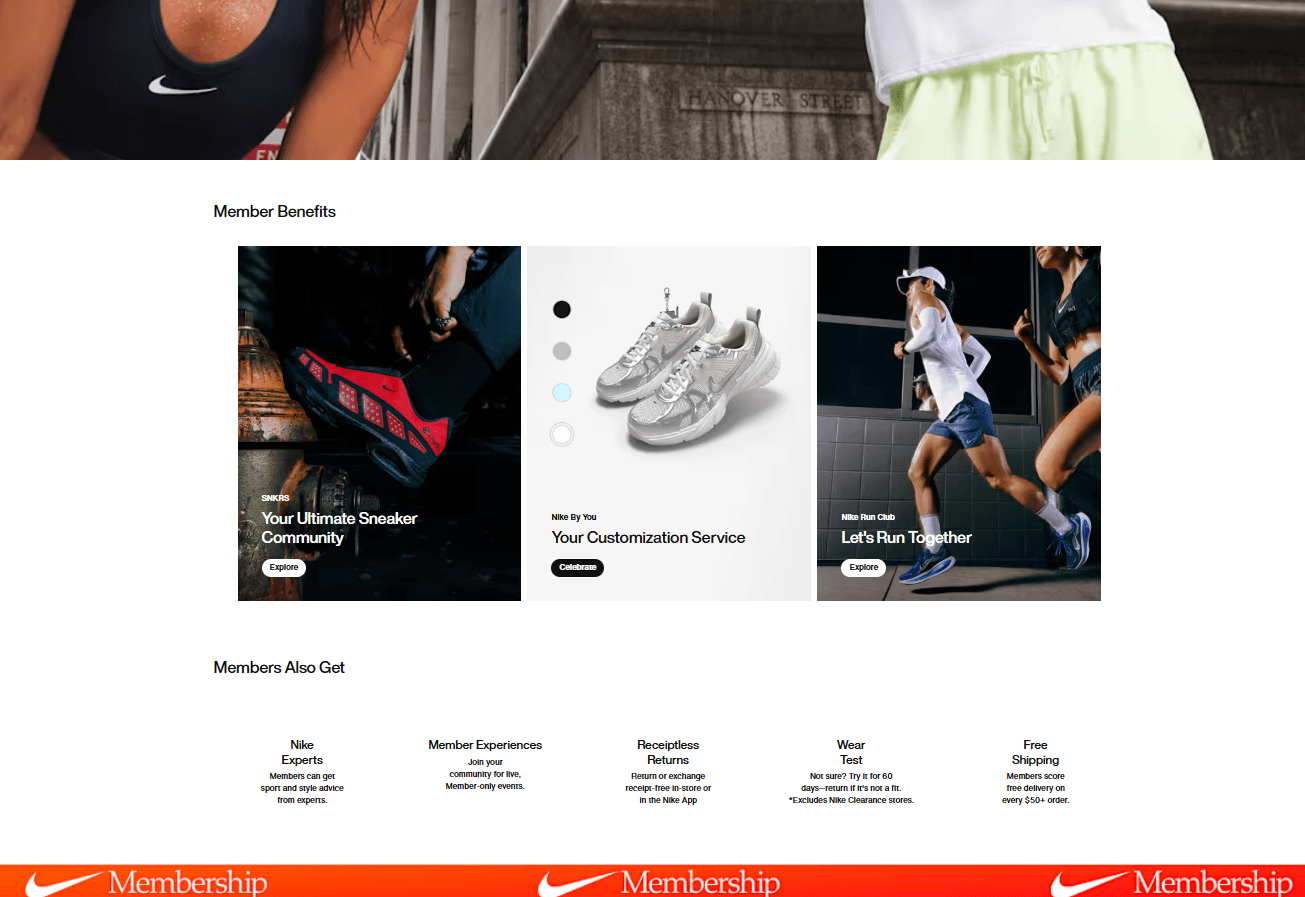
Nike’s loyalty landing page with distinct benefits and perks.
Three pages, three industries, one consistent design principle: outcome first, mechanics second, join third.
Enrollment: Removing Friction at the Front Door
Bonvoy's enrollment is deliberately short – name, email, password, country. That is it. Date of birth, travel preferences, communication preferences – every secondary detail is collected progressively, after the account exists.
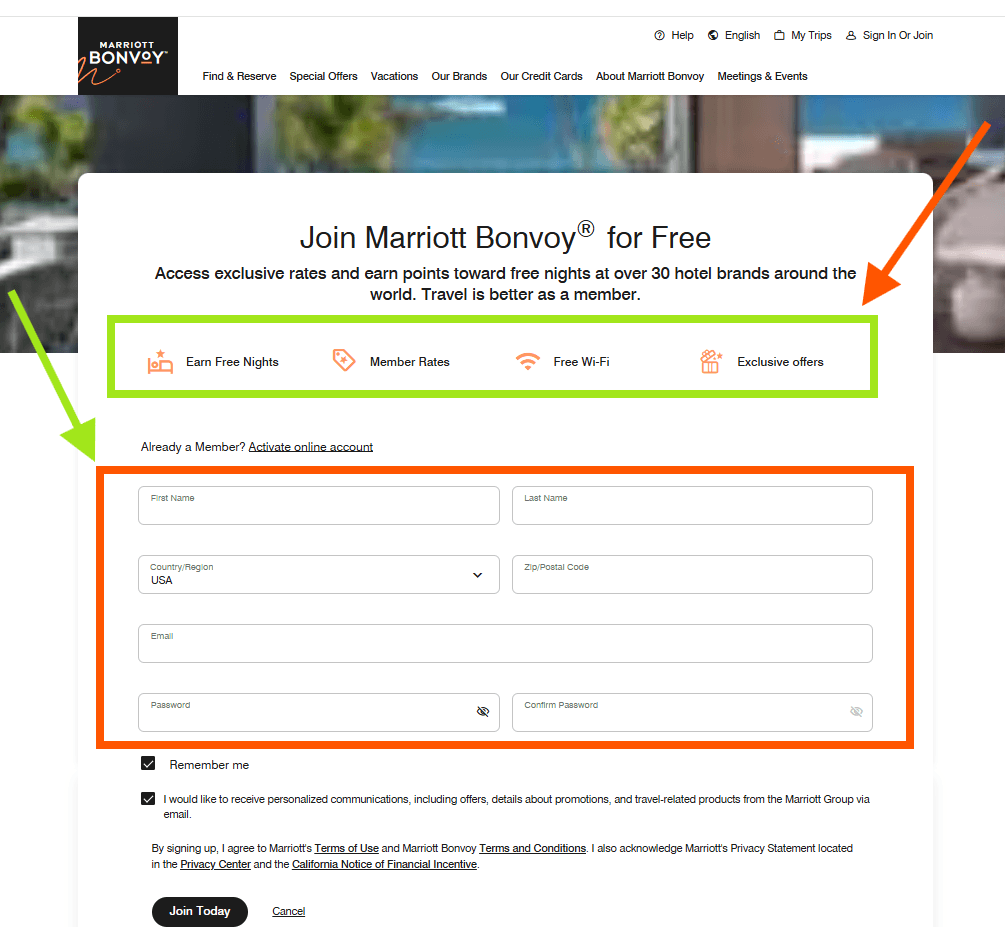
Bonvoy loyalty program’s join page with a minimum of information to fill in and membership benefits
This is a critical design choice. Every additional field in a signup form reduces completion. According to NP Digital’s research, conversion drops measurably for each form field added beyond the essentials. Bonvoy treats the email capture as the conversion event. Everything else is a later conversation.
The Math of Join-Loyalty-Program Form Fields
Here's the basic calculation I'd run before adding any field to a loyalty signup form: what is the marginal value of this data versus the marginal drop in completion? In most cases, the field can be collected later, in-app, after the member has experienced enough value to be willing to share. Defer everything that can be deferred.
Six Tiers: A Progression Ladder That Drives Stay Frequency
Most loyalty programs have three tiers. Bonvoy has six. Far from being a superficial detail, this architectural decision is the core engine behind this hospitality loyalty program's retention economics.
The Six Membership Tiers in Detail
Here is the full structure of the Marriott Bonvoy tiers, based on the loyalty program's official eligibility criteria:
Bonvoy Membership Tier | Qualifying Nights per Year | Additional Requirement | Base Earning Bonus | Key Visible Benefit |
|---|---|---|---|---|
Member | 0–9 nights | — | 0% | Mobile check-in and mobile key, complimentary in-room Wi-Fi, exclusive rates |
Silver Elite | 10 nights | — | +10% | Priority late checkout, member rates, complimentary in-room Internet access |
Gold Elite | 25 nights | — | +25% | Enhanced room upgrade, 2 p.m. late checkout |
Platinum Elite | 50 nights | — | +50% | Enhanced Suite upgrade, Annual Choice Benefit, 4 p.m. late checkout , welcome gift choice |
Titanium Elite | 75 nights | — | +75% | 5 Nightly Upgrade Awards, Annual Choice Benefit, 4 p.m. late checkout, welcome gift choice |
Ambassador Elite | 100+ nights | $23,000 annual qualifying spend | +75% | Dedicated Ambassador, Your24, 4 p.m. late checkout, welcome gift choice, and others |
Source: Marriott Bonvoy Elite Status help page
Bonvoy Elite members are the program's economic engine, and the Marriott Bonvoy Elite tiers above Platinum exist specifically to retain the loyalty program's highest-value frequent travelers – the segment where competing brands fight hardest.
Why Six and Not Three
The six-tier loyalty structure does something a three-tier structure cannot: it gives nearly every active member a next tier in visible reach. A guest with 8 qualifying nights is two nights away from Silver. A Gold member at 38 nights is 12 nights away from Platinum. A Platinum at 62 nights is 13 nights away from Titanium.
That proximity matters because tier proximity is what drives marginal stay decisions. The guest deciding between Marriott and a competitor for a one-night business trip is not deciding on amenity quality – they are deciding on whether this stay closes the gap to the next tier. The closer the gap, the more weight loyalty pulls into the decision.
Three tiers create three motivational zones. Six membership tiers create six motivational zones. For a hotel loyalty program where the strategic goal is maximizing share of nights, that math is decisive.
The Ambassador Trap – Spend Gate at the Top
Ambassador Elite has a feature no other Bonvoy tier has: a spend gate of $23,000 in annual qualifying spend, on top of the 100-night requirement. This is the only Bonvoy membership tier where stay frequency alone is not enough.
The spend gate solves a specific problem: it separates the high-value Ambassador segment from the merely high-frequency Titanium segment. A 100-night-a-year guest staying at the cheapest Marriott property is not the same customer as a 100-night-a-year guest averaging $230 per night at JW Marriott and Ritz-Carlton properties. The spend gate ensures the top tier's privileges – including a dedicated Ambassador and Your24 (the ability to set your own check-in/check-out time) – are reserved for the latter.
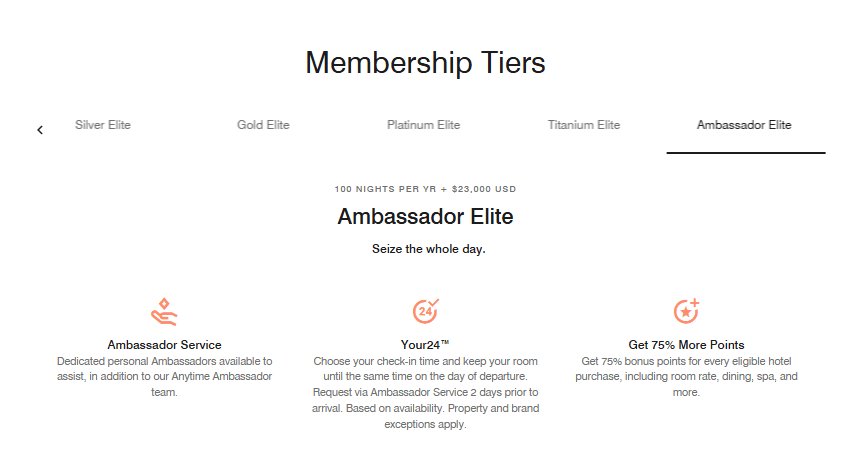
Annual Choice Benefits – Personalization at the Top
At Platinum and above, Bonvoy members can choose an Annual Choice Benefit from a menu – five Nightly Upgrade Awards, a free night certificate, a charitable donation, gift points, or other options. The mechanic is small. The signal it sends is large: we recognize that 50-night-a-year guests have different priorities, and we let them choose.
For a tiered loyalty program of any scale, choice at the top tier is one of the highest-leverage personalization mechanics available. It costs the loyalty program almost nothing in incremental margin (the member is choosing between options that are roughly equivalent in cost) and delivers a meaningful uplift in perceived personalization.
Point Accrual Across the Travel Lifecycle
Most hotel loyalty programs reward the stay. Bonvoy rewards everything around the stay. That difference is what turns Marriott Bonvoy points from a hotel currency into something closer to a travel wallet.
Mapping the Entire Travel Decision Tree
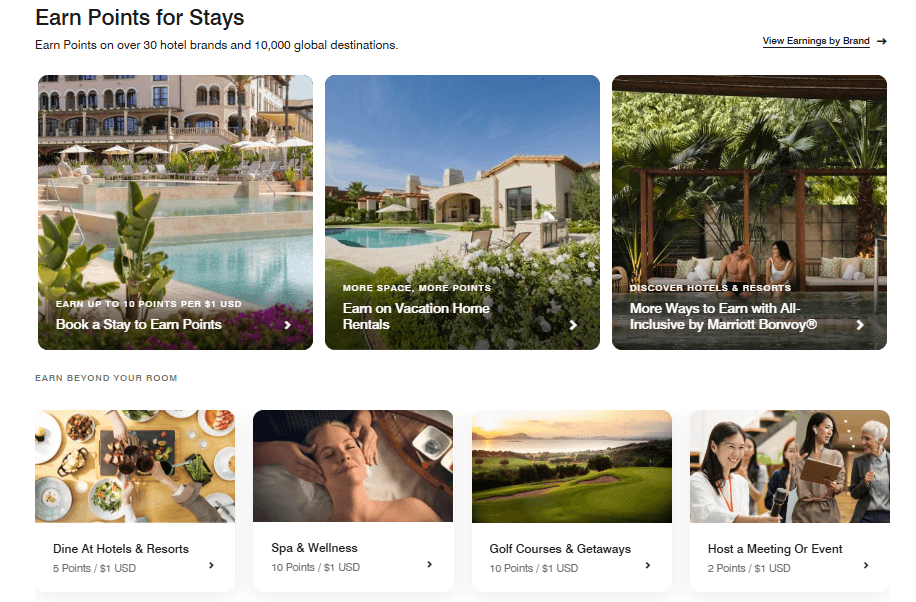
A member earns Bonvoy points across the following surfaces:
Hotel stays and beyond the room
10 base points per dollar at most brands; 5 at extended-stay brands; 4 at StudioRes; 2.5 at Marriott Executive Apartments.
Co-branded credit cards
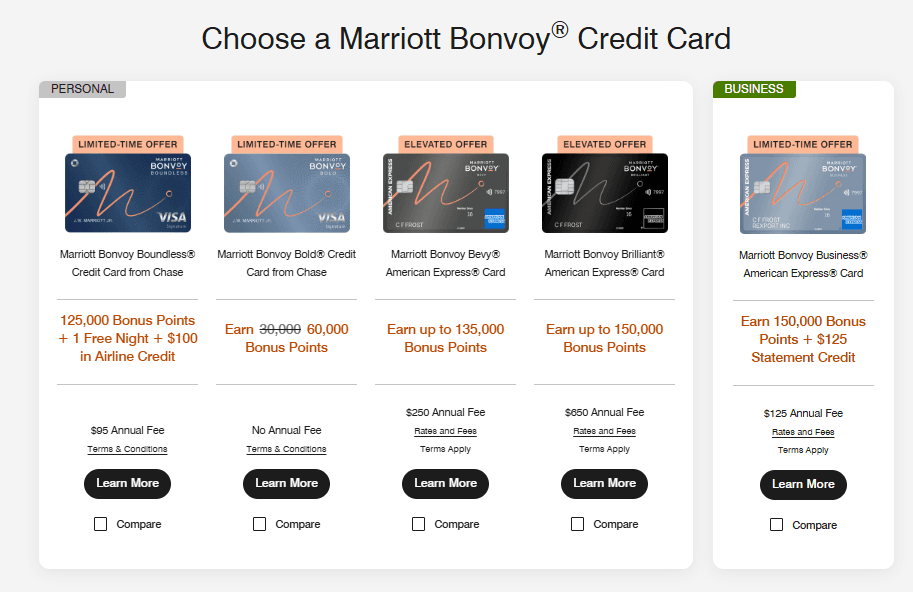
Five US Marriott Bonvoy cards stack three earning layers on a hotel stay – the card-issuer multiplier (typically 6×), Marriott's base 10× for being a member, and the elite-status bonus that comes with the card. Outside of stays, each card has its own bonus categories – restaurants and direct-booked flights on the Brilliant; restaurants and US supermarkets on the Bevy; combined gas, grocery and dining on the Boundless – so the right card depends on what a member actually spends on between trips.
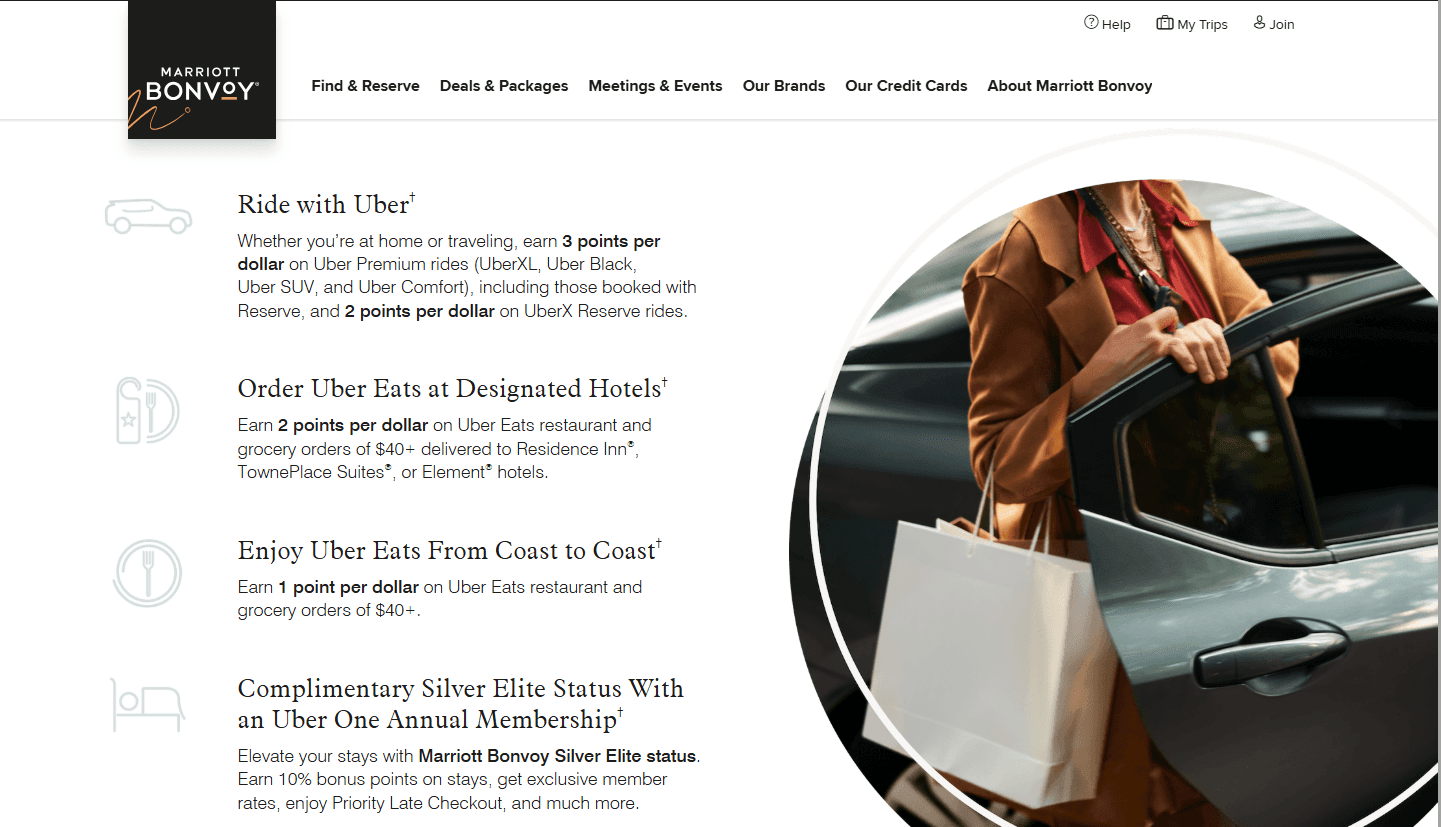
Uber rides
Up to 3 points per dollar on rides linked to a member's Bonvoy account and other benefits.
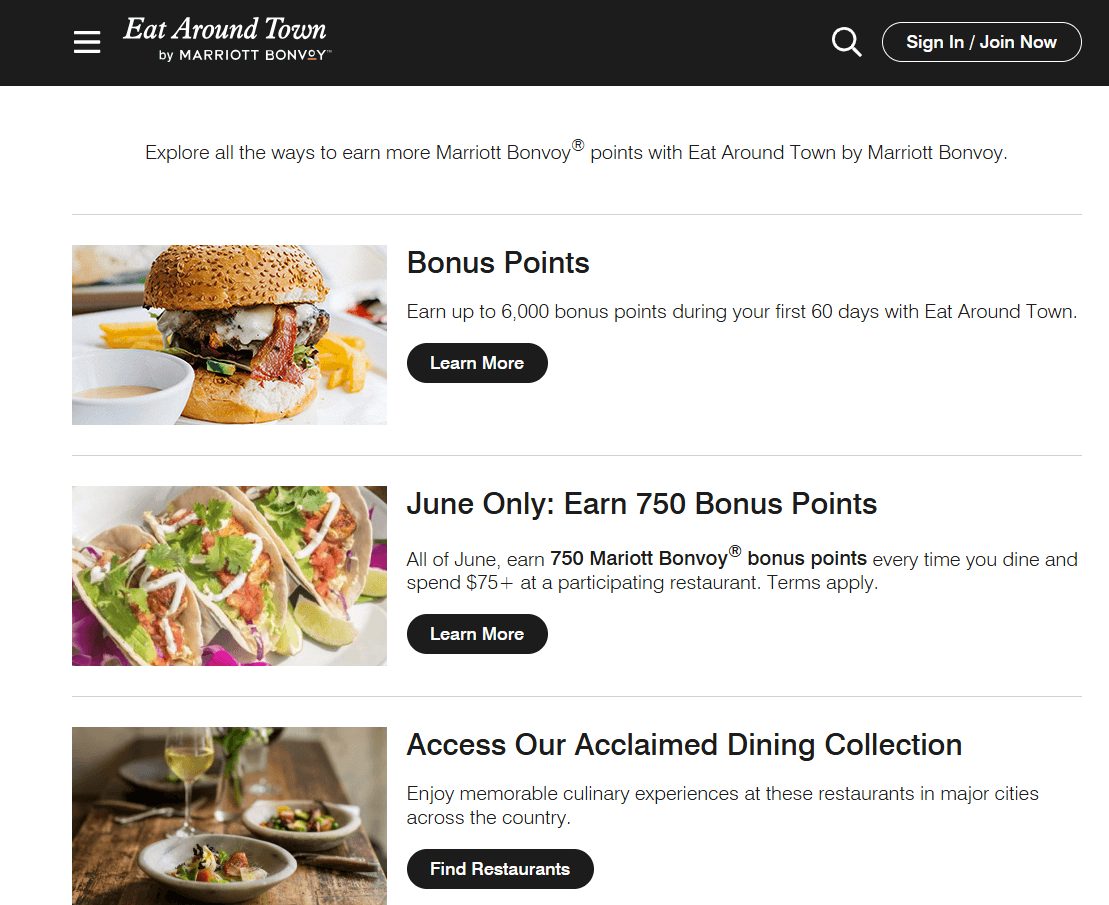
Eat Around Town dining program
Up to 4 points per dollar at participating restaurants when a linked card is used and more ways to earn more Marriott Bonvoy points.
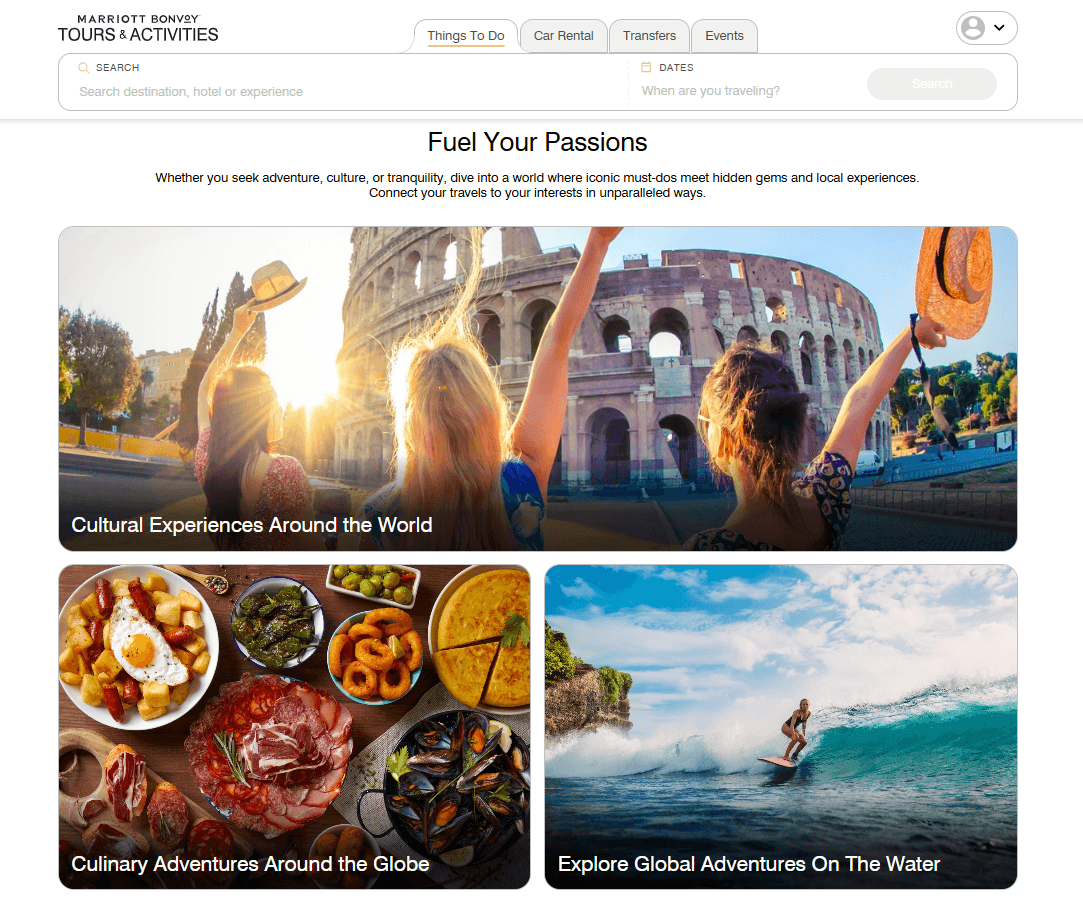
Marriott Bonvoy Tours and Activities
Up to 10 points per dollar on booked experiences across 10,000+ destinations.
Marriott Bonvoy Boutiques
Retail redemption and purchase activity.
=
One redemption mechanic worth calling out here, because it changes the unit economics of award stays: on free-night redemptions of five or more consecutive nights, the fifth night is free. A five-night stay at a 50,000-point-per-night property costs 200,000 points, not 250,000 – an effective 20% discount on every long-stay redemption.
Marriott members can also transfer points 1:1 from American Express Membership Rewards, Chase Ultimate Rewards, and Bilt Rewards, or convert points into airline miles across roughly 40 partner programs (United MileagePlus is the strongest, with a 5,000-mile bonus on every 60,000 Bonvoy points transferred).
The Wallet-Share War Beyond the Core Purchase
The strategic point is not the partner list. It is the decision tree that the partner list covers.
A traveler planning a trip makes a chain of related decisions:
how to get to the airport
how to get from the airport to the hotel
where to eat
what to do, and
what to bring home.
Bonvoy is present in nearly every node of that tree. Every node that is covered is a node where the loyalty program pulls the decision toward Marriott. Every node that is missed is a node where a competitor can win share.
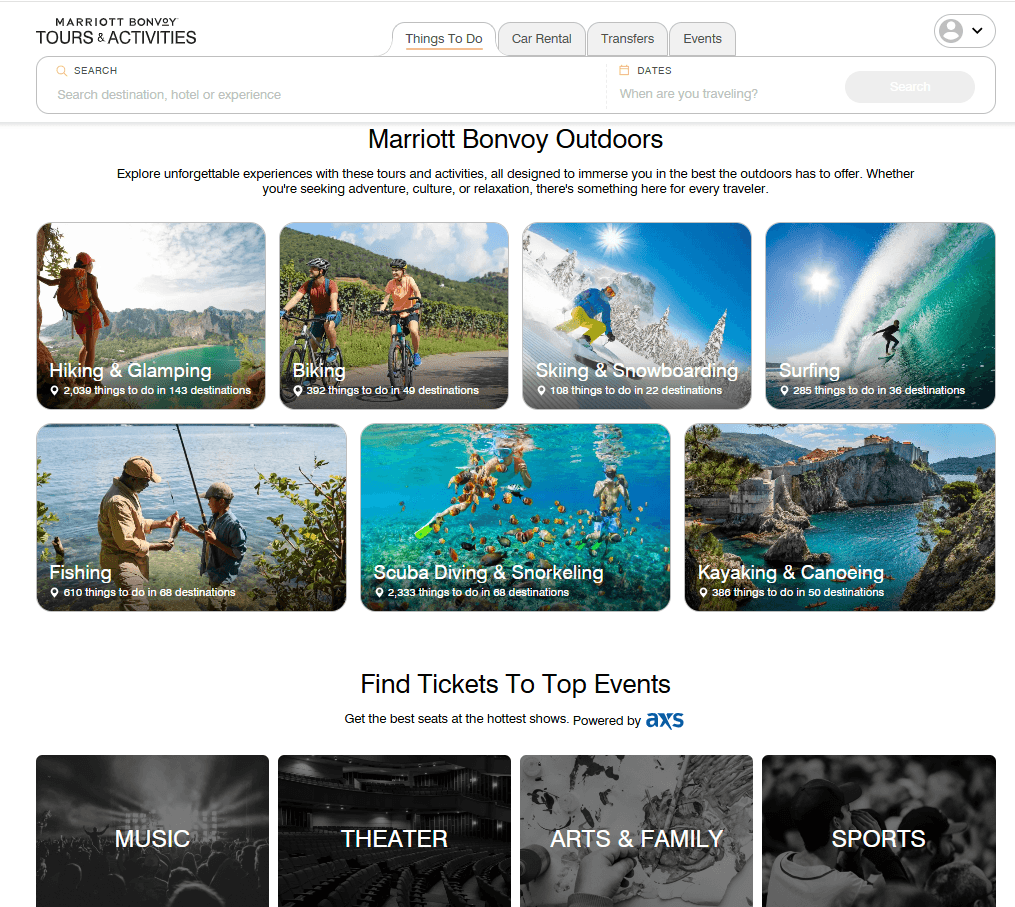
This is what people mean when they say loyalty programs have moved from being about repeat purchase to being about wallet share.
The unit of competition in hospitality loyalty program is no longer the booking – it is the entire trip.
Beyond Hospitality – How to Apply This
The transferable principle is simple: map the full decision tree your customer makes around your core purchase, not just the purchase itself.
A retailer's decision tree includes the inspiration phase, the comparison phase, the purchase, and the after-care.
A fintech's decision tree includes goal-setting, transaction, monitoring, and review. Each non-purchase node is an engagement opportunity that loyalty mechanics can reward.
For loyalty programs built without Bonvoy's partner network, the cleanest way to extend reward surfaces beyond the core purchase is event-based rewards tied to in-product behaviors, so you can reward referral, profile completion, content engagement, and other non-transactional actions inside the same loyalty currency as the transactional ones.
Reward the whole journey, not just the purchase
Event-based missions for every non-transactional action.

Marriott Bonvoy Moments: The Experiential Rewards Layer
If Marriott Bonvoy points are the loyalty program's currency, Marriott Bonvoy Moments are its emotional currency. Moments is the layer that makes the loyalty program memorable – not because the rewards are larger, but because they are categorically different from what every competing hospitality loyalty program offers.
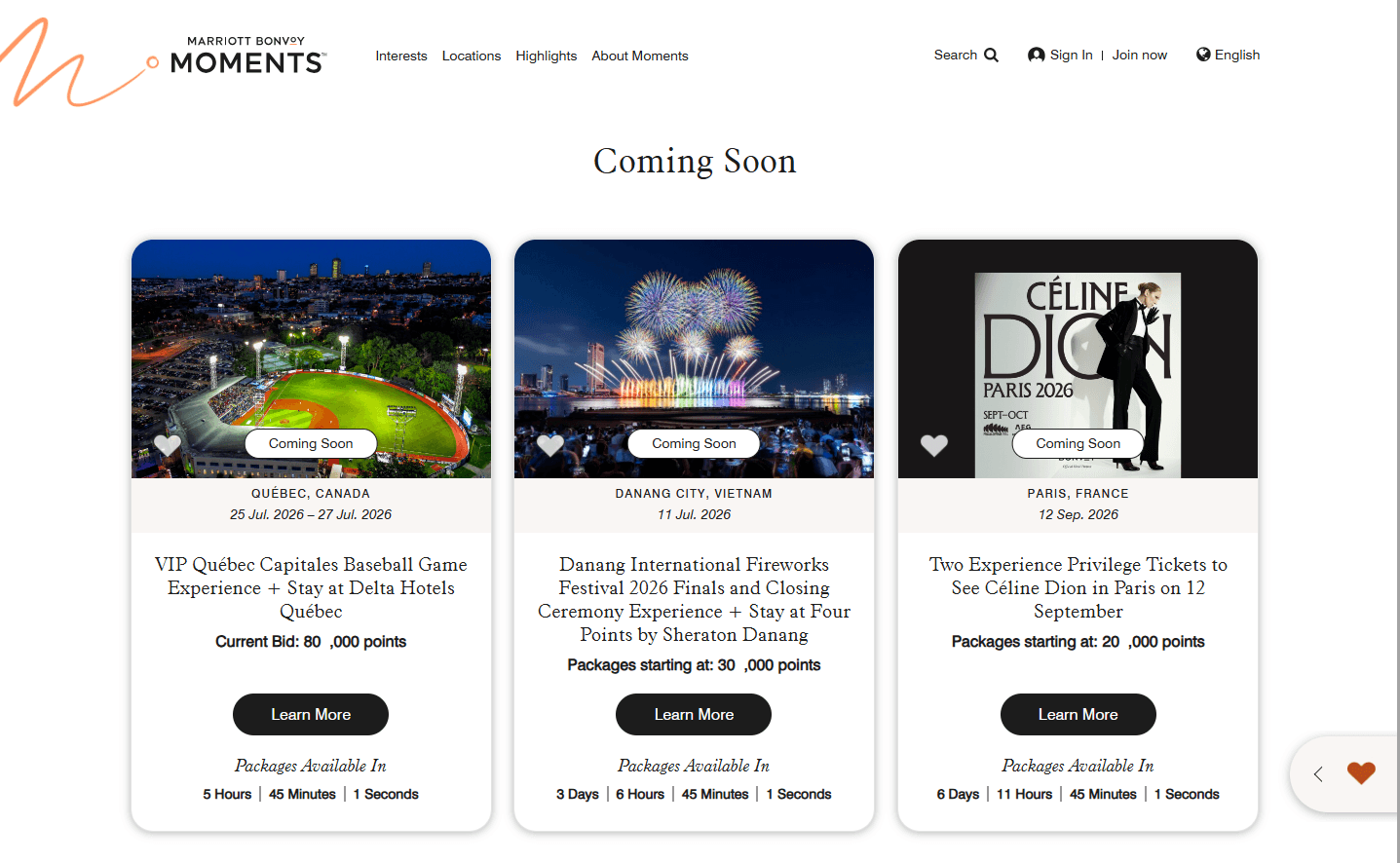
What Moments is – Catalogue of Experiences
Marriott Bonvoy Moments lets members redeem points (via fixed-price purchases or competitive auctions) for experiences in four categories: Culinary, Entertainment, Arts & Lifestyle, and Sports. Past examples have included VIP NCAA March Madness packages, behind-the-scenes red-carpet access at the MTV VMAs, Carnival in Rio, surfing with a pro in Ericeira, and dinners with celebrity chefs.
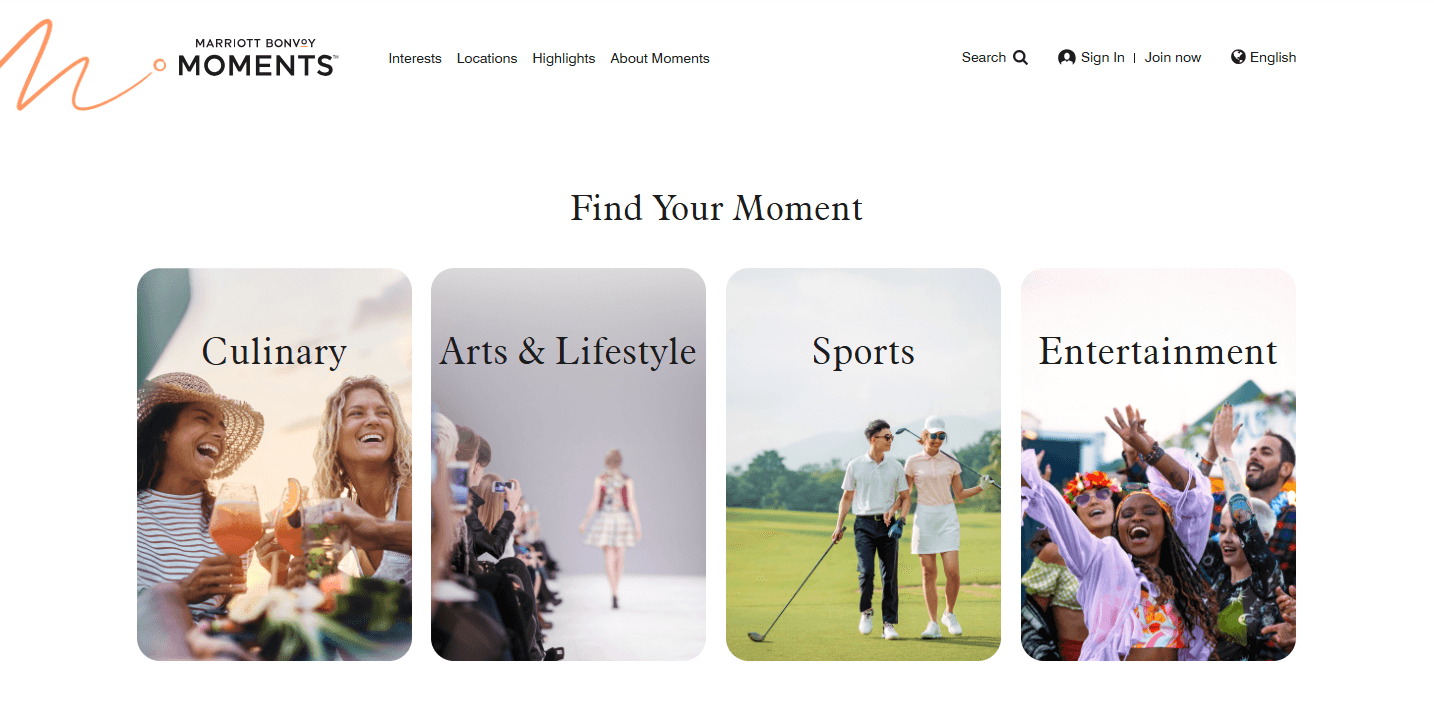
Beyond the standard catalogue, Bonvoy runs 1-Point Drops – Moments that members can access for one Bonvoy point, designed to make the experiential layer accessible to newer or lower-balance members who could not otherwise compete for high-bid auctions.

Source: Marriott Bonvoy launches One Point Moment Drops with an experience from Dos Hombres.
The mechanic is brilliant: it preserves the aspirational positioning of Moments while solving the accessibility problem that experiential tiers typically have.
Why Experiences Beat Discounts
There is consistent research behind the strategic move toward experiences. Gartner research has found that interest in experiential loyalty benefits has grown by 5% since 2018, while interest in transactional benefits has shown a slight decline over the same period.
Gartner has also predicted that by the end of 2026, loyalty programs integrating transactional and experiential benefits will surpass those based solely on points. Bonvoy Moments is the most fully realized version of that prediction in the market.
The reason experiences outperform discounts is psychological, not economic. A discount is rational – the member calculates whether the saving justifies the behavior. An experience is emotional – the member doesn't calculate, they aspire. Aspiration creates the kind of long-term brand attachment that discount-driven loyalty programs structurally cannot.
Adding Experiences to Your Customer Loyalty Program
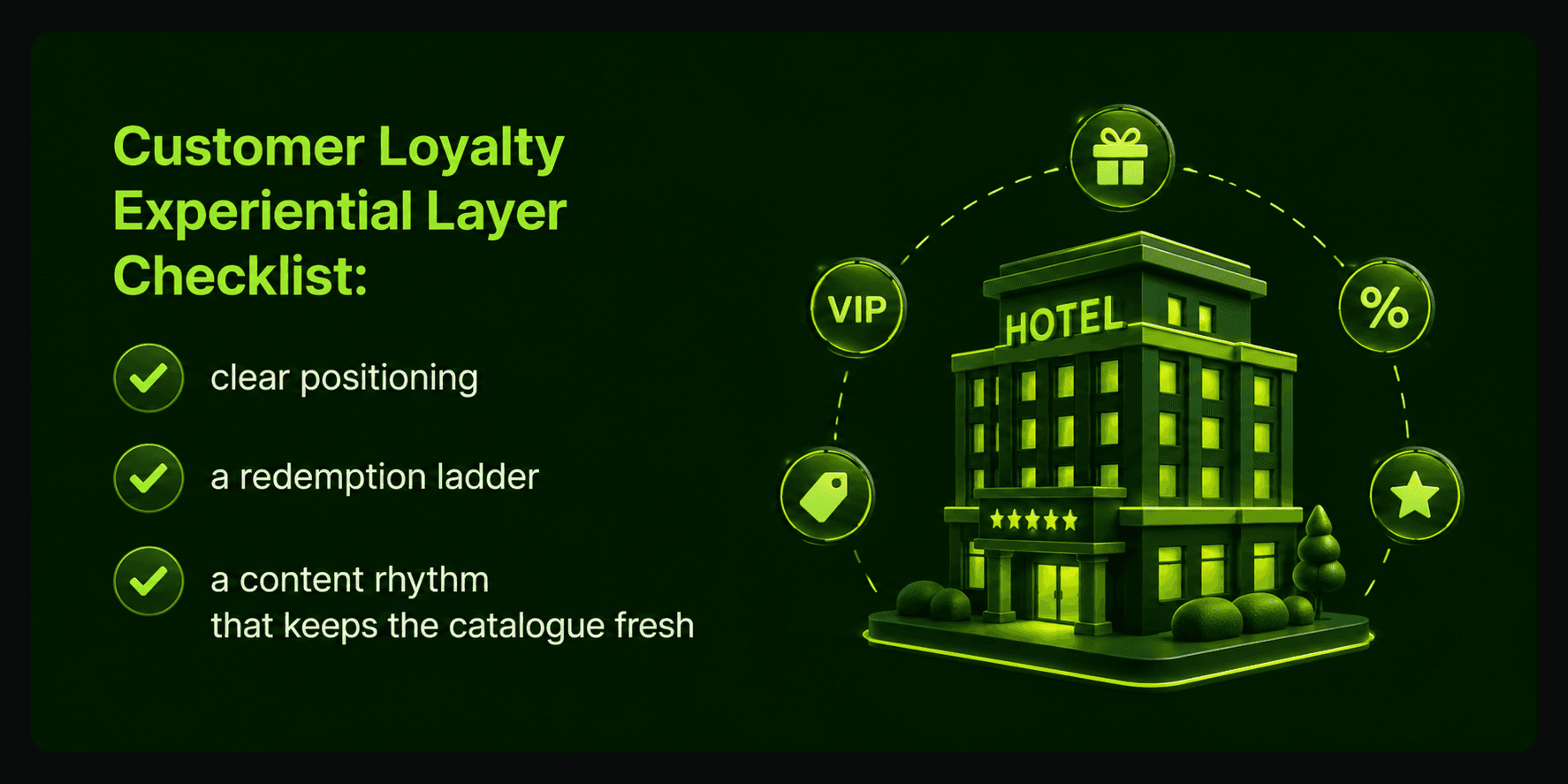
For a loyalty program of any scale, an experiential layer does not require a Marriott-sized partner network. It requires:
a clear positioning ("these rewards are not available anywhere else")
a redemption ladder (most members can access something, top members can access the high-value items), and
a content rhythm that keeps the catalogue fresh enough to drive repeat visits to the rewards page.
Elite Benefits: Why Status Outperforms Points
The single biggest reason guests stay loyal to Bonvoy is not the points. It is the Elite benefits – and specifically, the fact that those Marriott Bonvoy benefits are visible every single stay, not just at redemption.
The Elite Benefits Stack
Here is the full Elite Benefits by Tier matrix as published by Marriott, covering every benefit that meaningfully shifts between status levels:
Elite Benefit | Silver Elite | Gold Elite | Platinum Elite | Titanium Elite | Ambassador Elite |
|---|---|---|---|---|---|
Qualifying threshold | 10 nights/yr | 25 nights/yr | 50 nights/yr | 75 nights/yr | 100 nights/yr + $23K spend |
Ultimate Reservation Guarantee | ✓ | ✓ | ✓ | ✓ | ✓ |
Bonus Points on stays | 10% | 25% | 50% | 75% | 75% |
Priority Late Checkout | Priority | 2 p.m. | 4 p.m. | 4 p.m. | 4 p.m. |
Guaranteed Welcome Gift | — | Points | Points, Breakfast or Amenity | Points, Breakfast or Amenity | Points, Breakfast or Amenity |
Enhanced Room Upgrade | — | ✓ | ✓ (Select Suites) | ✓ (Select Suites) | ✓ (Select Suites) |
Dedicated Elite Support (24/7) | ✓ | ✓ | ✓ | ✓ | ✓ |
Guaranteed Lounge Access | — | — | ✓ | ✓ | ✓ |
Annual Choice Benefit | — | — | At 50 nights | At 75 nights | Included |
48-Hour Room Guarantee | — | — | ✓ | ✓ | ✓ |
Your24™ check-in/out | — | — | — | — | ✓ |
Ambassador Service | — | — | — | — | ✓ |
Emirates Skyward partnership | — | Miles on stays | Miles + priority | Miles + priority | Miles + priority |
Hertz Gold Plus Rewards® (US/CA) | — | — | Fast Track to Five Star® | Five Star® | President’s Circle® |
United MileagePlus® Premier® Silver | — | — | — | ✓ | ✓ |
Source: Marriott Bonvoy Member Benefits. The Ultimate Reservation Guarantee, Dedicated Elite Support, and other base benefits (Mobile Key, Mobile Check-in, exclusive member rates, complimentary Wi-Fi) are available to every member from day one.
Visible Every Stay, Not Just at Redemption
Here is the difference that makes Elite benefits more powerful than points: a member's points balance is invisible until they redeem. Elite benefits are visible every time the member walks into a hotel.
That visibility is what builds the habit. When a Platinum guest is upgraded to a suite they did not pay for, served a welcome amenity in the lounge, and given a 4 p.m. late checkout, the loyalty program is delivering value in real time – and that real-time value is what makes the guest choose Marriott for the next stay, even when a competing brand has a slightly cheaper room.
Points are a future promise. Elite benefits are a present reward. Both matter. Only one of them shows up on the day of the stay.
Visibility vs Liability – The Trade-Off
Elite benefits are not free. The hotels participating in the loyalty program absorb the cost of upgrades, breakfast, and lounge access on award stays. CBRE's 2025 hotel loyalty research found that the average cost per occupied room for loyalty programs is $5.46 – about 1.6% of total hotel revenue. That cost has to be balanced against the increased occupancy and direct-booking share that loyalty members drive (52.8% of occupied rooms in 2024, per CBRE).
The lesson for any tiered loyalty program: visible benefits are more retention-effective than invisible ones, but they create real cost on the operational side. The loyalty program design challenge is making the visible benefits valuable enough to drive loyalty without making them so costly that the unit economics collapse.
The Bonvoy App: Loyalty Where the Guest Actually Lives
The Bonvoy app is the most underrated piece of the entire Marriott loyalty architecture. It is also the piece that most non-hospitality loyalty programs get most wrong.
What the Mobile App Actually Does
The Marriott Bonvoy app handles the full guest journey in one surface:
Booking and search across 9,800+ properties in 145 countries.
Mobile Check-in up to two days before arrival, with a notification when the room is ready.
Mobile Key – using the phone as the room key at thousands of participating properties worldwide. Mobile Key Sharing lets a member share the key with up to three travel companions, removing the front-desk bottleneck for families and small groups.
Mobile Requests and Mobile Chat – chat-based service requests for towels, toiletries, restaurant reservations, or anything else the guest needs, available from 48 hours before check-in through the entire stay.
Mobile Ordering – room service ordering through the app at participating properties.
Wishlists – save, organize, and share dream destinations exclusively on the app.
Account management – points balance, tier progress, redemption, Moments browsing, promotion registration.
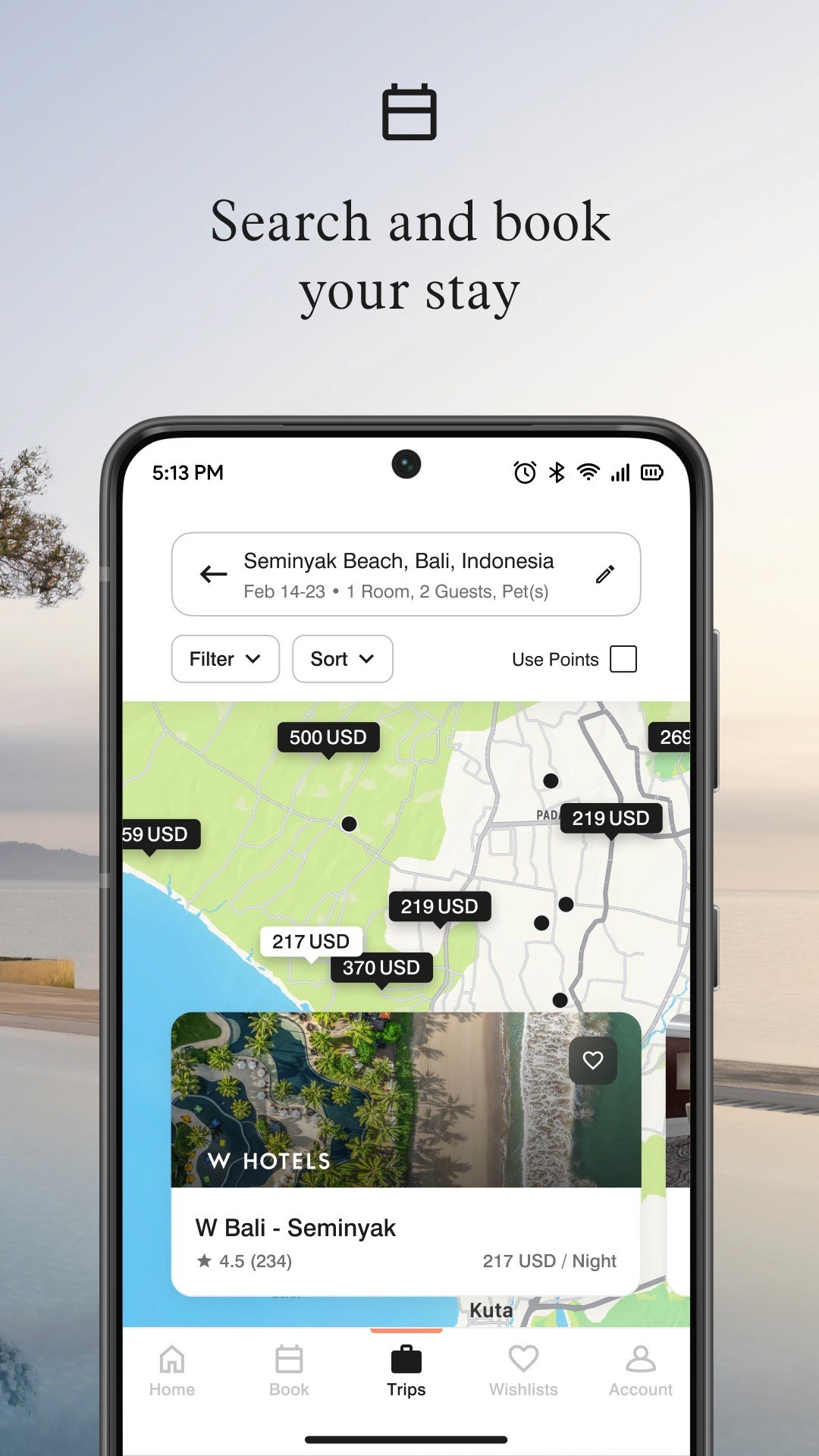
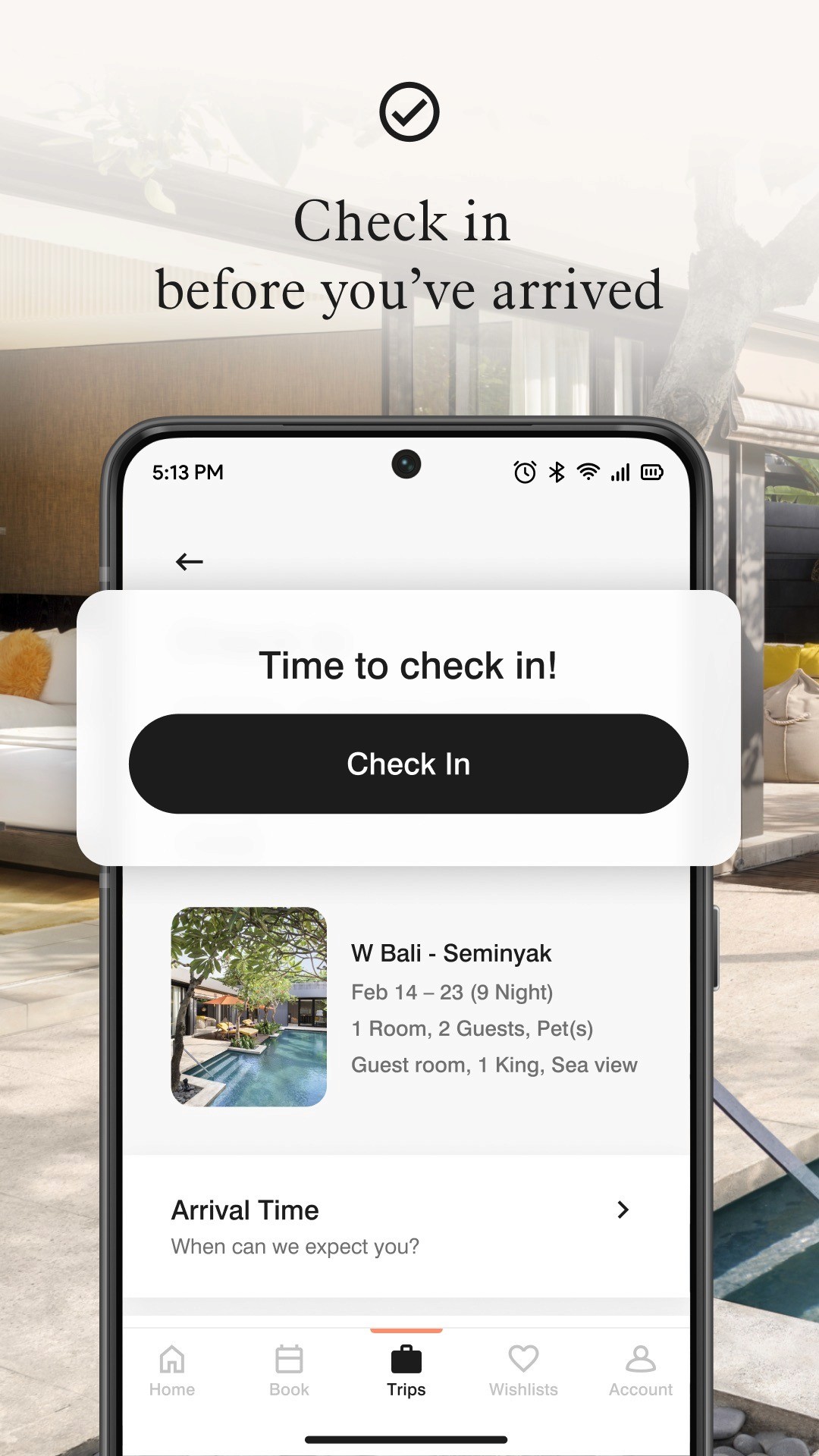
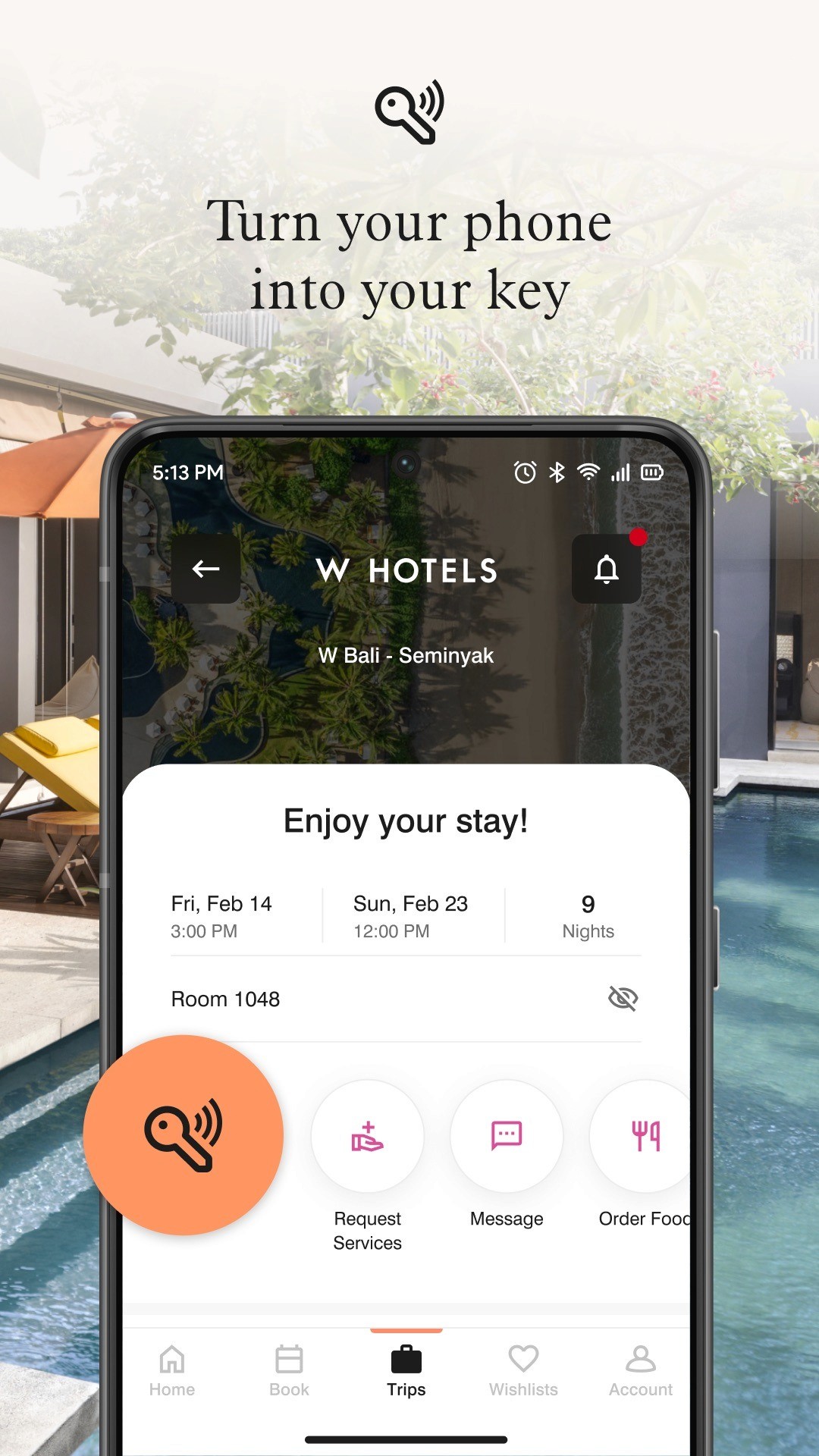
The Only Loyalty Surface That Lives in the Stay
Most loyalty apps are points trackers. The Bonvoy app is the stay itself. The member uses it to check in, to unlock the door, to order breakfast, or to request a fresh towel. The loyalty program is woven into every action the guest takes during the trip – which means the customer loyalty program is reinforced every time the app is opened, not just once a quarter when the member checks their points balance.
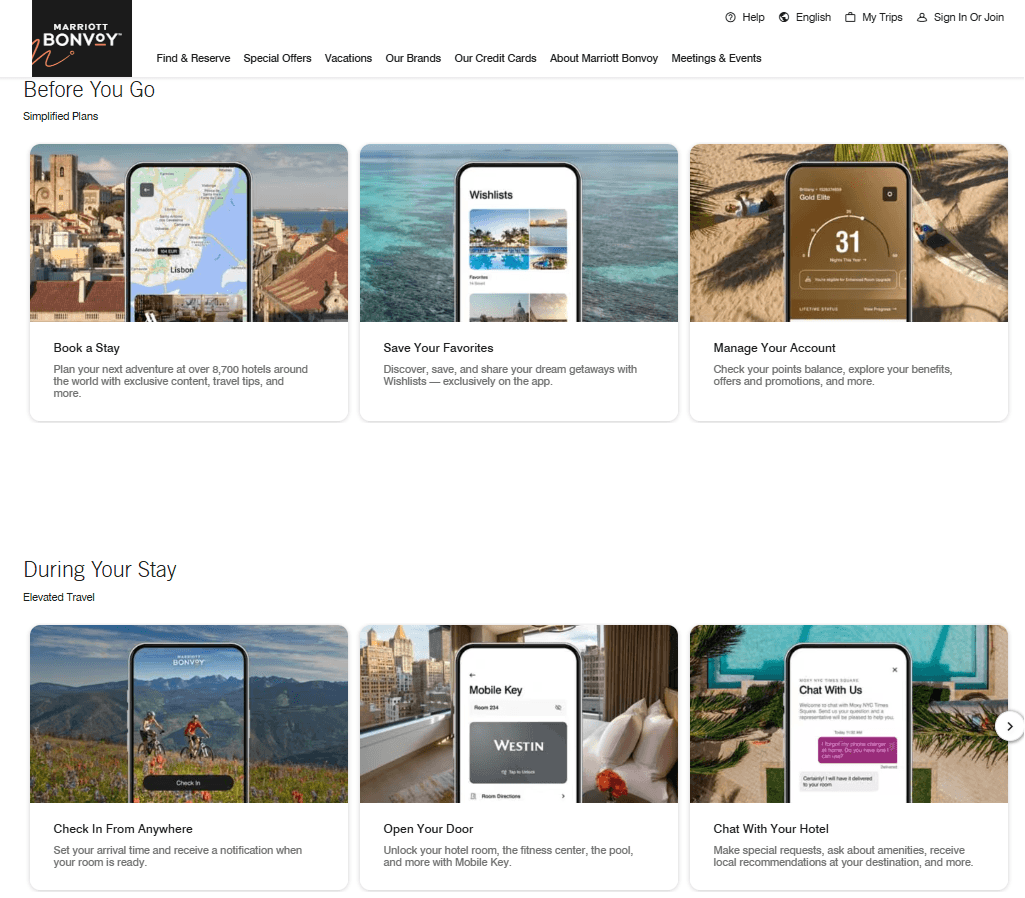
That distinction is the most important lesson of the entire Bonvoy loyalty architecture for any non-hospitality program. The strongest loyalty surfaces are the ones embedded in the core product experience, not bolted on as a separate destination. For digital products in any category, a white-label loyalty surface that sits inside your app – in your visual language, with your tone, branded as yours – does far more for retention than a separate "rewards portal" that the member visits once a month.
The Underplayed Channel – Push Between Trips
The other thing the Bonvoy app does that most loyalty programs underuse: it owns the channel between trips. Push notifications about expiring points, near-miss tier progress ("you're 3 nights away from Platinum"), Moments dropping in your city, and limited-time promotions are all delivered through the app – and the app's role as the in-stay tool is what gets the member to install and keep it installed.
This is the loyalty flywheel that competing customer loyalty programs without a strong mobile app cannot match: the in-stay utility justifies the install 🡪 the install creates the push channel 🡪 the push channel drives re-engagement between stays 🡪 re-engagement drives the next booking 🡪 the next booking creates the next in-stay use.
Each loop reinforces the next.
What Marriott Bonvoy Loyalty Program Gets Right (and Where It Falls Short)
No customer loyalty program is perfect. Here is what an honest Marriott Bonvoy review looks like.
What Works (5 Strengths)
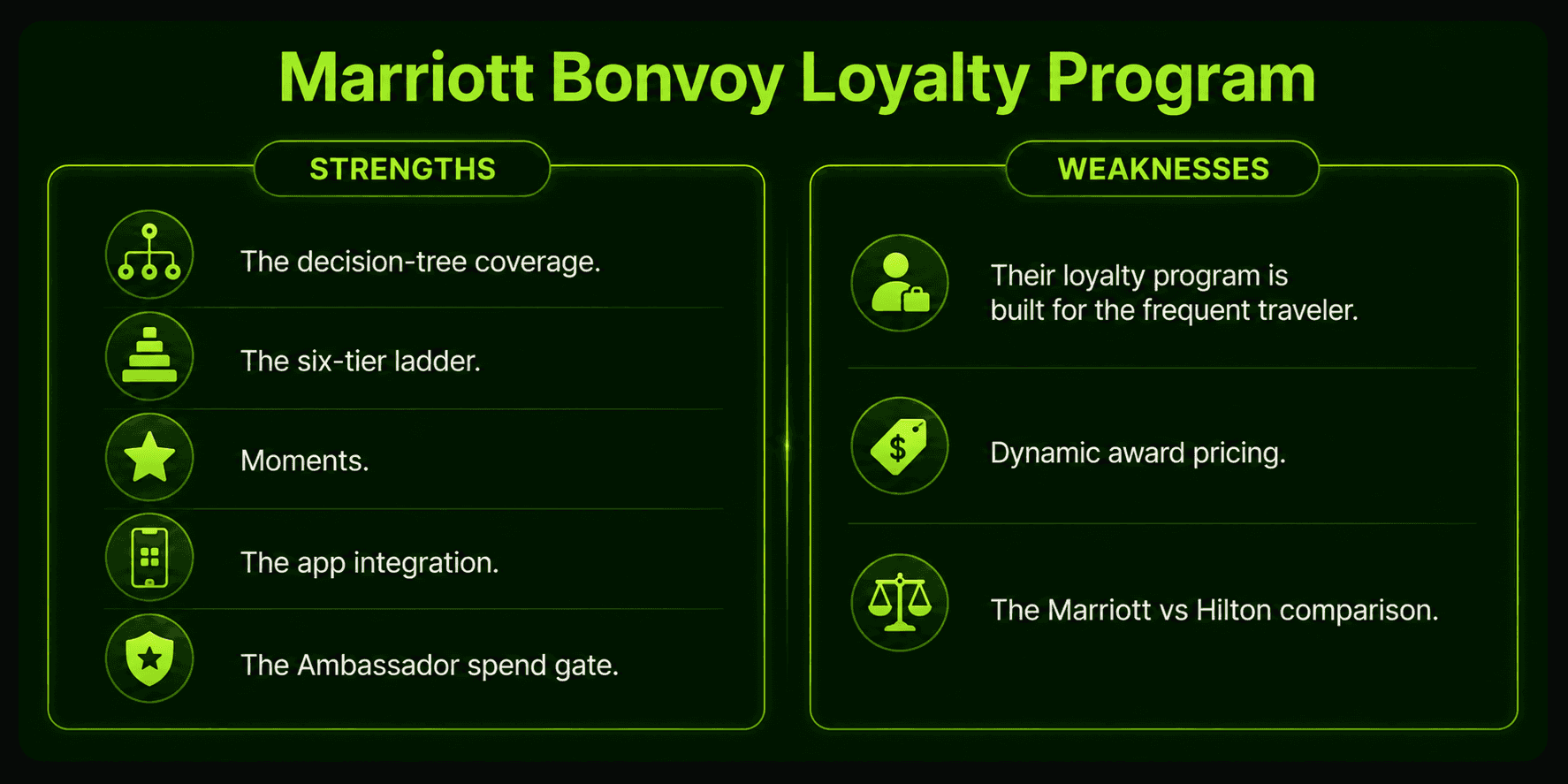
The decision-tree coverage. Points accrual across stays, partners, dining, ride-sharing, and credit cards keeps their loyalty program present at every node of the travel decision.
The six-tier ladder. Tier proximity drives marginal stay decisions in a way three-tier loyalty programs cannot match.
Moments. The experiential layer is the differentiator that competing loyalty programs struggle to copy, because building it requires both the partner relationships and the brand cachet.
The app integration. Mobile Key, Mobile Check-in, and Mobile Requests turn the loyalty program into an operational tool, not a side feature.
The Ambassador spend gate. Filtering the top tier by spend, not just nights, ensures the program's most expensive privileges go to the most economically valuable guests.
Where It Falls Short (4 Gaps)
Their loyalty program is built for the frequent traveler. A member with 4 nights a year gets a fraction of the value the program offers. For competing hospitality loyalty programs targeting infrequent or occasional users, this is an opportunity, not a flaw.
Dynamic award pricing. Marriott introduced dynamic award pricing on free-night redemptions, meaning the points required for a free night vary with cash demand. This is economically rational but erodes the predictability that long-time members valued – and it is a frequent source of complaint among the Marriott Bonvoy review community.
The Marriott vs Hilton comparison. Hilton Honors offers status qualification by nights, stays, or total spend – a more flexible path that some members prefer over Bonvoy's nights-first approach.
Engagement gaps between stays. Even with the app, members who travel quarterly rather than monthly can go weeks without an active engagement touchpoint. Customer loyalty programs with structured habit-loop mechanics (daily streaks, weekly missions) have an engagement advantage here.
That last gap – engagement between transactions – is where most loyalty programs across categories have the largest unsolved problem, and it is the area where Bonvoy's hospitality-specific loyalty architecture does not translate cleanly to loyalty programs in retail, fintech, or telecom where the transaction frequency is different. We will come back to that in the next section.
Is Marriott Bonvoy worth it overall?
For frequent business travelers who can credibly clear 50+ qualifying nights a year, yes – the Platinum-and-above benefit stack (suite upgrades, lounge access, 4 p.m. late checkout, Annual Choice Benefit) consistently outperforms the alternatives.
For occasional leisure travelers staying under 25 nights a year, the value compresses sharply; you earn points and get member rates, but the program's most-valued benefits sit out of reach. The honest framing is that Bonvoy is a frequent-traveler loyalty program with a permissive front door, not a casual-traveler loyalty program with a frequent-traveler tier on top.
Lessons for Designing Your Own Customer Loyalty Program
Here is the part of this teardown that translates beyond hospitality. Bonvoy is a benchmark, but the lessons are architectural – and architectural decisions move across categories.
Below are the five most common gaps I see in loyalty programs across our client base at Enable3, what Bonvoy does (or doesn't) about each, and how to close the gap in your own loyalty program.
If Your Tiers Don't Drive Behavior
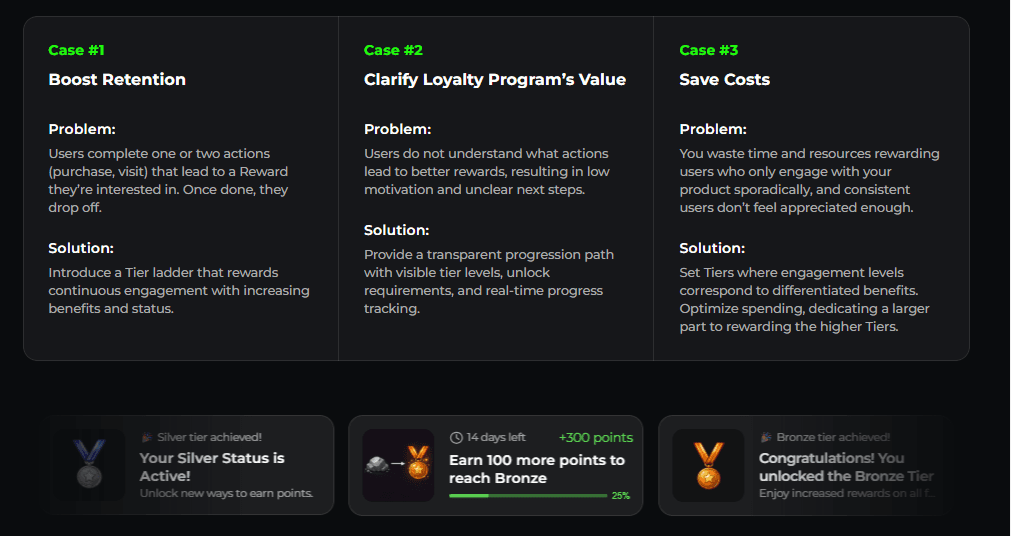
The most common failure mode of a tiered loyalty program is tiers that members cannot see, cannot track, and cannot reach in any reasonable time frame. Members earn a status badge and never interact with it again.
What Bonvoy gets right is making the next tier visible and reachable. The spend gate at Ambassador, the night thresholds at every other tier, and the constant reminders of progress in the app together turn the tier ladder into a behavioral system, not a static badge.
If your tiers don't drive behavior 🡺 Enable3's tiered loyalty program software lets you set tier conditions based on points accumulated, specific actions taken, or membership in a behavioral segment. Tier progression becomes a live mechanic in the member's daily experience, not a label they discover at year-end.
If Your Rewards Are Utility-Only
If every reward in your loyalty program is a discount or a free item, you have built a transactional loyalty program, and transactional loyalty programs are price-comparable to every competitor that runs a sale. The emotional layer is missing.
Bonvoy's answer is Moments. The transferable lesson is that the experiential layer doesn't have to compete on cost with your transactional rewards – it has to differ in kind. An experience your members can't get anywhere else is categorically different from a discount they can find with a search.
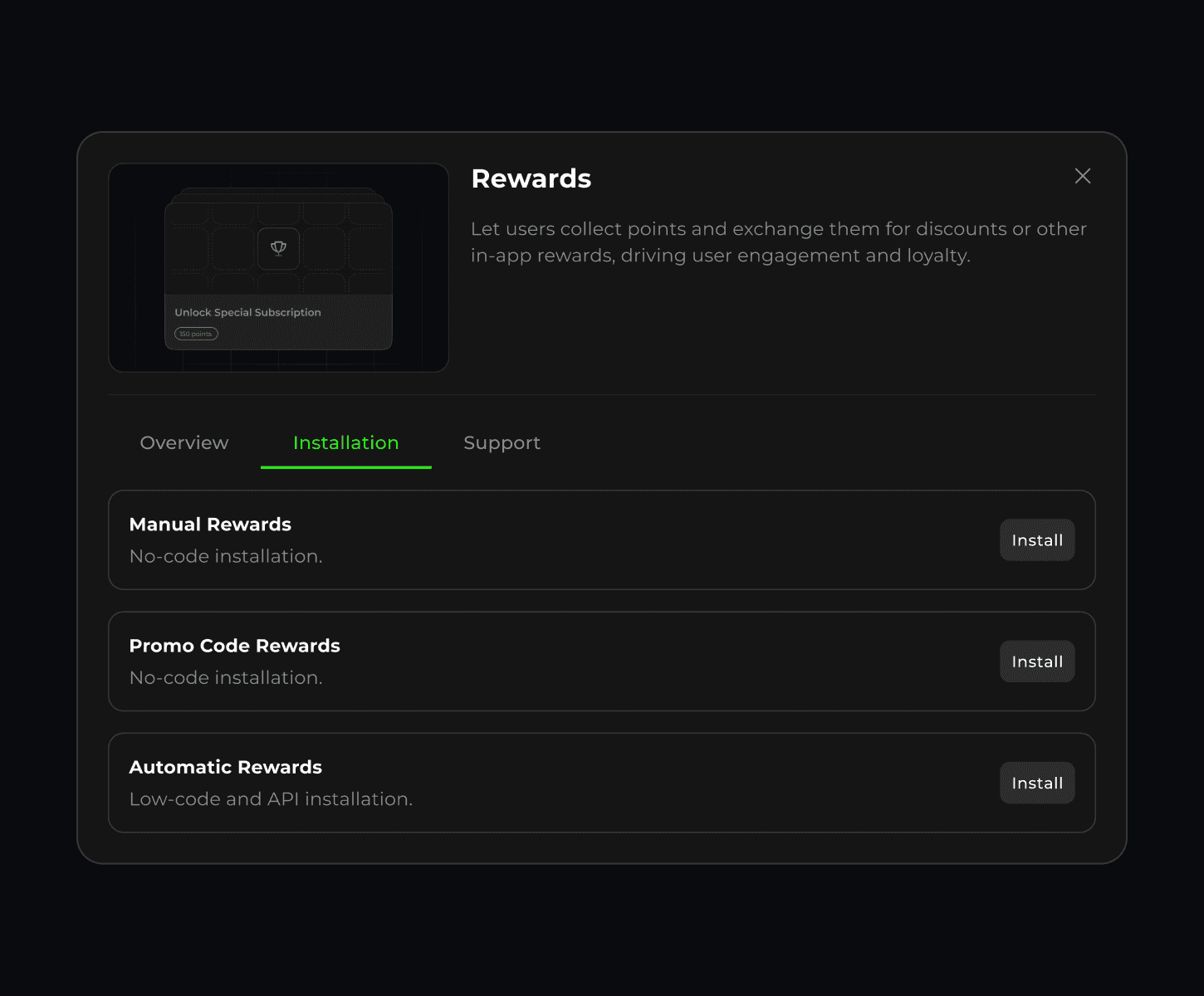
If your rewards are utility-only 🡺 Enable3's rewards engine supports automatic, promo code, and manual reward types in the same program, so you can run transactional and experiential rewards from a single rewards catalogue without separate fulfilment systems.
If Members Go Dark Between Purchases
This is the gap Bonvoy itself doesn't fully solve, and it is the largest single opportunity for customer loyalty programs in any category with non-daily transaction frequency. A member who books one stay a quarter has up to 12 weeks of silence between earning events. In that silence, competitors are accessible, attention drifts, and tier progress stalls.
The solution is to reward behaviors that aren't purchases. Profile completion, content engagement, app session frequency, social sharing, referral, review submission – each of these is an action your member takes between transactions, and each can be tied to a structured reward.
If your members go dark between purchases 🡺 Enable3's gamification engine uses event-based Missions to reward non-transactional behaviors inside the same loyalty system. The result is a member who is engaged daily or weekly, not just at the point of purchase, which is what compounds tier progress and keeps your brand at the front of your member's mind during the silence.
![Enable3-powered hospitality loyalty app interface: 1,500 points balance with Missions, Tap to Earn, Hold to Earn, and Rewards tabs; "Give 25 points, Get 25 points" referral banner inviting friends to the loyalty page; time-bound missions including Review Your Stay (+200 points, 3 days left, 0/1 progress, "share your feedback and help us improve your guest experience"), Refer a Friend (+750 points, 10 days left, 0/1 progress, earn when friend completes first stay), and Participate in a [event] (+500 points, 14 days left) — illustrating gamified mission-based engagement mechanics designed for hotel guest loyalty](https://framerusercontent.com/images/MKxu99WTMWb6EsA1EpyAe3DXMw.png)
If Personalization is Challenging
Every Bonvoy member gets the same first email. Every Platinum gets the same set of Annual Choice Benefits. There is meaningful personalization at the top tiers, but for the vast majority of the 271 million members, the program experience is broadly the same.
For a loyalty program at Bonvoy's scale, that is a defensible trade-off. For a loyalty program at your scale, it usually isn't – you have fewer members, richer data per member, and a higher marginal value of getting each interaction right.
If you have difficulties with personalization at scale 🡺 Enable3's segmentation engine groups members by behavioral dimension (purchase patterns, mission completion, tier proximity, session recency, referral activity) and attaches different missions, rewards, and campaigns to different segments. The same loyalty program runs differently for a high-frequency user, a near-churn user, and a tier-threshold user – all without manual list management.
If Integrating Loyalty Late Means Re-Engineering
The hardest loyalty implementations we see are the ones where the loyalty program is added on after the product has shipped, with a separate database, a separate authentication flow, a separate UI, and a separate analytics stack. Every integration is a custom engineering project. Every change requires a release cycle.
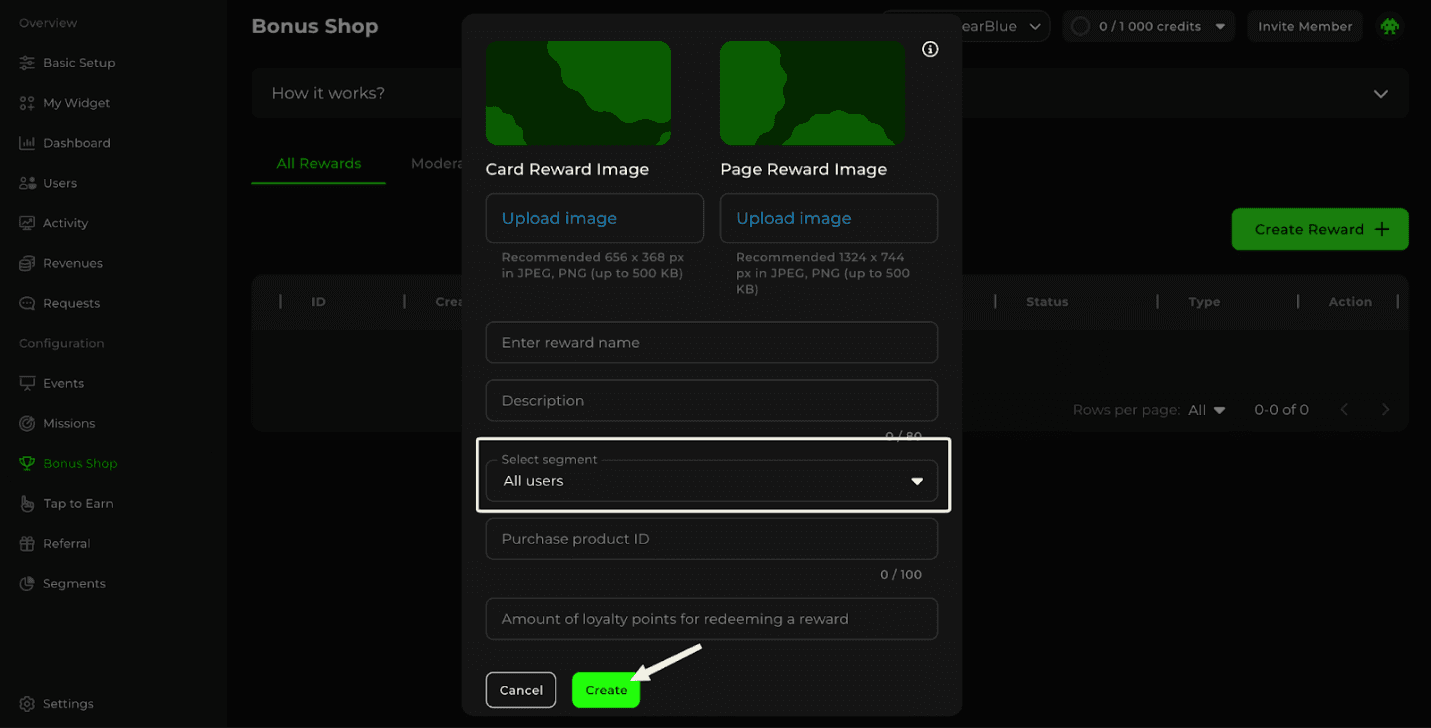
If integrating loyalty late means re-engineering 🡺 Enable3 is built with low-code configuration and API integration, so the customer loyalty program plugs into your existing product surface, your existing identity system, and your existing analytics.
To Sum Up
The Marriott loyalty program is not perfect, but it is the most sophisticated working example of loyalty architecture at scale in the world of travel and hospitality right now. Every layer – membership page, enrollment, tiers, points, Moments, Elite benefits, and the app – was designed with the same underlying principle: make the loyalty program the operating system for the customer's category, not a side feature of one transaction.
That principle is portable. The mechanics that deliver it depend on the loyalty platform you build on.
Want to design a loyalty program with the architectural sophistication of Marriott Bonvoy – without rebuilding hospitality’s largest engineering organization? Enable3 was built for exactly this. Contact our team today, and we’ll partner with you directly to configure your ideal solution.
Bonvoy-grade architecture
Without Bonvoy’s engineering org

Frequently Asked Questions
What is Marriott Bonvoy and how does Marriott Bonvoy work?
Marriott Bonvoy is the hospitality loyalty program for Marriott International, covering 30+ hotel brands across more than 9,800 properties in 145 countries. Members earn points on stays, partner spending, and co-branded credit card purchases, then redeem points for free nights, room upgrades, and experiences via Marriott Bonvoy Moments. This customer loyalty program operates a six-tier Elite ladder from Member through Ambassador Elite, with benefits that grow at each level. As of year-end 2025, Bonvoy had nearly 271 million members and accounted for 68% of global room nights booked at Marriott properties (75% in the US and Canada).
Is Marriott Bonvoy free to join?
Yes. Basic Marriott Bonvoy membership is free and gives you complimentary in-room Wi-Fi on direct bookings, exclusive member rates (typically 10–15% off the standard rate), Mobile Check-in and Mobile Key access at participating properties, and points earning from your very first stay. There is no paid subscription tier or membership fee at any level of the program – every Elite tier is earned through stays and qualifying spend rather than purchased.
How many tiers does Marriott Bonvoy have?
Marriott Bonvoy has six membership tiers: Member (0–9 qualifying nights), Silver Elite (10–24 nights), Gold Elite (25–49), Platinum Elite (50–74), Titanium Elite (75+), and Ambassador Elite (100+ nights and $23,000 in annual qualifying spend). The Ambassador tier is the only tier with a spend requirement on top of nights – that gate is what separates the program's highest-value travelers from its highest-frequency ones.
What is Marriott Bonvoy Moments?
Marriott Bonvoy Moments is the program's experiential rewards layer. Members can redeem points (via fixed-price purchases or competitive auctions) for once-in-a-lifetime experiences across four categories: Culinary, Entertainment, Arts & Lifestyle, and Sports. Past examples include VIP NCAA March Madness packages, red-carpet access at the MTV VMAs, behind-the-scenes events with celebrity chefs, and immersive stays at Design Hotels properties. One Point Drops make selected experiences accessible to all members for as little as one Bonvoy point.
Marriott Bonvoy vs Hilton Honors – which is better?
The Marriott Bonvoy vs Hilton Honors comparison comes down to what you optimize for. Bonvoy has the larger portfolio (1.78 million rooms vs. Hilton's 1.35 million) and a deeper luxury bench – Ritz-Carlton, St. Regis, JW Marriott, The Luxury Collection, W Hotels, and EDITION – making it stronger for high-end stays. Hilton offers more flexible status qualification (nights, stays, or spend) and waives resort fees on award stays, which makes it more accessible for occasional travelers. For frequent business travelers, Bonvoy's six-tier ladder and Ambassador Service generally outperform. For occasional leisure travelers, Hilton's flexibility often wins. At year-end 2025, Bonvoy had nearly 271 million members to Hilton Honors' 243 million.
What can your business learn from Marriott Bonvoy?
Five loyalty architectural lessons translate across categories: (1) lead the membership page with outcomes, not mechanics; (2) build a tier ladder where the next tier is always visible and reachable; (3) cover the full decision tree your customer makes around your core purchase, not just the purchase itself; (4) add an experiential rewards layer that differs in kind from your transactional rewards; (5) embed the loyalty surface inside the product the member already uses every day, rather than building a separate destination.